
Chapter 16: Constantinople — The City of Prophecy
A city surrounded by enormous stone walls, guarded by sea and steel, admired by travelers, feared by armies, and desired by emperors. To Christians, it was the heart of Eastern Christendom. To the heirs of Rome, it was the final jewel of an ancient civilization. And to Muslims, it carried another meaning as well.
THE BRIEF HISTORY OF ISLAM!
Danish Shafiq
6/18/20264 min read
Chapter 16: Constantinople — The City of Prophecy
For centuries, it stood like a wall between worlds.
Constantinople.
The mighty capital of the Byzantine Empire. A city surrounded by enormous stone walls, guarded by sea and steel, admired by travelers, feared by armies, and desired by emperors. To Christians, it was the heart of Eastern Christendom. To the heirs of Rome, it was the final jewel of an ancient civilization. And to Muslims, it carried another meaning as well.
A prophecy.
Generations earlier, Prophet Muhammad ﷺ had spoken words that remained alive in Muslim memory across centuries:
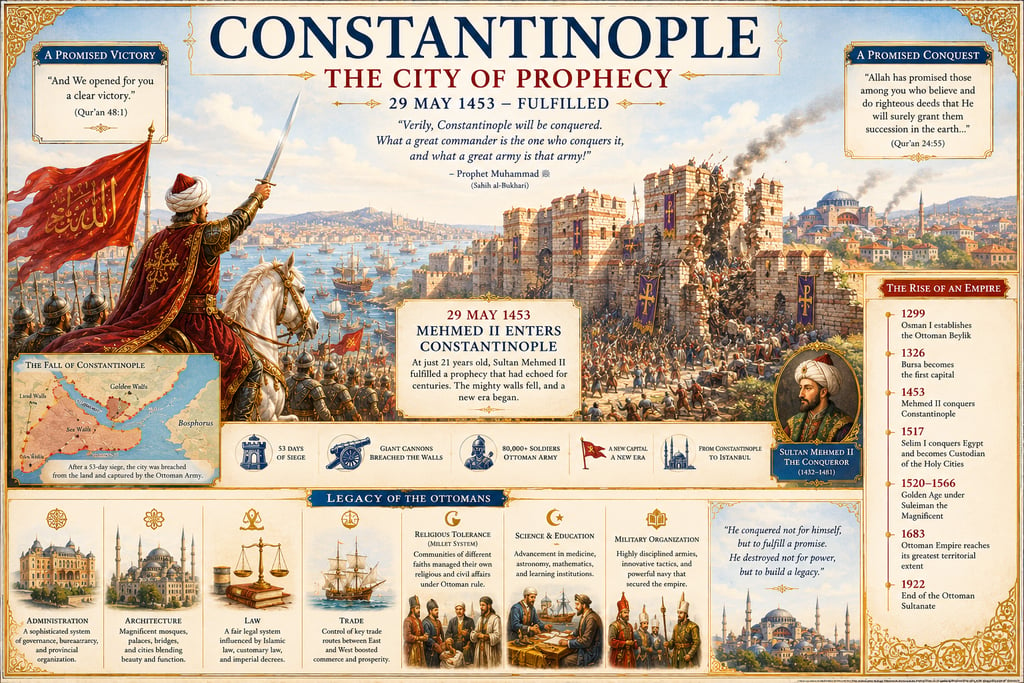
“You will surely conquer Constantinople. What a wonderful leader will her leader be, and what a wonderful army will that army be.”
For hundreds of years, Muslim rulers dreamed of fulfilling those words.
The Umayyads had tried. The Abbasids had tried. Warriors from different dynasties had marched toward its walls. But Constantinople remained unconquered. Its massive fortifications appeared almost impossible to break.
And so the city slowly became more than a military objective. It became a symbol. A dream carried from one generation to another. Meanwhile, the Ottoman state continued growing steadily after Osman. His descendants expanded carefully across Anatolia and the Balkans. Villages became cities. Cities became provinces. Trade routes strengthened. Mosques rose across newly governed lands.
And unlike many collapsing kingdoms around them, the Ottomans combined military discipline with long-term administration. But they also inherited the burdens of empire. As Ottoman power increased, palace politics slowly became more dangerous. Princes competed for succession. Court rivalries intensified. And over generations, the same empire built through sacrifice would sometimes struggle against luxury and internal tensions.
Still, the Ottomans carried within themselves a powerful sense of mission. Especially toward Constantinople. Then, in the year 1432, a prince was born who would permanently change world history.
Mehmed.
Later remembered as Mehmed al-Fatih. Mehmed the Conqueror.
From childhood, Mehmed was raised differently. He studied military strategy, governance, languages, history, and Islamic scholarship. His teachers repeatedly reminded him about the prophecy regarding Constantinople.
And deep within his heart, a dream slowly grew: Could he become the leader spoken of centuries earlier?
When Mehmed eventually became Sultan at a young age, many underestimated him. Some European rulers viewed him as inexperienced. Some rivals within politics doubted his strength. But Mehmed possessed extraordinary intelligence, patience, and determination. He prepared carefully. Cannons were designed on a scale rarely seen before. Fortresses strengthened Ottoman positions around the Bosphorus. Ships were assembled. Armies organized.
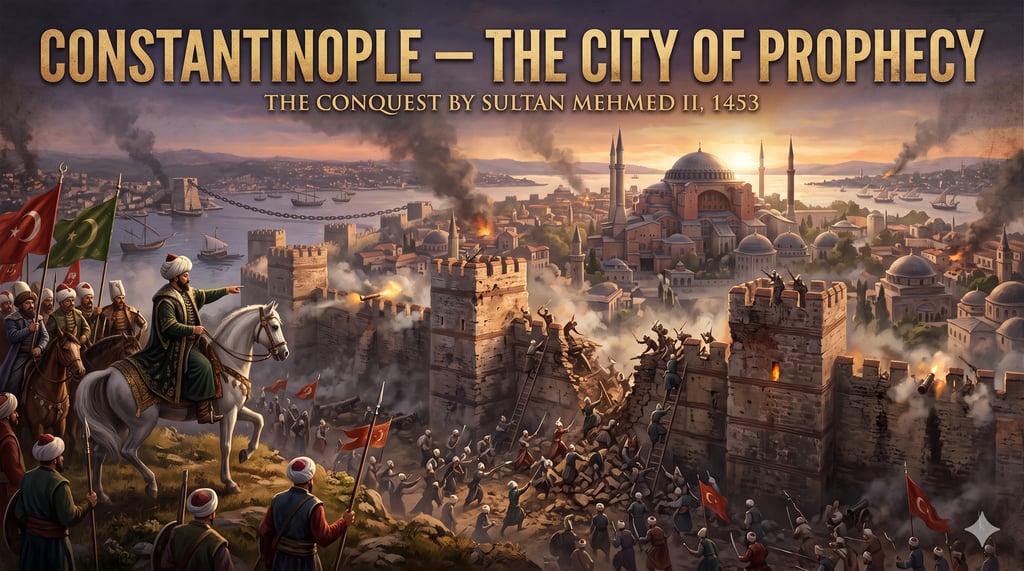
And finally, in 1453, the great siege began. The walls of Constantinople had survived countless invasions before. But this time felt different. Day after day, massive Ottoman cannons shook the ancient defenses. The city resisted fiercely. Inside Constantinople, fear and prayer filled churches and homes. Outside the walls, Ottoman soldiers prepared themselves for either victory or martyrdom.
For weeks, battle consumed land and sea. Then came one of the most astonishing moments in military history. To bypass the massive chain blocking entry through the Golden Horn, Mehmed ordered Ottoman ships transported across land itself. Greased logs were laid over hills. And under the darkness of night, ships moved across the earth toward the waters behind Byzantine defenses. When the defenders awoke, Ottoman ships stood where they seemed impossible to reach.
The city was slowly being surrounded completely. Finally, on May 29, 1453, Constantinople fell.
The Byzantine Empire — the last great remnant of ancient Rome — came to an end.
And the prophecy remembered by Muslims for centuries appeared fulfilled.
For many Muslims across the world, the victory carried enormous spiritual meaning. dream preserved for generations had finally become reality. But like many conquests in history, the fall of Constantinople also carried pain, fear, and human suffering.
War never arrives without tears. Civilians feared chaos. Churches filled with frightened people. Families prayed for survival. And yet, compared to many brutal sackings common in medieval warfare, Mehmed moved relatively quickly to restore order after entering the city.
One of his important decisions was preserving parts of the city’s religious structure and population rather than annihilating them entirely.
The great Hagia Sophia — once the cathedral of Byzantine Christianity — was transformed into a mosque. But many churches elsewhere continued existing under Ottoman rule. Christian and Jewish communities remained part of the empire under systems that, despite inequalities and limitations, often allowed more continuity than many medieval conquests elsewhere.
Mehmed understood something important: A city cannot become a capital through ruins alone. It must live. And so Constantinople slowly transformed into Istanbul — one of the greatest cities of the Islamic world. Scholars arrived. Markets expanded. Mosques rose beside older churches. Trade routes connected continents.
The Ottoman Empire now stood as a major global power bridging Europe and Asia.
Yet victory also brought new temptations. As the empire grew richer and stronger, palace life became increasingly grand. Royal courts expanded. Politics hardened. And over centuries, some rulers drifted away from the humility and simplicity that had shaped the early Ottoman spirit.
Because this had become one of the repeating lessons of Islamic history: Faith could inspire civilizations.
But power could also test them. Still, for ordinary Muslims living in those centuries, the Ottoman rise restored confidence after generations of invasions, fragmentation, and grief. The holy cities remained protected. Trade flourished. Scholarship continued. And from the Balkans to Arabia, the Ottoman world became one of the great centers of civilization.
Yet the empire had not yet reached its greatest height. That moment would come under a ruler remembered across both East and West:
Suleiman. The Lawgiver. The Magnificent.
And under him, the Ottoman world would enter its golden age.
End of Chapter 16