
Chapter 2: Abu Bakr Al-Ṣiddīq رَضِيَ ٱللَّٰهُ عَنْهُ - The Man Who Held the Ummah Together!
Before Islam, Abu Bakr رَضِيَ ٱللَّٰهُ عَنْهُ was already respected in Makkah for his honesty, wisdom, soft speech, and noble character. But after the revelation, his entire existence became devoted to the Prophet Muhammad صلى الله عليه وسلم.
THE BRIEF HISTORY OF ISLAM!
Danish Shafiq
5/22/202611 min read
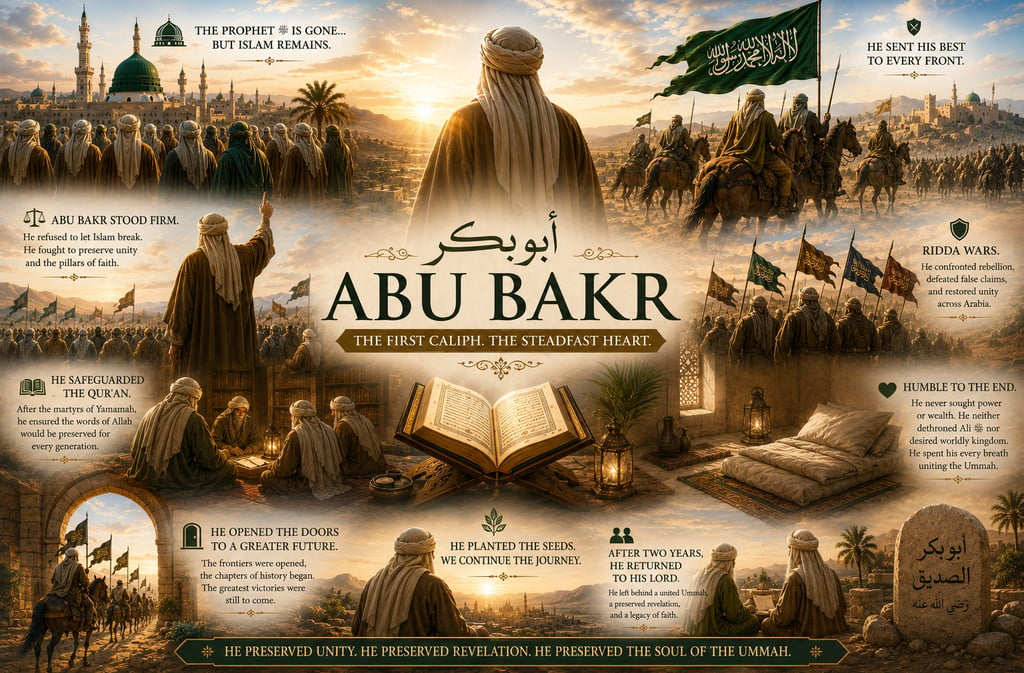
Chapter 2: Abu Bakr Al-Ṣiddīq رَضِيَ ٱللَّٰهُ عَنْهُ - The Man Who Held the Ummah Together!
Abu Bakr رَضِيَ ٱللَّٰهُ عَنْهُ stood at the edge of Medina, staring toward the horizon where endless desert sands blended with the skies. His frail body concealed a heart strong with purpose, eyes firm with conviction.
Several tribes across Arabia started turning away from Islam after the Prophet's (صلى الله عليه وسلم) departure. Some refused to pay zakat. Some believed Islam would collapse without Muhammad صلى الله عليه وسلم. Others followed men who falsely claimed to be the prophets.
And suddenly, the Muslim world faced a terrifying reality: Ummah itself seemed at risk of fragmenting immediately after the passing of the Prophet صلى الله عليه وسلم from this world. The Ummah stood shaken. The Prophet صلى الله عليه وسلم had just passed away. Arabia was unstable. Borders remained vulnerable at the north and east. Internal rebellions were spreading everywhere.
But then Abu Bakr رَضِيَ ٱللَّٰهُ عَنْهُ stood up. The gentle companion of the Prophet صلى الله عليه وسلم — the man whose heart melted quickest into tears — suddenly revealed a firmness that stunned Arabia itself.
This was the same Abu Bakr رَضِيَ ٱللَّٰهُ عَنْهُ:
who accompanied the Prophet صلى الله عليه وسلم inside the Cave during migration.
who spent his wealth freeing oppressed slaves like Bilal رَضِيَ ٱللَّٰهُ عَنْهُ.
who immediately accepted Islam when others mocked the Prophet صلى الله عليه وسلم.
who remained beside him through humiliation, danger, hunger, exile, and war.
Before Islam, Abu Bakr رَضِيَ ٱللَّٰهُ عَنْهُ was already respected in Makkah for his honesty, wisdom, soft speech, and noble character. But after the revelation, his entire existence became devoted to the Prophet Muhammad صلى الله عليه وسلم.
When the world doubted the Prophet صلى الله عليه وسلم after the Night Journey (Isra wal Mi’raj), Abu Bakr declared: “If Muhammad صلى الله عليه وسلم has said it, then it is the truth.”
And from that day, he became known as: As-Siddiq — The Truthful One.
Now that same man stood before a collapsing Arabia. And history witnessed one of the greatest moments of leadership ever seen. When tribes refused zakat, Abu Bakr رَضِيَ ٱللَّٰهُ عَنْهُ proclaimed:
“By Allah, if they withhold even a rope they used to give during the Prophet’s time, I will fight them for it.” This was not merely about taxes or money. Abu Bakr رَضِيَ ٱللَّٰهُ عَنْهُ understood something far deeper: if Islam fragmented now, the entire message of the Prophet صلى الله عليه وسلم could collapse into tribal chaos forever.
Even as Abu Bakr رَضِيَ ٱللَّٰهُ عَنْهُ prepared to restore unity within Arabia, another responsibility awaited him.
Before his passing, Prophet Muhammad صلى الله عليه وسلم had prepared an army under the young commander Usamah ibn Zayd رَضِيَ ٱللَّٰهُ عَنْهُ to march toward the Roman frontier. Many Companions wondered whether the expedition should now be delayed. Madinah itself appeared vulnerable. Rebellions had erupted across Arabia. The very survival of the Muslim state seemed uncertain.
Many sincere Companions worried that sending the army at such a dangerous moment might leave Madinah exposed. Even Umar ibn al-Khattab رَضِيَ ٱللَّٰهُ عَنْهُ initially suggested that the expedition be postponed until stability returned to Arabia. Their concern was not born of fear, but of genuine responsibility for the safety of the Muslim community.
But Abu Bakr رَضِيَ ٱللَّٰهُ عَنْهُ refused to stop the army. He saw the matter differently. "By Allah," he declared, "I would not untie a banner tied by the Messenger of Allah صلى الله عليه وسلم."
He understood the psychology of nations. If the Muslims showed weakness immediately after the passing of the Prophet’s صلى الله عليه وسلم from this world, Arabia and Rome alike would believe Islam was collapsing, and more importantly, he could not bring himself to reverse a command personally given by the Messenger of Allah صلى الله عليه وسلم. If Allah's Messenger had ordered the army to march, then it would march.
So the army marched. And Abu Bakr رَضِيَ ٱللَّٰهُ عَنْهُ himself walked beside Usama’s رَضِيَ ٱللَّٰهُ عَنْهُ horse outside Madinah as a gesture of humility and respect. The old companion walked… while the young commander rode. The world was changing, but the principles of Islam remained alive.
Usama marched north exactly as ordered. The army reached the Byzantine frontier. They carried out swift raids against tribes allied with Byzantium around Ubna. The expedition successfully demonstrated that the Muslims remained militarily capable despite the Prophet's ﷺ passing.
The Byzantine frontier forces were caught off guard. Rather than launching a major battle, Usama avoided unnecessary losses while accomplishing the Prophet's صلى الله عليه وسلم objective. After approximately forty days, Usama returned safely to Madinah.
He lost very few men. The expedition was considered successful. And suddenly Arabia realized something powerful:
Prophet Muhammad صلى الله عليه وسلم had passed away… but Islam had not died.
Arabia saw that Madinah remained strong.
The northern tribes realized the Muslims had not collapsed.
Even the Byzantines recognized that the new Caliph intended to continue the Prophet's ﷺ policies.
Yet beyond all these events, a dangerous storm was gathering.
The passing of the Prophet صلى الله عليه وسلم led several tribes across Arabia to believe that their covenant with Islam had ended. Some refused to pay the obligatory Zakat, considering it a personal pledge made only to the Prophet صلى الله عليه وسلم. Others openly renounced Islam, while a few ambitious men falsely claimed prophethood, seeking power by exploiting the uncertainty of the time.
What began as scattered acts of rebellion soon threatened to fracture the unity that the Messenger of Allah صلى الله عليه وسلم had spent twenty-three years building. These confrontations would later become known as the Ridda Wars—the Wars of Apostasy—not merely battles for political authority, but a determined effort to preserve the unity, faith, and identity of the young Muslim Ummah.
For Abu Bakr رضي الله عنه, this was never merely a political dispute over taxation. Zakat was one of the pillars established by Allah سُبْحَانَهُ وَتَعَالَى Himself. Allowing people to abandon it would mean allowing the very foundations of Islam to crumble.
Soon, Abu Bakr رَضِيَ ٱللَّٰهُ عَنْهُ concentrated fully on the Ridda Wars.
One after another, Abu Bakr رَضِيَ ٱللَّٰهُ عَنْهُ dispatched his commanders to confront the rebellions. Some tribes returned peacefully after dialogue and persuasion. Others chose to fight. Gradually, the scattered fires of rebellion were extinguished, and the authority of the Muslim state was restored across much of Arabia. Among those commanders fighting the Ridda Wars, one name was distinctly visible - Khalid-ibn-Waleed رَضِيَ ٱللَّٰهُ عَنْهُ—the brilliant military leader whom the Messenger of Allah صلى الله عليه وسلم had honored with the title Saifullah (The Sword of Allah).
Khalid رَضِيَ ٱللَّٰهُ عَنْهُ was no ordinary commander. His courage and brilliance would soon alter the course of history. Before Islam, Khalid had once fought against the Muslims. At Uhud, his military brilliance caused severe damage to the Muslim ranks after he strategically attacked from behind the mountain passage left exposed by archers.
But Islam did not destroy his brilliance. It transformed it. When Khalid رَضِيَ ٱللَّٰهُ عَنْهُ eventually embraced Islam, the Prophet صلى الله عليه وسلم recognized something extraordinary within him. The same sword once raised against Islam would now become one of its greatest shields. And history changed. Khalid رَضِيَ ٱللَّٰهُ عَنْهُ possessed extraordinary courage with unwavering faith and complete obedience to Allah سُبْحَانَهُ وَتَعَالَى and His Messenger صلى الله عليه وسلم.
Campaign after campaign, Khalid's leadership helped restore stability across Arabia. While many tribes had already returned to the fold of Islam, one man continued to defy the authority of Madinah.
His name was Musaylimah ibn Habib, remembered in Islamic history as Musaylimah al-Kadhdhab—the Liar. During the Prophet's (صلى الله عليه وسلم) lifetime, Musaylimah sent letters claiming that he too shared in prophethood, demanding that authority over Arabia be divided between himself and the Messenger of Allah صلى الله عليه وسلم. The Prophet صلى الله عليه وسلم firmly rejected his claim, describing him as one of the great impostors who would appear among his Ummah.
After the Prophet's صلى الله عليه وسلم passing, Musaylimah seized the moment. Exploiting tribal loyalties, political uncertainty, and his own false claims of revelation, he gathered an army said to number in the tens of thousands. Yamamah became the strongest center of resistance against Madinah, and many feared that if Musaylimah prevailed, the unity of the Muslim Ummah would shatter forever.
Recognizing the gravity of the situation, Abu Bakr رَضِيَ ٱللَّٰهُ عَنْهُ again entrusted Khalid ibn al-Walid رَضِيَ ٱللَّٰهُ عَنْهُ with confronting the rebellion. The Muslim army marched toward Yamamah, fully aware that this would not be an ordinary battle. It was a struggle to preserve the unity of Islam itself.
The fighting that followed was among the fiercest the early Muslims had ever experienced. Musaylimah's followers resisted with extraordinary determination, and for a time the battle seemed uncertain.
As the battle reached its decisive moment, Musaylimah and his remaining followers withdrew into a heavily fortified orchard that later became known as "The Garden of Death" (Hadīqat al-Mawt). There, the Muslims launched one final assault. During the intense fighting, Wahshi ibn Harb رَضِيَ ٱللَّٰهُ عَنْهُ—the same man who, before accepting Islam, had tragically killed Hamzah ibn Abdul Muttalib رَضِيَ ٱللَّٰهُ عَنْهُ at the Battle of Uhud—cast his spear with remarkable precision, striking Musaylimah.
As Musaylimah fell wounded, other Muslim soldiers, including Abu Dujanah رَضِيَ ٱللَّٰهُ عَنْهُ (renowned since the Battle of Uhud for the extraordinary bravery with which he had carried the sword entrusted to him by the Messenger of Allah صلى الله عليه وسلم), pressed forward and ensured the battle came to its end.
With the death of Musaylimah, the greatest internal threat facing the young Muslim community collapsed. The rebellion in Yamamah was broken, the Ridda Wars drew to their conclusion, and the unity of Arabia was restored under the leadership of Abu Bakr رَضِيَ ٱللَّٰهُ عَنْهُ.
The victory restored unity across Arabia, yet it came at a heavy price. Hundreds of Muslims had fallen, among them many of the finest reciters and memorizers of the Qur'an. Their sacrifice deeply moved Abu Bakr رَضِيَ ٱللَّٰهُ عَنْهُ and Umar ibn al-Khattab رَضِيَ ٱللَّٰهُ عَنْهُ, leading to one of the most significant decisions in Islamic history: the compilation of the Qur'an into a single written collection, so that the words of Allah سُبْحَانَهُ وَتَعَالَى would remain preserved for every generation to come.
With Musaylimah defeated and the flames of rebellion gradually extinguished, Arabia once again stood united under the banner of Islam.
Though the rebellion within Arabia had been settled, two massive empires loomed like storm clouds, threatening the very survival of this young, fragile Islamic state. After stabilizing Arabia internally, Abu Bakr رَضِيَ ٱللَّٰهُ عَنْهُ once again turned toward the great empires waiting beyond the desert:
Rome…
and Persia.
The storms of world history were now approaching.
Abu Bakr رَضِيَ ٱللَّٰهُ عَنْهُ had summoned his closest advisors and generals. They had gathered in a modest house, sitting cross-legged on worn carpets. The air inside was tense, heavy with anticipation. Abu Bakr رَضِيَ ٱللَّٰهُ عَنْهُ began quietly, "Our Prophet dreamed of spreading Allah’s message beyond Arabia. Those dreams must not end with his passing. It is time to carry the message forward."
Silence filled the room as each man understood the magnitude of his words. Abu Bakr رَضِيَ ٱللَّٰهُ عَنْهُ was proposing something extraordinary: challenging two of the most powerful empires the world had ever seen.
To the east, the Vast Sasanian Persians, and to the north, the Romans, known historically as Byzantines.
These two superpowers had dominated the region for centuries. Compared to them, the Muslims possessed neither vast wealth nor enormous armies. Many had only recently emerged from the deserts of Arabia. Yet Abu Bakr رَضِيَ ٱللَّٰهُ عَنْهُ saw something that the world's great empires could not. He knew that true strength did not lie merely in numbers, weapons, or fortresses, but in hearts firmly anchored to Allah سُبْحَانَهُ وَتَعَالَى and the passion burning brightly in hearts.
Having witnessed Khalid ibn al-Walid's رَضِيَ ٱللَّٰهُ عَنْهُ extraordinary leadership during the Ridda Wars, Abu Bakr رَضِيَ ٱللَّٰهُ عَنْهُ entrusted him with a new mission. He ordered him to march toward Iraq, where the frontiers of the Persian Empire awaited (the vast Sasanian Persian Empire, renowned for its powerful cavalry, ancient traditions, and magnificent palaces). Khalid رَضِيَ ٱللَّٰهُ عَنْهُ secured remarkable victories over the Sasanian Persians at the Battles of Chains, Walaja, and Ullais.
To the north, against the Byzantine frontiers in Syria, he dispatched some of Islam's finest Companions: Abu Ubaydah ibn al-Jarrah, Amr ibn al-As, Yazid ibn Abi Sufyan, and Shurahbil ibn Hasanah رَضِيَ ٱللَّٰهُ عَنْهُم. Byzantines (Romans) were mighty warriors. The Muslim armies faced increasingly overwhelming Byzantine resistance.
Abu Bakr رَضِيَ ٱللَّٰهُ عَنْهُ summoned Khalid ibn al-Walid رَضِيَ ٱللَّٰهُ عَنْهُ from Iraq.
What followed became one of the most remarkable military maneuvers of the early Islamic era.
Rather than taking the well-traveled routes that the Byzantine commanders expected, Khalid رَضِيَ ٱللَّٰهُ عَنْهُ chose a harsh and unforgiving path across the Syrian Desert—a route so barren and perilous that many considered it impossible for an army to survive. Guided by determination, careful planning, and complete trust in Allah سُبْحَانَهُ وَتَعَالَى, his men crossed vast stretches of waterless desert where even seasoned travelers hesitated to venture.
When news finally reached the Byzantine commanders, it came with astonishment. The army they had expected from one direction had emerged from another. Their carefully prepared defenses had been outmaneuvered before the battle had even begun.
It is said that the reputation of Khalid ibn al-Walid رَضِيَ ٱللَّٰهُ عَنْهُ had already begun spreading beyond Arabia. His swift campaigns against the Persians and his remarkable march across the Syrian Desert surprised even seasoned commanders. Friend and foe alike recognized him as one of the most capable military leaders of his generation. Against the mighty Sasanian Empire in the east and the powerful Byzantine Empire in the west, Khalid رَضِيَ ٱللَّٰهُ عَنْهُ stood with unwavering courage—not trusting in numbers or weapons, but in Allah سُبْحَانَهُ وَتَعَالَى, whose help he believed was greater than any earthly power.
Yet the true strength of the Muslims did not lie in a single commander.
The Romans possessed disciplined legions, centuries of military tradition, fortified cities, immense resources, and experienced generals. The Persians commanded one of the oldest and most powerful empires of the age. By comparison, the Muslims possessed neither vast armies nor overflowing treasuries. They carried instead hearts united by faith, disciplined by the teachings of the Qur'an, inspired by the example of the Messenger of Allah ﷺ, and led by men who sincerely sought the pleasure of Allah سُبْحَانَهُ وَتَعَالَى before worldly success.
While the armies of Islam advanced across distant frontiers, Abu Bakr رَضِيَ ٱللَّٰهُ عَنْهُ remained in Madinah, quietly overseeing the affairs of the growing Muslim state. Every report that arrived from Syria and Iraq reminded him not of military glory, but of the immense responsibility Allah سُبْحَانَهُ وَتَعَالَى had placed upon the Ummah. His greatest concern was never the expansion of territory alone, but the preservation of faith, justice, and unity among the believers.
As news of these early victories reached Madinah, Abu Bakr رَضِيَ ٱللَّٰهُ عَنْهُ lowered his head in gratitude before Allah سُبْحَانَهُ وَتَعَالَى. He understood that these successes were not the conclusion of the journey, but merely its beginning. The great empires of Byzantium and Persia still stood before the Muslims. Syria had not yet been secured, Jerusalem remained beyond the horizon, and the decisive battles that would reshape civilizations were still to come. Yet the foundations had been laid, and a door had been opened that history would never close again.
Soon afterward, the first Caliph felt his own strength beginning to fade.
As Abu Bakr رَضِيَ ٱللَّٰهُ عَنْهُ approached the end of his blessed life, Khalid ibn al-Walid رَضِيَ ٱللَّٰهُ عَنْهُ remained on the Syrian frontier alongside Abu Ubaydah ibn al-Jarrah, Amr ibn al-As, and Shurahbil ibn Hasanah رَضِيَ ٱللَّٰهُ عَنْهُم. The Muslim armies had secured encouraging victories and established a firm foothold against the Byzantine Empire, yet the defining moments of the Syrian campaign still belonged to the future; both the Byzantine and Sasanian Empires remained formidable powers whose final chapters had yet to be written.
The seeds had been planted.
Abu Bakr رَضِيَ ٱللَّٰهُ عَنْهُ would not live to witness the extraordinary victories that were soon to unfold. Yet it was his wisdom, steadfast faith, and unwavering trust in Allah سُبْحَانَهُ وَتَعَالَى that reunited the fractured Ummah, restored stability across Arabia, and set those events into motion.
But perhaps his greatest achievement was not military at all.
He never sought a throne. He never ruled from a palace. He never surrounded himself with the luxury of kings. Had worldly power been his ambition, he could have spent his caliphate building monuments to himself. Instead, he spent every moment preserving the religion of Allah سُبْحَانَهُ وَتَعَالَى and healing a community on the verge of breaking apart.
Nor did he seek to diminish the honor of Ali ibn Abi Talib رَضِيَ ٱللَّهُ عَنْهُ. Ali رَضِيَ ٱللَّٰهُ عَنْهُ remained among the most beloved members of the Prophet's صلى الله عليه وسلم household, and Abu Bakr رَضِيَ ٱللَّٰهُ عَنْهُ continued to honor him with the respect due to his knowledge, virtue, and close relationship to the Messenger of Allah صلى الله عليه وسلم. The disagreements that arose during those difficult days were the struggles of sincere believers navigating an unprecedented moment—not the rivalry of men chasing crowns. Their final meeting ended not with hatred, but with reconciliation, mutual respect, and allegiance for the sake of preserving the unity of the Ummah.
Abu Bakr رَضِيَ ٱللَّٰهُ عَنْهُ had preserved the Ummah in its darkest hour. He reunited Arabia after the passing of the Messenger of Allah صلى الله عليه وسلم, defended the pillars of Islam during the Ridda Wars, initiated the preservation of the Qur'an after the sacrifices of Yamamah, and opened the frontiers that future generations would carry forward.
After just over two years as Caliph, his body grew weak, but his concern for the Ummah never diminished. Following consultation with the senior Companions, he entrusted the leadership to Umar ibn al-Khattab رَضِيَ ٱللَّٰهُ عَنْهُ, believing him to be the man best suited to carry the trust that had first rested upon his own shoulders after the passing of the Messenger of Allah صلى الله عليه وسلم.
Then, quietly, the first Khalifah (Caliph) returned to his Lord.
Before his death, Abu Bakr instructed that the small allowance he had received from the public treasury during his caliphate should be repaid from his own property. After his passing, even his camel, a servant, and a simple piece of cloth were returned to the Bayt al-Mal according to his wishes. When Umar رضي الله عنه learned of this, he wept and said, "May Allah have mercy on Abu Bakr. He has exhausted those who come after him."
He left behind no dynasty, no palace, no treasure, and no earthly kingdom. He left behind something far greater.
A united Ummah. A preserved Qur'an. A community whose hearts once again looked toward Allah سُبْحَانَهُ وَتَعَالَى alone.
Perhaps Abu Bakr's رَضِيَ ٱللَّٰهُ عَنْهُ greatest lesson is that true leadership is not measured by how much power a person acquires, but by how faithfully he carries the trust that Allah سُبْحَانَهُ وَتَعَالَى places upon him.
Empires are often remembered through conquest.
Abu Bakr رَضِيَ ٱللَّٰهُ عَنْهُ is remembered because he preserved...
The unity of the Ummah.
The Revelation of Allah سُبْحَانَهُ وَتَعَالَى.
The dignity of the Khilafah.
and the fragile bridge between the passing of Prophethood and the continuation of Islamic civilization.
The Messenger of Allah صلى الله عليه وسلم had completed the Revelation. Abu Bakr رَضِيَ ٱللَّٰهُ عَنْهُ ensured that Revelation would endure.
The foundation had been secured.
Now, under Umar ibn al-Khattab رَضِيَ ٱللَّٰهُ عَنْهُ, history itself was about to change.
End of Chapter 2
Chapter 3: Part 1 - Umar ibn al-Khattab رَضِيَ ٱللَّٰهُ عَنْهُ — The Weight of the Ummah