
Chapter 2: Abu Bakr رَضِيَ ٱللَّٰهُ عَنْهُ and The Rising Storms – The Clash with Rome and Persia!
Abu Bakr رَضِيَ ٱللَّٰهُ عَنْهُ stood at the edge of Medina, staring toward the horizon where endless desert sands blended with the skies. His frail body concealed a heart strong with purpose, eyes firm with conviction.
THE BRIEF HISTORY OF ISLAM!
Danish Shafiq
5/22/20268 min read
Chapter 2: Rising Storms – The Clash with Rome and Persia
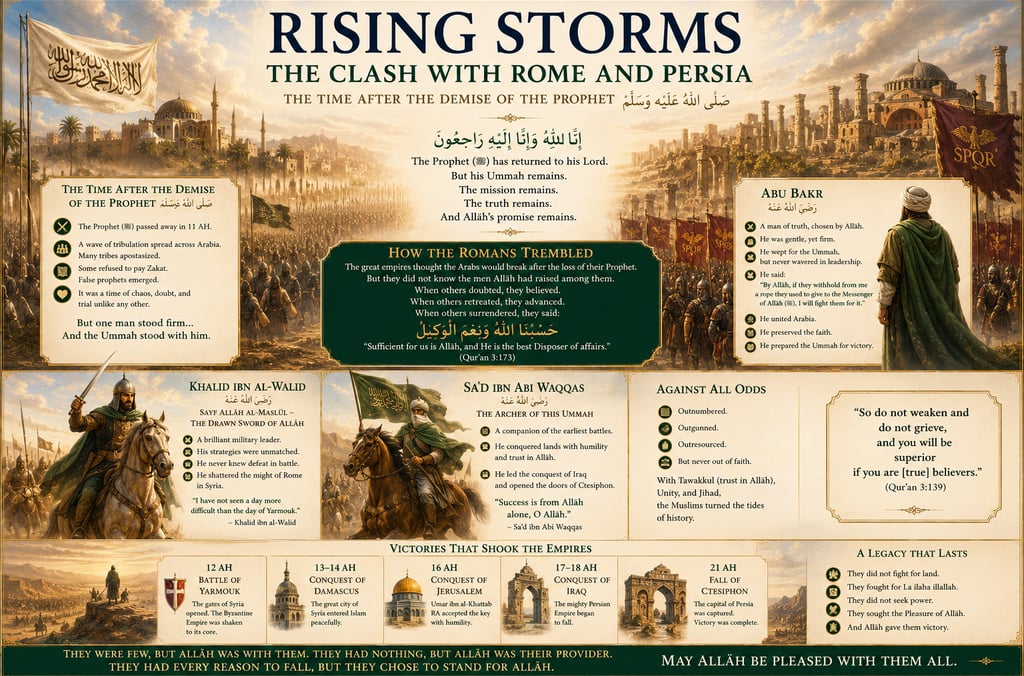
Abu Bakr رَضِيَ ٱللَّٰهُ عَنْهُ stood at the edge of Medina, staring toward the horizon where endless desert sands blended with the skies. His frail body concealed a heart strong with purpose, eyes firm with conviction. Though the rebellion within Arabia had been settled, two massive empires—Rome in the west and Persia in the east—loomed like storm clouds, threatening the very survival of this young, fragile Islamic state.
Several tribes across Arabia started turning away from Islam after the Prophet’s departure. Some refused to pay zakat. Some believed Islam would collapse without Muhammad ﷺ. Others followed men who falsely claimed prophethood for themselves.
Among the most dangerous of them was: Musailima al-Kadhdhab — Musailima the Liar. He came from Yamama and had once met delegations connected to Madinah during the Prophet’s lifetime. But ambition consumed him. He began claiming that revelation also descended upon him. Gradually thousands followed him. Not because he brought truth — but because Arabia was still deeply tribal. Many tribes saw religion through politics and loyalty rather than spiritual conviction.
And suddenly the Muslim world faced a terrifying reality: Islam itself seemed at risk of fragmenting immediately after the Prophet ﷺ. The Ummah stood shaken. Many companions feared: “How can we fight now?”
The Prophet ﷺ had just passed away. Arabia was unstable. The Romans remained powerful in the north.
Internal rebellions were spreading everywhere. Even Umar ibn al-Khattab رَضِيَ ٱللَّٰهُ عَنْهُ initially questioned whether military confrontation should happen so quickly.
But then Abu Bakr رَضِيَ ٱللَّٰهُ عَنْهُ stood up. The gentle companion of the Prophet ﷺ — the man whose heart melted quickest into tears — suddenly revealed a firmness that stunned Arabia itself.
This was the same Abu Bakr رَضِيَ ٱللَّٰهُ عَنْهُ:
who accompanied the Prophet ﷺ inside the Cave of Thawr during migration,
who spent his wealth freeing oppressed slaves like Bilal رَضِيَ ٱللَّٰهُ عَنْهُ,
who immediately accepted Islam when others mocked the Prophet ﷺ,
who remained beside him through humiliation, danger, hunger, exile, and war.
Before Islam, Abu Bakr رَضِيَ ٱللَّٰهُ عَنْهُ was already respected in Makkah for his honesty, wisdom, soft speech, and noble character. But after revelation, his entire existence became devoted to Prophet Muhammad ﷺ.
When the world doubted the Prophet ﷺ after the Night Journey (Isra wal Mi’raj), Abu Bakr declared: “If Muhammad ﷺ has said it, then it is truth.”
And from that day, he became known as: As-Siddiq — The Truthful One.
Now that same man stood before a collapsing Arabia. And history witnessed one of the greatest moments of leadership ever seen. When tribes refused zakat, Abu Bakr رَضِيَ ٱللَّٰهُ عَنْهُ proclaimed:
“By Allah, if they withhold even a rope they used to give during the Prophet’s time, I will fight them for it.” This was not merely about tax or money. Abu Bakr رَضِيَ ٱللَّٰهُ عَنْهُ understood something far deeper: if Islam fragmented now,
the entire message of the Prophet ﷺ could collapse into tribal chaos forever.
And then another challenge emerged. Before his passing, Prophet Muhammad ﷺ had prepared an army under the young commander Usama ibn Zayd رَضِيَ ٱللَّٰهُ عَنْهُ to march toward the Roman frontier. Many companions felt the expedition should now be delayed. Madinah itself was vulnerable. Arabia was unstable. Rebellions surrounded them.
But Abu Bakr رَضِيَ ٱللَّٰهُ عَنْهُ refused to stop the army. He declared: “I will not untie a banner tied by the Messenger of Allah ﷺ.” This decision shocked many. How could Madinah spare troops during such danger?
But Abu Bakr رَضِيَ ٱللَّٰهُ عَنْهُ understood the psychology of nations. If the Muslims showed weakness immediately after the Prophet’s ﷺ demise, Arabia and Rome alike would believe Islam was collapsing.
So the army marched. And Abu Bakr رَضِيَ ٱللَّٰهُ عَنْهُ himself walked beside Usama’s رَضِيَ ٱللَّٰهُ عَنْهُ horse outside Madinah as a gesture of humility and respect. The old companion walked… while the young commander rode. The world was changing, but the principles of Islam remained alive.
The expedition succeeded. And suddenly Arabia realized something powerful:
Prophet Muhammad ﷺ had passed away… but Islam had not died.
Then Abu Bakr رَضِيَ ٱللَّٰهُ عَنْهُ launched the Ridda Wars against the false prophets and rebellious tribes. The battles were brutal. At Yamama, Musailima’s forces fought fiercely. Many Qur’an memorizers were martyred. The Muslim world bled heavily. But eventually Musailima was defeated and killed. And with his fall, one of the greatest internal threats to early Islam collapsed forever.
It was during these painful battles that the companions realized another danger: many Huffaz — memorizers of the Qur’an — were being martyred rapidly. This later became one of the reasons Abu Bakr رَضِيَ ٱللَّٰهُ عَنْهُ initiated the preservation and compilation process of the Qur’an into a unified written form.
And only after stabilizing Arabia internally did the Muslims once again turn toward the great empires waiting beyond the desert:
Rome…
and Persia.
The storms of world history were now approaching.
Days earlier, Abu Bakr رَضِيَ ٱللَّٰهُ عَنْهُ had summoned his closest advisors and generals. They had gathered in a modest house, sitting cross-legged on worn carpets. The air inside was tense, heavy with anticipation.
Abu Bakr رَضِيَ ٱللَّٰهُ عَنْهُ began quietly, "Our Prophet dreamed of spreading Allah’s message beyond Arabia. Those dreams must not end with his passing. It is time to carry the message forward." Silence filled the room as each man understood the magnitude of his words. Abu Bakr رَضِيَ ٱللَّٰهُ عَنْهُ was proposing something extraordinary: challenging two of the most powerful empires the world had ever seen.
To the north, the Romans—known historically as Byzantines—were mighty warriors. They commanded disciplined armies, vast resources, and fortified cities. In the east, the Persians, with their majestic palaces and feared cavalry, were masters of warcraft, fiercely protective of their centuries-old empire. The Muslims had only limited experience, few resources, and comparatively smaller armies.
Yet Abu Bakr رَضِيَ ٱللَّٰهُ عَنْهُ believed deeply that faith could overcome all odds. He knew the Muslims had a strength not counted in numbers, but in the passion burning brightly within their hearts.
He selected trusted generals—Khalid ibn al-Walid رَضِيَ ٱللَّٰهُ عَنْهُ, known for his fearless courage, and Sa'd ibn Abi Waqqas رَضِيَ ٱللَّٰهُ عَنْهُ, famed for his strategic mind. These generals would carry Islam’s banner into new lands.
Khalid ibn al-Walid RA رَضِيَ ٱللَّٰهُ عَنْهُ was no ordinary commander. This was the man whom Prophet Muhammad ﷺ himself called:
“Saifullah” — The Sword of Allah.
Before Islam, Khalid had once fought against the Muslims. At Uhud, his military brilliance caused severe damage to the Muslim ranks after he strategically attacked from behind the mountain passage left exposed by archers.
But Islam did not destroy his brilliance. It transformed it. When Khalid رَضِيَ ٱللَّٰهُ عَنْهُ eventually embraced Islam, the Prophet ﷺ recognized something extraordinary within him. The same sword once raised against Islam would now become one of its greatest shields. And history changed. Khalid was not merely a warrior. He was movement itself. His speed shocked armies. His strategies confused generals. His courage inspired exhausted soldiers standing against impossible odds. Across deserts where death itself seemed to walk beside armies, Khalid رَضِيَ ٱللَّٰهُ عَنْهُ marched relentlessly.
It was said that whenever the Romans heard his name approaching, fear entered their camps before his soldiers even arrived. For the Muslim world, Khalid رَضِيَ ٱللَّٰهُ عَنْهُ became a wall against the collapsing pressure of the great empires surrounding Arabia.
Against Persia…
against Byzantium…
against overwhelming numbers… he stood firm like a storm forged from conviction itself.
One of his most legendary moments came during the campaigns toward Syria, when he led daring military maneuvers across brutal desert routes that many believed impossible to cross. The Byzantine forces expected armies from conventional paths. But Khalid رَضِيَ ٱللَّٰهُ عَنْهُ appeared where they least imagined.
And suddenly the balance of history shifted. At battles like Yarmouk, Muslim forces — far smaller in number — stood against one of the greatest military powers on Earth.
The Romans possessed:
armored divisions,
military traditions centuries old,
superior resources,
and experienced generals.
Yet the Muslim armies carried something different: faith, discipline, unity, and commanders like Khalid ibn al-Walid رَضِيَ ٱللَّٰهُ عَنْهُ. His battlefield brilliance became legendary across the region. The man who once fought Islam had now become one of the strongest protectors of the Islamic world. And perhaps that itself reflected one of Islam’s deepest realities: that guidance can transform even the fiercest opponent into a defender of truth.
Khalid’s رَضِيَ ٱللَّٰهُ عَنْهُ sword did not merely conquer lands. It changed the psychological vision of entire empires.
Khalid رَضِيَ ٱللَّٰهُ عَنْهُ led a force northward toward the Romans. His warriors, many young and eager, were driven by faith but new to large-scale warfare. They moved swiftly, crossing harsh deserts, rugged mountains, and unfamiliar territory. Khalid رَضِيَ ٱللَّٰهُ عَنْهُ himself rode ahead, his presence alone filling the soldiers with confidence. Stories had spread that Khalid رَضِيَ ٱللَّٰهُ عَنْهُ had never lost a battle—a reputation earned from his decisive victories in the recent rebellions.
Their first great challenge arose near the town of Yarmouk, by the banks of a river, in a valley of rocky cliffs and deep ravines. The Romans had mustered an army unlike anything the Muslims had seen before. Thousands upon thousands of soldiers stood armored, disciplined, confident of victory.
When Khalid رَضِيَ ٱللَّٰهُ عَنْهُ saw the Roman army stretched across the horizon, one of his companions turned nervously, whispering, “Look at their numbers, how can we stand against such a force?”
Khalid رَضِيَ ٱللَّٰهُ عَنْهُ smiled calmly, replying softly, "Victory comes from Allah. We fight not for worldly glory, but for truth. And truth is stronger than armor or steel."
The battle erupted at dawn. Roman commanders confidently ordered attacks, expecting an easy victory. But Khalid رَضِيَ ٱللَّٰهُ عَنْهُ was no ordinary opponent. He skillfully directed his cavalry, using tactics unfamiliar to the Roman generals—swift raids, sudden retreats, and fierce counter-attacks. For days, the valley shook with the cries of warriors, the clash of swords echoing off the mountains.
Finally, after days of intense fighting, Roman discipline cracked under relentless pressure. Confusion spread among their ranks. Khalid رَضِيَ ٱللَّٰهُ عَنْهُ seized the moment, charging forward himself, rallying his troops with a passionate cry, “Allahu Akbar!”
The Roman lines broke apart, and their warriors scattered. Yarmouk ended in a decisive victory for the Muslims, dramatically altering history. The Romans had never expected such defeat from a small, determined army from the desert.
Meanwhile, in the east, a similar story unfolded against Persia. Sa'd ibn Abi Waqqas رَضِيَ ٱللَّٰهُ عَنْهُ had led an army deep into Persian territory, facing a force larger and more experienced near a village called Qadisiyah. The Persians, led by their proud general Rustam, wore richly decorated armor and helmets glittering in the sun. Their cavalry was legendary, feared by all who faced them.
Sa'd and his soldiers camped quietly in the sand, listening carefully as Persian drums thundered, announcing their approach. The Persian army arrived, confident of their superiority. Rustam even mockingly sent envoys demanding Muslims retreat immediately.
But Sa'd رَضِيَ ٱللَّٰهُ عَنْهُ replied confidently, "We came not seeking land or wealth, but to spread Allah's word. Accept the message, and we leave in peace. Reject it, and we place our trust in Allah."
A fierce battle began, lasting three intense days. Dust rose like clouds, blinding warriors as swords clashed fiercely. Sa’d رَضِيَ ٱللَّٰهُ عَنْهُ, though weakened by illness, inspired his army from behind the lines, guiding his generals calmly. On the third day, the turning point arrived when a group of fearless warriors managed to reach Rustam’s tent amidst the chaos. Rustam, caught by surprise, was struck down. Word quickly spread among the Persian ranks that their mighty general had fallen. Panic took hold.
What once seemed impossible had become reality: The Persians were defeated, their empire forever changed by this decisive battle. Victory at Qadisiyah became a symbol of courage and faith in Muslim hearts.
As messengers returned to Medina, bringing news of stunning victories, Abu Bakr رَضِيَ ٱللَّٰهُ عَنْهُ thanked Allah humbly, yet his heart remained heavy. He knew these early victories marked just the beginning of a much larger, longer struggle. The world had changed profoundly, and the responsibilities ahead seemed enormous.
But soon, the first Caliph felt his own strength fading. After two short but transformative years as leader, Abu Bakr رَضِيَ ٱللَّٰهُ عَنْهُ lay weak, sensing his journey nearing its end. Yet, even then, he kept his eyes set firmly toward the future, summoning Umar ibn Al-Khattab رَضِيَ ٱللَّٰهُ عَنْهُ to his bedside.
“Umar رَضِيَ ٱللَّٰهُ عَنْهُ,” Abu Bakr رَضِيَ ٱللَّٰهُ عَنْهُ whispered gently, grasping his friend's hand, "lead this Ummah with justice, strength, and mercy. This trust is heavy, but Allah will aid you."
Days later, Abu Bakr رَضِيَ ٱللَّٰهُ عَنْهُ passed away peacefully, leaving behind an Ummah stronger and more unified. Umar رَضِيَ ٱللَّٰهُ عَنْهُ, strong yet humble, stepped forward, knowing that ahead lay the greatest trials yet.
Perhaps the Abu Bakr’s رَضِيَ ٱللَّٰهُ عَنْهُ greatest gift to Islamic history is that during the moment when everything appeared ready to collapse, he held the Ummah together. His caliphate lasted only a short period. Yet without Abu Bakr رَضِيَ ٱللَّٰهُ عَنْهُ , Islamic civilization itself may never have survived its first great crisis.
Empires are often remembered through conquest. But Abu Bakr’s greatness emerged through preservation. He preserved:
unity,
revelation,
discipline,
and the soul of the Ummah itself.
Far beyond Medina, the Roman and Persian empires reeled from defeat but prepared for new battles. For the Muslims, the storm was still rising, and the true test of faith had only just begun.
(End of Chapter 2)