Chapter 22: From Sindh to Delhi — The Rise of Islam in the Indian Subcontinent
Long before great Muslim empires rose over Delhi, before Mughal domes touched the skies of Hindustan, before Persian poetry echoed through Indian courts, Islam had already begun quietly entering the Indian subcontinent through the winds of trade, travel, spirituality, and human interaction.
THE BRIEF HISTORY OF ISLAM!
Danish Shafiq
6/18/202610 min read
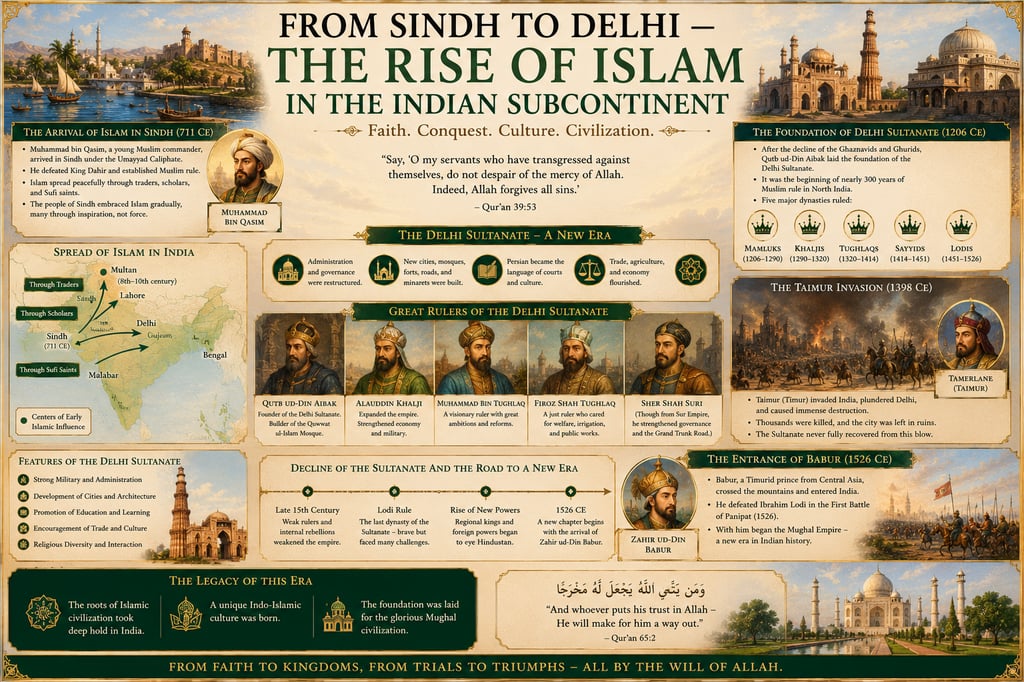
Chapter 22: From Sindh to Delhi — The Rise of Islam in the Indian Subcontinent
Arab merchants had sailed toward the western coasts of India even before the birth of Prophet Muhammad ﷺ.
The shores of Malabar, Gujarat, Sindh, and southern India were already connected through ancient maritime trade routes with Arabia, East Africa, and Persia.
After the rise of Islam, these same routes slowly carried not only goods — but also faith. Muslim traders arrived carrying dates, perfumes, textiles, horses, and spices. But more importantly, they carried:
honesty in trade,
discipline in prayer,
simplicity in worship,
and belief in One God.
Many local communities encountered Islam not first through armies… but through character. The idea that all human beings stood equal before Allah, regardless of caste or birth, deeply attracted sections of Indian society burdened beneath rigid social hierarchies.
The simplicity of Islamic monotheism attracted many hearts.
The idea that:
no human was born superior by caste,
no priest stood between man and God,
and every believer stood equal before Allah in prayer,
felt revolutionary to many communities living beneath rigid social hierarchies.
And thus Islam entered India first not merely as political authority — but as a spiritual encounter.
Yet history would soon move beyond trade and spirituality into warfare and empire. During the Umayyad period, events unfolding in Sindh would create the first major Muslim political foothold in the Indian subcontinent. The story began with conflict along maritime trade routes near the Arabian Sea.
According to historical narrations, ships carrying Muslim merchants and travelers were attacked near the Sindh region. Appeals for justice reportedly reached the Umayyad governor Hajjaj ibn Yusuf. He is already known for his iron-handed rule in Iraq and the eastern provinces — responded militarily.
And thus a young commander entered history: Muhammad bin Qasim. Barely in his youth, Muhammad bin Qasim marched toward Sindh leading Umayyad forces across harsh deserts and difficult terrain.
The ruler of Sindh at that time was Raja Dahir. Battles followed across the Indus region. Eventually, Muhammad bin Qasim defeated Dahir and established Muslim political authority in parts of Sindh around the early 8th century.
Thus began the first lasting Muslim political presence in the Indian subcontinent. Yet history remembers this conquest through different emotional lenses. Some Muslim historians portrayed it as the opening of Islam into India. Others remember the warfare, political violence, and suffering accompanying conquest. And perhaps both realities existed together.
Because history rarely moves through purity alone.
Human ambition,
politics,
religion,
trade,
and military expansion often travel side by side.
Still, despite military conquest, Islam did not spread across India overnight through force. For centuries, Muslim political influence remained geographically limited mainly around Sindh and frontier regions.
The deeper spread of Islam into the Indian subcontinent happened gradually through:
trade,
migration,
scholarship,
intermarriage,
Sufi movements,
social transformation.
and human interaction over generations.
The Indian subcontinent itself during this period was politically fragmented. Large unified nation-states did not exist in the modern sense. India consisted of numerous kingdoms, dynasties, tribal powers, and regional rulers often competing among themselves.
Rajput kingdoms fought each other. Regional dynasties struggled for territory. Political alliances shifted constantly.
Meanwhile beyond India’s northwestern mountains, the Muslim world itself was undergoing enormous changes. The Abbasids had transformed Baghdad into a center of knowledge. Persian civilization flourished. Turkic military powers emerged. Sufi spirituality expanded. Mongol invasions later devastated entire regions.
And at the center of these transformations stood one of the greatest intellectual and spiritual regions of the medieval Islamic world:
Khurasan. Stretching across parts of present-day Iran, Afghanistan, Turkmenistan, and Central Asia, Khurasan became home to:
scholars,
poets,
philosophers,
theologians,
scientists,
Sufis,
and rulers.
Cities like:
Nishapur,
Balkh,
Bukhara,
Samarqand,
and Herat
became shining centers of Islamic civilization.
Persian language and culture flourished deeply here.
Poetry,
mathematics,
astronomy,
theology,
medicine,
and spirituality evolved together beneath the umbrella of Islamic civilization.
But these regions also repeatedly suffered from invasions, dynastic wars, and political fragmentation. Turkic dynasties rose across Central Asia and Afghanistan. And slowly, these powers began looking toward India. One of the earliest major figures to permanently impact northern India was:
Mahmud of Ghazni - He remains one of the most debated figures in the history of the Indian subcontinent.
Ruling from Ghazni in present-day Afghanistan during the 11th century, he launched numerous military expeditions into northern India. Muslim chroniclers often celebrated him as a powerful ruler who expanded his empire and patronized scholarship, while many historical memories in India remember the destruction caused by some of his campaigns—most notably the raid on Somnath.
History, however, deserves to be approached with both honesty and balance.
Mahmud of Ghazni was a ruler, not the embodiment of Islam itself. Like many kings of his age—whether Muslim, Hindu, Byzantine, or European—his campaigns were shaped by a mixture of political ambition, imperial expansion, strategic interests, and the immense wealth that prosperous kingdoms and temples possessed.
To attribute every military decision he made solely to religion is to oversimplify a far more complex historical reality. Islam itself cannot be judged through the actions of any single ruler. Its primary sources are the Qur'an and the teachings of Prophet Muhammad ﷺ, who proclaimed:
"There is no compulsion in religion."
(Qur'an 2:256)
For this reason, it is important to distinguish between Islam as a faith and the policies of Muslim rulers, just as one distinguishes Christianity from every Christian king or Hinduism from every Hindu ruler. Throughout history, rulers of every civilization have acted from a combination of faith, politics, economics, and personal ambition.
The spread of Islam in the Indian subcontinent was likewise not defined by one conqueror. Long before and long after Mahmud, countless merchants, scholars, and Sufi saints introduced Islam through compassion, scholarship, trade, and service to society. Millions embraced the faith over centuries not because of armies, but because they were inspired by its message and the exemplary character of those who lived it.
To understand history fairly is neither to glorify nor to demonize. It is to acknowledge both achievements and mistakes, while refusing to confuse the actions of individuals with the principles of an entire faith followed by over a billion people across the world.
Like many rulers of his era, his motives included:
political expansion,
wealth,
military prestige,
and control over trade and territory.
He transformed Ghazni into an important center of Persian-Islamic culture, art, and learning. Yet his invasions also left wounds that remained alive in collective memory for centuries. And perhaps this became one of the great tragedies of medieval history: that the spiritual beauty of Islam often traveled alongside the harsh ambitions of empires.
Still, while kings conquered through armies, another force quietly transformed India far more deeply:
The Sufis. Across villages, towns, forests, and cities, saints and scholars entered India carrying not crowns —
but humility.
Not armies —
but compassion.
Not palaces —
but remembrance of Allah.
Figures such as:
Khwaja Moinuddin Chishti of Ajmer,
Baba Farid,
Nizamuddin Auliya,
and countless others became spiritual lights across the subcontinent.
Their khanqahs fed the poor, welcomed travelers, comforted the broken, and reminded humanity that Islam at its core was submission to One God and kindness toward creation. Millions encountered Islam through their character rather than through political authority.
And perhaps this became the true soul of Islam in India. Not conquest alone. But spiritual transformation.
After the Ghaznavids came the Ghurids or the Ghorids. And with them, Muslim political control in northern India became far more permanent.
Unlike Mahmud of Ghazni, who mainly raided and returned, Muhammad Ghori laid the foundations for sustained political administration within India itself.
In the late 12th century, he fought decisive battles against powerful Rajput rulers including Prithviraj Chauhan. The Battles of Tarain changed the future of northern India dramatically. After initial setbacks, Muhammad Ghori eventually defeated Rajput forces and established stronger Muslim political authority across major regions of North India.
But history again must be understood honestly.
These wars were not simple battles between “good” and “evil.”
They were medieval struggles for empire, territory, wealth, survival, and power — similar to conflicts occurring across the world during that era. Hindu kingdoms fought each other. Turkic dynasties fought one another. Mongols devastated Muslim lands. Europe itself witnessed brutal wars between Christian kingdoms.
Across the medieval world, empires were built upon military expansion, warfare and conquest. And India too became part of this larger global pattern.
This does not justify cruelty. But it helps explain the historical reality of that era. The medieval world functioned differently from the moral expectations of modern democratic societies.
And perhaps one of the greatest mistakes today is when people judge entire modern communities through selective memories of medieval rulers.
No ordinary Indian Muslim today is responsible for the actions of medieval kings. Just as modern Hindus are not personally responsible for every war or oppression committed by ancient rulers.
History should educate societies — not poison generations against one another.
Yet modern political narratives often simplify history into emotional slogans. Some media voices repeatedly reopen medieval wounds only to create present-day anger.
Kings become symbols.
Communities become targets.
And ordinary people begin inheriting hatred for events they never lived through.
But Islam itself never taught hatred against innocent people.
The Qur’an declared:
“Whoever kills a soul unjustly, it is as though he has killed all humanity.”
The teachings of Prophet Muhammad ﷺ emphasized:
justice,
mercy,
protection of civilians,
honesty,
and accountability before Allah.
Human rulers often failed these ideals. Muslim rulers sometimes committed injustice. Hindu rulers sometimes committed injustice. Mongols committed massacres. European empires later colonized continents. Human beings across civilizations repeatedly misused power.
And perhaps this is one of the deepest lessons of history itself: religion often remained spiritually pure, while politics repeatedly became corrupted by human ambition.
After Muhammad Ghori’s death, his former military commanders established rule from Delhi.
Thus emerged:
The Delhi Sultanate.
For the first time, large parts of northern India came under long-term Muslim political authority. But the Delhi Sultanate was not one single dynasty. It became a succession of ruling houses:
The Mamluks,
Khaljis,
Tughlaqs,
Sayyids,
and Lodis.
Each brought:
reforms,
wars,
ambitions,
achievements,
and failures.
Some rulers expanded aggressively. Others collapsed under conspiracies, rebellions, famine, and internal corruption.
The early Mamluk rulers consolidated Muslim authority in North India. Among them, Qutb-ud-Din Aibak established foundations for Delhi’s rise as a political center. Construction projects began expanding, including early Indo-Islamic architecture symbolized later by monuments such as Qutub Minar.
Persian administrative systems entered India more deeply. Trade routes expanded between India, Central Asia, Persia, and Arabia. Delhi itself slowly transformed into one of the great urban centers of the Islamic world in South Asia. Mosques rose beside ancient Indian cities. Persian became the language of administration and scholarship.
Madrasas expanded. Markets flourished. Caravan routes connected India with Central Asia, Persia, and Arabia. Architecture itself evolved into something entirely new. Indian craftsmanship merged with Persian and Central Asian styles.
Domes,
arches,
calligraphy,
gardens,
forts,
and minarets slowly reshaped the visual identity of northern India.
At the same time, political cruelty remained common. Some sultans ruled wisely. Others ruled through fear. Palace conspiracies, executions, heavy taxation, rebellions, and violent campaigns became recurring realities.
Human ambition often overshadowed moral ideals. And yet despite all this turmoil, Indo-Islamic civilization continued growing.
Languages blended.
Music evolved.
Art transformed.
Food traditions mixed.
Trade expanded enormously.
Even everyday life began changing through centuries of interaction between Indian civilization and the wider Islamic world.
Then came Alauddin Khalji. A powerful yet controversial ruler. He expanded the empire aggressively and successfully defended India against repeated Mongol invasions that threatened to devastate the subcontinent.
His military reforms strengthened the Sultanate enormously.
He reorganized markets,
regulated prices,
strengthened intelligence networks,
and centralized administration.
But his rule also became associated with harsh authoritarian methods, heavy taxation, and political fear.
And once again history showed how rulers often pursued stability through power rather than compassion.
Yet despite political brutality, his rule also became associated with authoritarian control and harsh taxation. Again history reflected the same painful pattern: great administrative achievement often coexisted beside fear and brutality.
Then emerged Muhammad bin Tughlaq — perhaps one of the most intellectually ambitious yet politically unstable rulers of medieval India. He possessed remarkable imagination and vision. His grand experiments often collapsed disastrously. His controversial decision to shift the capital from Delhi to Daulatabad caused enormous hardship.
Economic instability spread.
Rebellions erupted.
The empire weakened.
And slowly the Delhi Sultanate began fracturing internally. The empire weakened. Regional kingdoms rose independently.
Bengal,
Gujarat,
the Deccan,
and southern powers increasingly asserted autonomy.
The political unity of northern India weakened.
And gradually the Delhi Sultanate began fracturing internally.
Then from Central Asia another storm descended upon India. A conqueror claiming descent from Turkic-Mongol lineages. A warrior whose name spread terror across civilizations:
Timur. Known in South Asia as Timur Lang — Timur the Lame.
By the late 14th century, the Delhi Sultanate had already weakened through internal instability. Timur invaded northern India in 1398. His armies swept through cities with devastating brutality. Delhi itself suffered horrifying massacres and destruction.
The invasion shattered the already fragile political stability of northern India. Countless lives were lost. Trade suffered. Cities declined. Fear spread across the subcontinent.
Timur eventually returned toward Central Asia, carrying immense wealth with him. But the scars remained.
History remembers these events because they happened, and they should neither be ignored nor romanticized.
At the same time, it is important to distinguish Timur the conqueror from Islam the faith. Timur's campaigns reflected the ambitions of a medieval emperor seeking power, wealth, and imperial prestige. Like many conquerors of his age, his military decisions were driven by political and dynastic objectives as much as by any religious language that may have accompanied them.
The Qur'an teaches:
"Whoever kills an innocent soul…it is as though he has killed all mankind." (Qur'an 5:32)
For this reason, the actions of any ruler—whether Muslim, Christian, Hindu, Mongol, or otherwise—cannot be taken as the standard by which an entire religion is judged.
Equally important is another historical reality often overlooked: the overwhelming majority of Indian Muslims are not descendants of foreign invaders. Historians widely agree that most trace their ancestry to the very people of the Indian subcontinent who embraced Islam gradually over many centuries through the influence of traders, scholars, neighbors, and Sufi saints. Their heritage is deeply rooted in the same soil, languages, and cultures as their fellow Indians.
To hold today's communities responsible for the actions of rulers who lived six centuries ago is neither just nor historically sound. The tragedies of the past belong to history; they should be studied with honesty, remembered with compassion for all who suffered, and never used to justify hatred between people who share the same homeland today.
And after him, the Delhi Sultanate never fully regained its earlier strength. The once-mighty empire slowly fragmented. Regional powers rose independently. Afghan dynasties struggled to maintain control.
The Sayyids and Lodis attempted to restore stability.
But internal divisions,
regional rebellions,
Afghan rivalries,
and political fragmentation continued weakening Delhi.
And perhaps one of the deepest realities of this entire period was this:
while kings fought endlessly for thrones,
ordinary people simply struggled to survive.
Farmers cultivated fields beneath changing rulers.
Traders crossed dangerous roads.
Artisans built cities for kings they would never meet.
And saints continued reminding humanity about Allah while empires rose and collapsed around them.
For despite all political conflicts, another beautiful reality was also unfolding:
the birth of Indo-Islamic civilization.
And beyond the mountains of Central Asia, another young prince watched history carefully unfold.
A prince descended from both:
Timur
and
Genghis Khan.
A ruler who lost kingdoms before finding destiny elsewhere. A man wandering between exile, ambition, poetry, warfare, and survival. His name was:
Zahir-ud-Din Muhammad Babur.
And soon, the age of the Delhi Sultanate would end before him.
A new empire —
the Mughal Empire —
was about to rise over India.
One Important message: The modern generations must understand carefully:
Medieval rulers belonged to a different age of empire-building.
Some committed justice.
Some committed oppression.
Some built civilizations.
Some destroyed lives.
But modern communities should not inherit endless hatred from medieval conflicts. Today’s Indian Muslims are not medieval invaders. Today’s Hindus are not medieval enemies.
Both communities now share the same land, the same air, the same future. And perhaps history should become a source of wisdom — not fuel for permanent division.
One reality remained constant beneath centuries of conflict:
Islam at its core continued calling humanity toward:
Tawheed,
justice,
humility,
compassion,
knowledge,
and remembrance of Allah سبحانه وتعالى.
Kings came and vanished. Empires rose and collapsed. But the simple call of:
“La ilaha illallah” continued echoing across the Indian subcontinent.
End of Chapter 22