
Chapter 34: Acknowledgements In the Name of Allah, The Most Compassionate, The Most Merciful
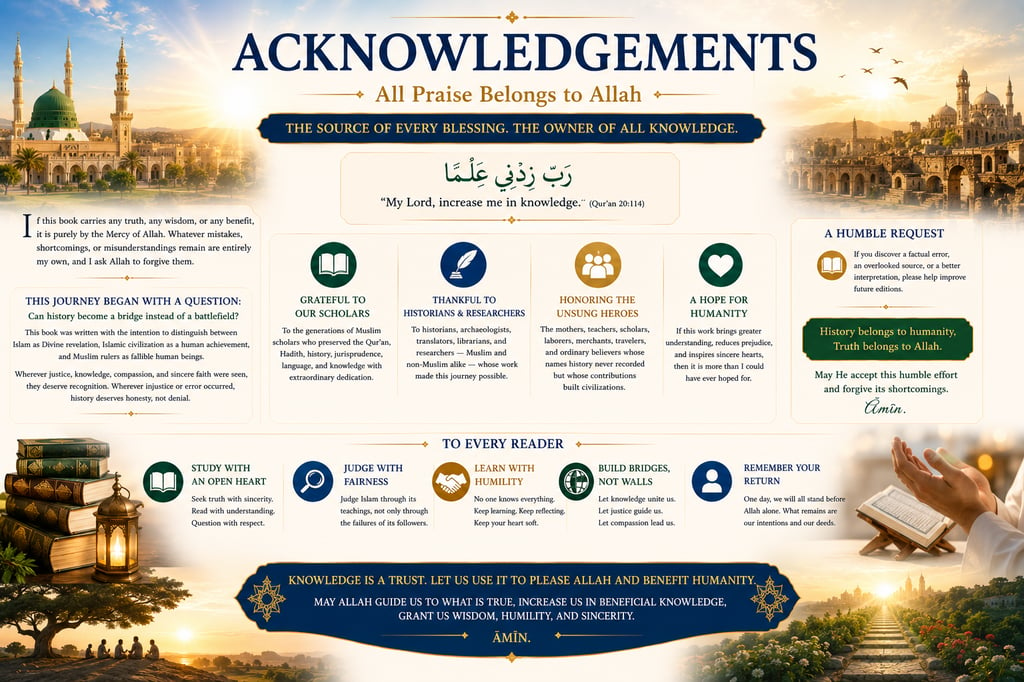
If this book contains any truth, any wisdom, or any benefit, then it is purely by the Mercy of Allah. Whatever mistakes, shortcomings, or misunderstandings remain are entirely my own, and I ask Allah to forgive them.
THE BRIEF HISTORY OF ISLAM!
Danish Shafiq
6/18/20264 min read
Chapter 34: Acknowledgements - In the Name of Allah, The Most Compassionate, The Most Merciful
In the Name of Allah, The Most Compassionate, The Most Merciful
"My Lord, increase me in knowledge." (Qur'an 20:114)
All praise belongs to Allah سبحانہ و تعالیٰ alone—the Lord of the heavens and the earth, the Creator of history itself, and the One before whom every king, scholar, emperor, saint, and ordinary believer will one day stand.
If this book contains any truth, any wisdom, or any benefit, then it is purely by the Mercy of Allah سبحانہ و تعالیٰ. Whatever mistakes, shortcomings, or misunderstandings remain are entirely my own, and I ask Allah سبحانہ و تعالیٰ to forgive them.
This journey began not with the intention of defending a civilization, a dynasty, or a political ideology. It began with a question:
Can history become a bridge instead of a battlefield?
For centuries, Islamic history has often been presented through extremes. Some narratives glorify every Muslim ruler without criticism. Others reduce fourteen centuries of civilization to nothing more than conquest and conflict.
Neither approach reflects the richness or complexity of history.
This book was therefore written with a sincere intention to distinguish between Islam as Divine revelation, Islamic civilization as a human achievement, and Muslim rulers as fallible human beings. Wherever Muslim rulers displayed justice, scholarship, compassion, and sincere faith, those qualities deserve recognition. Wherever they committed oppression or error, history deserves honesty rather than denial.
I am deeply grateful to the generations of Muslim scholars who preserved the Qur'an, Hadith, history, jurisprudence, language, and knowledge with extraordinary dedication. Without their efforts, much of humanity's intellectual heritage would have been lost.
I also acknowledge the contributions of historians, archaeologists, translators, librarians, manuscript preservers, and modern researchers—Muslim and non-Muslim alike—whose work has made it possible to study the past with greater clarity.
Special gratitude belongs to the countless ordinary believers whose names history has never recorded. The mothers who taught their children the Qur'an. The teachers who educated without seeking fame. The scholars who wrote by candlelight. The travelers who carried knowledge across deserts and oceans. The merchants whose honesty introduced Islam to distant lands. The Sufi saints who softened hearts through compassion rather than power. The laborers who built the mosques, libraries, roads, gardens, forts, and monuments that civilizations later admired.
History remembers kings. Allah سبحانہ و تعالیٰ remembers every sincere heart.
If this work contributes, even in a small way, to greater understanding between Muslims and non-Muslims, between Hindus and Muslims, and between people of every background who sincerely seek truth, then I consider my efforts worthwhile.
Finally, I ask every reader for a simple kindness.
If you discover a factual error, an overlooked source, or a better interpretation, I ask you not merely to criticize—but to help improve future editions.
History belongs to humanity. Truth belongs to Allah سبحانہ و تعالیٰ alone.
May He accept this humble effort and forgive its shortcomings.
Āmīn.
References & Methodology
How This Journey Was Researched
This book is a work of historical reflection with the help of modern-day AI tools and online sources like Wikipedia rather than a formal academic monograph. It seeks to present the development of Islamic civilization through a balanced reading of classical Islamic sources, contemporary historical research, archaeological evidence where available, and modern academic scholarship.
Recognizing that history often contains multiple perspectives, this work has intentionally compared different sources before presenting conclusions. Where significant scholarly disagreement exists, the reader has been informed rather than presented with certainty where certainty does not exist.
The guiding principles throughout this work have been:
The Qur'an remains the primary reference for understanding Islamic belief.
Authentic Hadith provide the principal historical foundation for the life of Prophet Muhammad (Peace be upon Him).
Classical Muslim historians preserve invaluable historical narratives while also reflecting the contexts in which they wrote.
Modern historians, both Muslim and non-Muslim, contribute critical analysis through archaeology, manuscript studies, comparative history, and documentary evidence.
Every historical source is approached with respect, while recognizing that all human authors remain fallible.
This book, therefore, encourages readers to continue their own journey of learning and never rely upon a single source alone.
Primary Islamic Sources
The Holy Qur'an
Sahih al-Bukhari
Sahih Muslim
Sunan Abu Dawud
Jami' al-Tirmidhi
Sunan al-Nasa'i
Sunan Ibn Majah
Musnad Ahmad ibn Hanbal
Muwatta Imam Malik
Classical Islamic Historians
Ibn Ishaq — Sirat Rasul Allah
Ibn Hisham — Sirah Nabawiyyah
Al-Waqidi
Ibn سعد (Tabaqat al-Kubra)
Al-Baladhuri
Al-Tabari — Tarikh al-Rusul wa al-Muluk
Al-Mas'udi — Muruj al-Dhahab
Ibn Kathir — Al-Bidayah wa al-Nihayah
Ibn Khaldun — Muqaddimah & Kitab al-'Ibar
Al-Dhahabi
Imam Al-Nawawi
Imam Ibn Taymiyyah (where historically relevant
Medieval & Mughal Sources
Baburnama
Humayun Nama (Gulbadan Begum)
Akbarnama (Abu'l-Fazl)
Ain-i-Akbari
Tuzuk-i-Jahangiri
Padshahnama
Maasir-i-Alamgiri
Fatawa-e-Alamgiri
Modern Historical Works
This book also benefited from the works of numerous modern historians, including:
Marshall G. S. Hodgson
Ira M. Lapidus
Hugh Kennedy
Albert Hourani
Karen Armstrong
Jonathan A. C. Brown
Richard M. Eaton
Audrey Truschke
Satish Chandra
John F. Richards
William Dalrymple
Francis Robinson
Peter Frankopan
Bernard Lewis (consulted critically and comparatively)
Patricia Crone (where relevant, alongside mainstream scholarship)
Reference Institutions
Throughout the preparation of this work, historical facts and geographical references were cross-checked using materials from institutions such as:
Encyclopaedia Britannica
Cambridge University Press
Oxford University Press
Harvard University Press
Princeton University Press
Library of Congress
British Library
UNESCO World Heritage documentation
The Metropolitan Museum of Art
The Topkapı Palace Museum
The Aga Khan Museum
Al-Azhar historical resources
A Note to the Reader
No single book can contain the entirety of fourteen centuries of Islamic civilization. This work should therefore be understood as an invitation rather than a conclusion. If these pages inspire you to open the Qur'an with fresh eyes... To study the life of Prophet Muhammad (Peace be upon Him) more deeply... To appreciate the achievements of civilizations without ignoring their failures... To seek justice before judgment... And to replace inherited prejudice with sincere understanding...
Then this journey has fulfilled its purpose.
May Allah سُبْحَانَهُ وَ تَعَالَى guide us all to what is true, increase us in beneficial knowledge, grant us wisdom, humility, and sincerity, and make us among those who listen carefully, reflect deeply, and follow what is best.
Āmīn.
The End - All praise belongs to Allah, Lord of all the worlds. (Alhamdulillāhi Rabbil-'Ālamīn)