
Chapter 4: Part 1 - Uthman رَضِيَ ٱللَّٰهُ عَنْهُمْ – The Gentle Soul of Islam
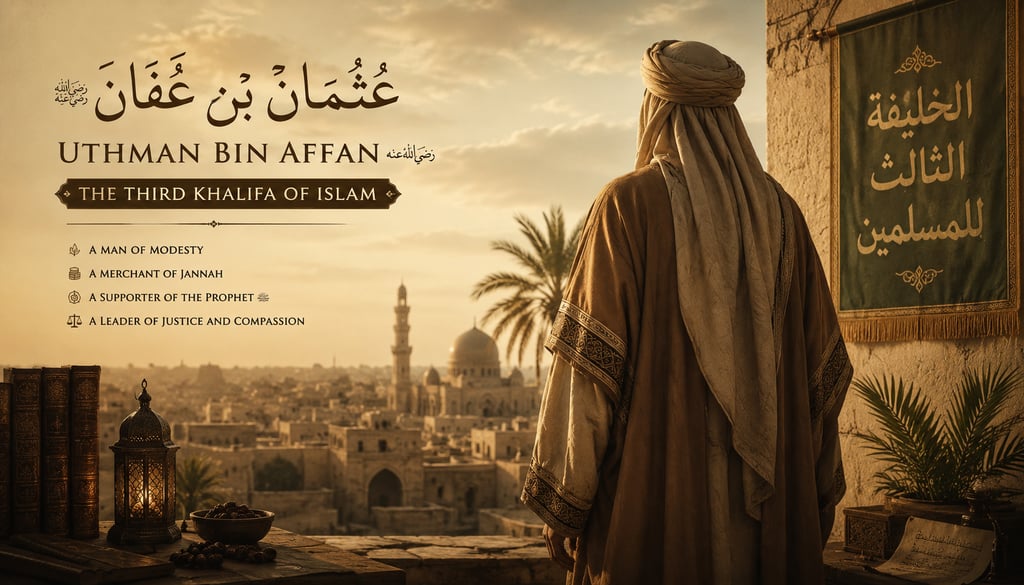
Thus, with consultation rather than coercion, with unity rather than rivalry, and with mutual respect rather than political conflict, Uthman ibn Affan رضي الله عنه became the third Rightly Guided Caliph of Islam., a man whose character had been known to Makkah long before Islam had reached the world.
THE BRIEF HISTORY OF ISLAM!
Danish Shafiq
6/12/20267 min read
Chapter 4: Part 1 - Uthman رضي الله عنه – The Gentle Soul of Islam
The city of Madinah had fallen into a silence unlike any it had known before.
Only days earlier, its streets had echoed with grief as the Commander of the Believers, Umar ibn al-Khattab رضي الله عنه, was laid to rest beside the Messenger of Allah صلى الله عليه وسلم and Abu Bakr al-Siddiq رضي الله عنه. A generation that had carried Islam upon its shoulders was slowly departing from this world.
Yet the Ummah could not remain without a shepherd.
From the modest city that the Prophet صلى الله عليه وسلم had transformed into the heart of a new civilization, an empire now stretched farther than anyone could have imagined during the earliest days of Islam. To the east, the banners of Islam flew over the fallen lands of the Sasanian Empire. To the west, the Byzantine frontier had been pushed back beyond Syria and Palestine. Egypt had entered the Muslim realm. New peoples, languages, and cultures now lived beneath the protection of the Islamic state.
The victories were extraordinary. But with every new province came new responsibilities. Governors had to be appointed. Judges had to uphold justice. Taxes had to be administered fairly. Roads secured. Armies supplied. The Khalifa was no longer responsible for a single city or a handful of tribes. He carried the trust of millions of souls spread across three continents.
As the people of Madinah mourned Umar رضي الله عنه, another question quietly settled over the city. Who would now carry this immense Amanah?
Before departing this world, Umar رضي الله عنه had refused to transform the Caliphate into an inherited throne. Though urged by some to nominate his own son, Abdullah ibn Umar رضي الله عنهما, he firmly declined. Leadership, he believed, belonged neither to bloodlines nor to families. It belonged only to the one most worthy before Allah سُبْحَانَهُ.
Instead, while lying upon his deathbed, he appointed a council of six of the greatest Companions of the Messenger of Allah صلى الله عليه وسلم: Uthman ibn Affan, Ali ibn Abi Talib, Talhah ibn Ubaydullah, Az-Zubayr ibn al-Awwam, Abdur Rahman ibn Awf, and Sa'd ibn Abi Waqqas رضي الله عنهم جميعًا. These men had stood beside the Prophet صلى الله عليه وسلم through hardship and victory alike, and Umar entrusted them to choose the next leader among themselves through sincere consultation.
For three days, Madinah waited. The members of the Shūrā met repeatedly. They prayed. They consulted. They sought the opinions of the senior Companions and many among the people of Madinah. No voices were raised. No armies gathered. No blood was spilled. The future of one of the greatest empires on earth was being decided not through the sword, but through consultation.
Among the six members of the Shūrā, Abdur Rahman ibn Awf رضي الله عنه soon made a remarkable decision. Rather than seeking leadership for himself, he voluntarily withdrew his own name from consideration so that he could serve as an impartial mediator. It was yet another example of the remarkable character that Islam had nurtured within the first generation. Positions of authority were not prizes to be won, but trusts to be carried before Allah سُبْحَانَهُ.
For the next three days, Madinah witnessed a consultation unlike anything the world had known.
Abdur Rahman رضي الله عنه did not confine his discussions to the six members of the council alone. He sought the opinions of the senior Muhājirūn, the Ansār, the veterans of Badr, respected elders, military commanders, governors who happened to be in Madinah, and many ordinary believers. From morning until late into the night, he listened far more than he spoke, determined that the next Caliph should be the one whom the Ummah trusted most to continue the path established by the Messenger of Allah صلى الله عليه وسلم, Abu Bakr رضي الله عنه, and Umar رضي الله عنه.
As the consultation progressed, it became increasingly clear that the Ummah's attention rested upon two extraordinary men. Ali ibn Abi Talib رضي الله عنه—the cousin of the Messenger of Allah صلى الله عليه وسلم, among the earliest believers, renowned for his courage, knowledge, and unwavering devotion. And Uthman ibn Affan رضي الله عنه—the gentle merchant of Quraysh, whose generosity, modesty, and sincerity had become legendary among the Companions.
Neither man campaigned for authority. Neither gathered supporters to pressure the council. Neither sought to divide the believers. Both understood that leadership in Islam was never a personal right; it was an Amanah to be accepted only if Allah سُبْحَانَهُ had decreed it.
Before making his final decision, Abdur Rahman رضي الله عنه met privately with each of the two remaining candidates. According to the earliest historical reports, he asked each of them whether they would govern according to the Book of Allah سُبْحَانَهُ, the Sunnah of His Messenger صلى الله عليه وسلم, and the established precedent of Abu Bakr and Umar رضي الله عنهما.
Uthman ibn Affan رضي الله عنه readily affirmed all three.
Ali ibn Abi Talib رضي الله عنه affirmed his unwavering commitment to the Book of Allah سُبْحَانَهُ and the Sunnah of His Messenger صلى الله عليه وسلم. Regarding the precedent of Abu Bakr and Umar رضي الله عنهما, he replied that he would follow it to the best of his knowledge and judgment wherever it accorded with what he understood from the Qur'an and the Sunnah. It was not a rejection of their noble example, but an affirmation that every ruler bears the responsibility of exercising sincere ijtihād while remaining bound to the guidance of Allah سُبْحَانَهُ and His Messenger صلى الله عليه وسلم.
Having completed his consultation, his prayer, and his careful deliberation, Abdur Rahman ibn Awf رضي الله عنه finally stood before the people gathered in the Prophet's Mosque. The atmosphere was filled with anticipation. The future of an empire stretching from Egypt to Persia rested upon the words he was about to speak.
Taking the hand of Uthman ibn Affan رضي الله عنه, he pledged his allegiance to him as the Commander of the Believers. One by one, the Companions followed. Among the first was Ali ibn Abi Talib رضي الله عنه himself. Despite being one of the two final candidates, he accepted the decision of the Shūrā and pledged his allegiance without calling the people to rebellion, without gathering an army, and without allowing personal disappointment to fracture the unity of the Muslims. It was a profound lesson for every generation that would come after them.
These were men whose hearts had been nurtured by the Messenger of Allah صلى الله عليه وسلم himself. For them, preserving the unity of the Ummah was greater than personal position, and obedience to Allah سُبْحَانَهُ outweighed every worldly ambition.
Thus, with consultation rather than coercion, with unity rather than rivalry, and with mutual respect rather than political conflict, Uthman ibn Affan رضي الله عنه became the third Rightly Guided Caliph of Islam, a man whose character had been known to Makkah long before Islam had reached the world.
A man whose modesty was so profound that even the angels were described as feeling shy before him. A man whose generosity had rescued the Muslim community again and again in its most difficult moments. A man who had married not one... but two daughters of the Messenger of Allah صلى الله عليه وسلم, and was called Dhun-Nurayn.
Yet to understand why this gentle, soft-spoken merchant had earned the trust of an entire generation... We must return many years earlier. Back to the narrow streets of Makkah. Back to a city still buried beneath the darkness of ignorance. Back to the household where one of the purest hearts in Islamic history first opened his eyes to the world.
The Noble Merchant of Makkah!
Long before Uthman ibn Affan رضي الله عنه became the ruler of one of the greatest civilizations the world had ever witnessed... Long before history remembered him as Dhun-Nurayn... There was simply a young man walking through the markets of Makkah.
The city itself stood at the heart of Arabia.
Nestled among barren mountains where little could be cultivated, Makkah possessed neither mighty rivers nor fertile valleys. It owed its importance not to agriculture or military power, but to something far greater—the Sacred House built by Prophet Ibrahim عليه السلام and his son Ismail عليه السلام.
Every year, tribes from every corner of Arabia journeyed to the Ka'bah. Some came to trade. Others came to worship. Many came for both. The marketplaces of Makkah overflowed with merchants, poets, travelers, tribal leaders, and caravans carrying goods from Yemen in the south and the lands of Syria in the north.
Among the respected families of this bustling city was the noble clan of Banu Umayyah, one of the most distinguished branches of Quraysh. From this household was born a young boy named Uthman ibn Affan ibn Abi al-'As ibn Umayyah.
His father, Affan, was a successful merchant whose caravans regularly travelled across Arabia, while his mother, Arwa bint Kurayz, belonged to another honored household of Quraysh and was related to the Messenger of Allah صلى الله عليه وسلم through his noble lineage.
From both sides, Uthman inherited nobility, respect, and honorable ancestry. Yet among the Arabs, noble lineage alone never guaranteed noble character. Many men were born into prestigious families only to squander their honor through arrogance, drunkenness, and tribal pride.
Uthman ibn Affan would become known for something entirely different. Even before Islam illuminated Arabia... he possessed a purity that quietly distinguished him from many around him. Unlike numerous nobles of Quraysh, he avoided the excesses that had become common in the days of Jāhiliyyah. His temperament was calm. His speech was gentle. His manners were refined.
As he grew older, he entered the world of commerce. The caravan routes became his classrooms. From Yemen to Syria... he travelled among merchants, negotiated agreements, witnessed distant civilizations, and built a reputation that spread far beyond Makkah itself.
Allah سُبْحَانَهُ blessed his trade. His wealth increased steadily. Before reaching middle age, Uthman ibn Affan had already become one of the most successful merchants of Quraysh. Yet something remarkable happened. The greater his wealth became... the less attached he seemed to it. People admired him not because he possessed riches... but because riches never seemed to possess him.
He dressed with dignity but never extravagance. He spoke softly when others shouted. He treated servants with kindness. He honored relatives. He fulfilled his promises. He was known as a man whose word carried value equal to a written contract. In a society where power often belonged to the loudest voices... Uthman ibn Affan became respected through quiet integrity.
No one in Makkah imagined that this gentle merchant... whose greatest concern appeared to be honest trade and honorable conduct... would one day preserve the Qur'an for generations yet unborn... or become the third successor of the Messenger of Allah صلى الله عليه وسلم.
But Allah سُبْحَانَهُ وَتَعَالَى had already begun preparing His servant... long before the world knew the role he was destined to fulfill.
End of Chapter 4: Part 1
Chapter 4: Part 2 - Uthman رَضِيَ ٱللَّٰهُ عَنْهُمْ - The Light of Islam Reaches a Noble Heart!