
Chapter 6: Muawiya & Hasan ibn Ali رَضِيَ ٱللَّٰهُ عَنْهُمْ – and The Rise of the Umayyad Dynasty!
Muawiya ibn Abu Sufiyan رَضِيَ ٱللَّٰهُ عَنْهُ. For some Muslims, he remains: a respected companion of Prophet Muhammad ﷺ, a wise statesman, a stabilizer after civil war, and a capable ruler. For others, he represents: the beginning of dynastic kingship, political manipulation, and the path that eventually led toward Karbala. History remembers him with both admiration and criticism. And perhaps only a balanced heart can understand why.
THE BRIEF HISTORY OF ISLAM!
Danish Shafiq
6/12/20268 min read


Chapter 6: Muawiya & Hasan ibn Ali رَضِيَ ٱللَّٰهُ عَنْهُمْ – and The Rise of the Umayyad Dynasty!
But there was one decision that would alter Islamic history forever:
Muawiya رَضِيَ ٱللَّٰهُ عَنْهُ appointed his son Yazid (Al Lanati - the cursed one) as successor. For many Muslims, this became deeply controversial. Leadership after the Prophet ﷺ had previously emerged largely through consultation and wider acceptance. But now hereditary succession openly entered Islamic politics.
Among those troubled by this transition were: Hussain ibn Ali رَضِيَ ٱللَّٰهُ عَنْهُ and Abdullah ibn al-Zubair رَضِيَ ٱللَّٰهُ عَنْهُ.
Hussain ibn Ali رَضِيَ ٱللَّٰهُ عَنْهُ . The beloved younger grandson of Prophet Muhammad ﷺ. The child whom the Prophet ﷺ once carried close to his heart.
Ahead now waited Karbala. And in the burning desert of Iraq, the family of Prophet Muhammad ﷺ would soon face one of the darkest tragedies in human memory.
End of Chapter 6
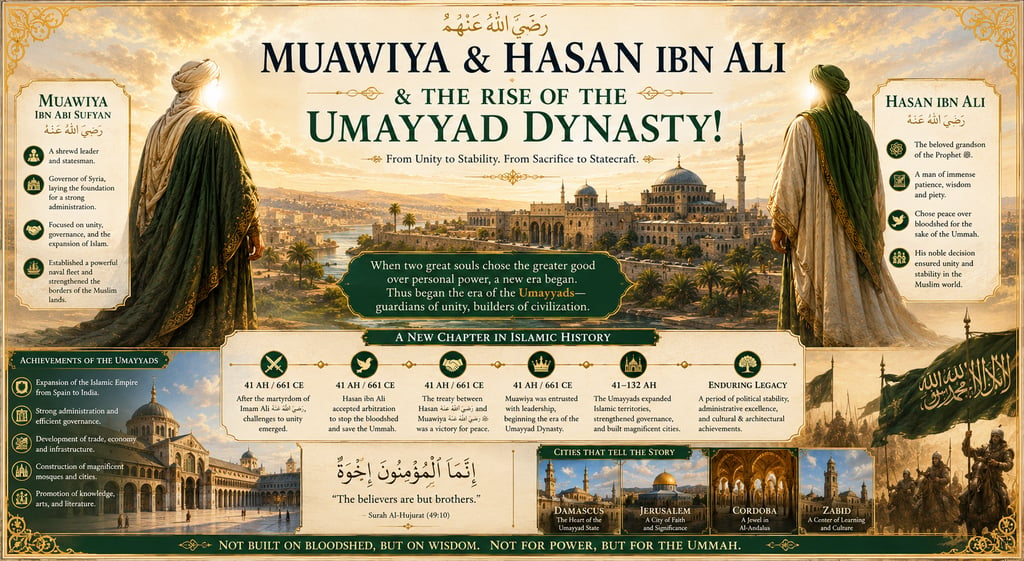
Muawiya ibn Abi Sufyan and Hasan ibn Ali رَضِيَ ٱللَّٰهُ عَنْهُمْ — Between Peace, Power and the Shadow of Karbala
The martyrdom of Ali ibn Abi Talib رَضِيَ ٱللَّٰهُ عَنْهُ left the Muslim world trembling.
For nearly three decades after the departure of Prophet Muhammad ﷺ, the Ummah had lived through extraordinary transformations: Revelations had united Arabia, Persia had fallen, Rome had retreated, and Islam had spread across deserts, cities, and civilizations.
But now another reality emerged: the companions of the Prophet ﷺ themselves had become divided through politics, justice, grief, and power. The wounds of Uthman’s (رَضِيَ ٱللَّٰهُ عَنْهُ) martyrdom still burned. The Battle of Jamal had already shaken Muslim unity. Siffin had brought Muslims face-to-face upon the battlefield.
And now Ali رَضِيَ ٱللَّٰهُ عَنْهُ too had left this world. The generation raised directly under Revelation was slowly fading. Ahead stood uncertainty. And rising within this uncertainty was one of the most complex and debated personalities in Islamic history:
Muawiya ibn Abu Sufiyan رَضِيَ ٱللَّٰهُ عَنْهُ.
For some Muslims, he remains: a respected companion of Prophet Muhammad ﷺ, a wise statesman, a stabilizer after civil war, and a capable ruler.
For others, he represents: the beginning of dynastic kingship, political manipulation, and the path that eventually led toward Karbala.
History remembers him with both admiration and criticism. And perhaps only a balanced heart can understand why.
Muawiya رَضِيَ ٱللَّٰهُ عَنْهُ belonged to the powerful Quraysh tribe of Makkah. In the early years of Islam, his family stood among the strongest opponents of the Prophet Muhammad ﷺ. Arabia itself was shaking under the arrival of revelation, and many leaders feared losing their tribal influence and old social order. But after the conquest of Makkah, hearts began changing.
Muawiya رَضِيَ ٱللَّٰهُ عَنْهُ accepted Islam. This is the view accepted by the majority of classical Muslim historians, but Imam Ahmad (Rahimahullah) has recorded a narration which indicates that Mu’awiyah رَضِيَ ٱللَّٰهُ عَنْهُ accepted Islam before the Conquest of Makkah, but concealed his faith while living among the Quraysh. (Musnad Ahmad, vol. 4, pg. 97)
Over time, he developed a close relationship with the Prophet (ﷺ). He served among the scribes who wrote official letters and correspondence for the Messenger of Allah ﷺ. His sister, Umm Habiba رَضِيَ ٱللَّٰهُ عَنْهَا, became one of the Prophet Muhammad's ﷺ wives.
This made Muawiya رَضِيَ ٱللَّٰهُ عَنْهُ: the brother-in-law of the Prophet ﷺ. Within most of the Sunni tradition, this relationship elevated his respect. He was no outsider to the early Islamic community. He had witnessed revelation, companionship, and the final years of the Prophet ﷺ firsthand.
Yet history also remembered another reality:
Muawiya رَضِيَ ٱللَّٰهُ عَنْهُ entered Islam later than companions such as Abu Bakr رَضِيَ ٱللَّٰهُ عَنْهُ, Umar رَضِيَ ٱللَّٰهُ عَنْهُ, Ali رَضِيَ ٱللَّٰهُ عَنْهُ, Bilal رَضِيَ ٱللَّٰهُ عَنْهُ, Ammar رَضِيَ ٱللَّٰهُ عَنْهُ, Salman al-Farsi رَضِيَ ٱللَّٰهُ عَنْهُ, and others who had endured the harshest persecution during the earliest painful years. This difference would later shape how different Muslim traditions viewed him emotionally.
During the caliphate of Umar ibn al-Khattab رَضِيَ ٱللَّٰهُ عَنْهُ, Muawiya رَضِيَ ٱللَّٰهُ عَنْهُ became governor of Syria. And here his political ambition became visible. Syria, under his leadership, transformed into one of the strongest and most stable provinces of the Muslim world.
Roads improved. Administration strengthened. Military discipline increased. Naval power expanded against the Byzantine Empire. Damascus slowly emerged as a major political center. Many historians — even critics — acknowledge Muawiya’s رَضِيَ ٱللَّٰهُ عَنْهُ administrative intelligence.
But Muawiya’s رَضِيَ ٱللَّٰهُ عَنْهُ vision stretched beyond the deserts of Arabia. Until that time, the Muslims were primarily a land-based force. The Arabs were masters of deserts and cavalry warfare, while the Byzantine Empire dominated the seas through its enormous naval strength across the Mediterranean. Muawiya رَضِيَ ٱللَّٰهُ عَنْهُ understood a strategic reality that many had not yet fully realized: as long as Byzantium ruled the seas uncontested, the Islamic world would remain vulnerable.
During the caliphate of Umar رَضِيَ ٱللَّٰهُ عَنْهُ, Muawiya رَضِيَ ٱللَّٰهُ عَنْهُ repeatedly requested permission to establish a naval fleet in Syria. At first, Umar رَضِيَ ٱللَّٰهُ عَنْهُ hesitated. The Muslims were desert people, not sailors. But Muawiya رَضِيَ ٱللَّٰهُ عَنْهُ persisted with patience and strategic foresight. Gradually, shipbuilding began expanding along the Syrian coast.
Ports strengthened. Sailors trained. A new military culture emerged within Islamic civilization. Then, during the caliphate of Uthman ibn Affan رَضِيَ ٱللَّٰهُ عَنْهُ, larger naval expeditions finally received full approval.
And history witnessed something remarkable: the people who once crossed only deserts now challenged the mighty Byzantine navy itself. Under Muawiya’s رَضِيَ ٱللَّٰهُ عَنْهُ leadership, Muslim fleets entered the Mediterranean and confronted Byzantine power directly.
One of the most famous moments came during the Battle of the Masts, where Muslim naval forces achieved a major victory against Byzantine fleets. The Mediterranean world was shocked. A new civilization had arrived upon the seas. Many historians consider Muawiya رَضِيَ ٱللَّٰهُ عَنْهُ among the principal architects of early Islamic naval power. Through strategy, discipline, and administration, he helped transform the Muslim empire into a force capable of competing across both land and sea.
Yet history would remember him not only through ships and victories…but through the far heavier storms that later emerged within the soul of the Ummah itself.
When Uthman ibn Affan رَضِيَ ٱللَّٰهُ عَنْهُ was brutally martyred in Madinah, the Muslim world entered emotional chaos. The blood of a companion of the Prophet ﷺ had been spilled by Muslims themselves.
And now the question spread across the Ummah: Who would bring justice?
Ali رَضِيَ ٱللَّٰهُ عَنْهُ became caliph during this deeply unstable moment.
But Muawiya رَضِيَ ٱللَّٰهُ عَنْهُ, being both governor of Syria and a relative of Uthman رَضِيَ ٱللَّٰهُ عَنْهُ, demanded immediate punishment for the killers before fully recognizing Ali’s رَضِيَ ٱللَّٰهُ عَنْهُ authority. Ali رَضِيَ ٱللَّٰهُ عَنْهُ feared that rushing judgment amid political chaos could collapse the empire into greater civil war.
Both sides believed they were protecting the Ummah. Yet tragedy unfolded.
At Siffin, Muslims stood facing Muslims. Companions who once prayed shoulder to shoulder behind Prophet Muhammad ﷺ now stood upon opposite sides of a battlefield. This became one of the most painful moments in Islamic history.
|| Not because Islam failed. But because human beings remained human — even after witnessing greatness.
Politics, emotion, tribal loyalty, fear, and ambition had entered the heart of the empire. The conflict weakened the unity severely.
Then came another devastating blow:
Ali ibn Abi Talib رَضِيَ ٱللَّٰهُ عَنْهُ was assassinated while praying in the mosque of Kufa. With his martyrdom, the era of the great Rashidun leaders neared its end. And now the eyes of the Muslim world turned toward a young man carrying the bloodline of the Prophet ﷺ himself: Hasan ibn Ali رَضِيَ ٱللَّٰهُ عَنْهُ.
Hasan رَضِيَ ٱللَّٰهُ عَنْهُ was the beloved grandson of Prophet Muhammad ﷺ. The Prophet ﷺ loved Hasan رَضِيَ ٱللَّٰهُ عَنْهُ and Hussain رَضِيَ ٱللَّٰهُ عَنْهُ deeply. He ﷺ carried them upon his shoulders. Kissed them before the companions.
Called them: “the leaders of the youth of Paradise.” (Jami' al-Tirmidhi — Hadith 3768, Sunan Ibn Majah — Hadith 118, Musnad Ahmad — multiple narrations!)
Hasan رَضِيَ ٱللَّٰهُ عَنْهُ inherited not only noble lineage, but also gentleness and wisdom. The Muslim world now expected another war between Iraq and Syria. But Hasan رَضِيَ ٱللَّٰهُ عَنْهُ saw something terrifying: the Ummah bleeding itself apart endlessly. Muslim swords had already killed Muslims. Families were divided. Trust had shattered. Political ambitions were consuming spirituality.
And so Hasan رَضِيَ ٱللَّٰهُ عَنْهُ made one of the most emotionally difficult decisions in Islamic history. He chose peace. Rather than continue the civil war, Hasan رَضِيَ ٱللَّٰهُ عَنْهُ entered into a treaty with Muawiya رَضِيَ ٱللَّٰهُ عَنْهُ. He stepped away from political leadership to prevent more bloodshed among Muslims.
This moment became deeply respected in Sunni tradition. Many saw Hasan’s رَضِيَ ٱللَّٰهُ عَنْهُ sacrifice as the fulfillment of a saying of the Prophet Muhammad ﷺ, who had once pointed toward Hasan رَضِيَ ٱللَّٰهُ عَنْهُ and said:
“This son of mine is a leader, and perhaps Allah will bring reconciliation between two great groups of Muslims through him.”
(Sahih al-Bukhari 3746: Book 62, Hadith 91: Vol. 5, Book 57, Hadith 89.)
And indeed reconciliation came. For a time, the Ummah breathed again. Muawiya رَضِيَ ٱللَّٰهُ عَنْهُ now became the undisputed ruler of the Muslim world.
Thus formally began: The Umayyad Dynasty.
And with it, Islamic governance transformed forever.
The simple consultative atmosphere of Madinah slowly evolved into imperial kingship centered in Damascus. Palaces grew larger. Administration became more centralized. Political systems matured into dynastic structures. At the same time, the empire expanded dramatically.
Muslim armies moved across North Africa, toward Central Asia, against Byzantine territories, and toward the frontiers of Sindh. Trade routes flourished. Governance strengthened. Naval fleets expanded.
For many ordinary Muslims exhausted by years of civil war, Muawiya’s رَضِيَ ٱللَّٰهُ عَنْهُ reign brought some political stability.
Muawiya’s رَضِيَ ٱللَّٰهُ عَنْهُ ruled as the first Umayyad Caliph for approximately 19 years and 3 months.
Duration of his Caliphate!
Began: Rabi' al-Awwal, 41 AH (661 CE)
This year is famously known as ʿĀm al-Jamāʿah (The Year of Unity), when Hazrat Hasan ibn Ali رَضِيَ ٱللَّهُ عَنْهُ voluntarily handed over the caliphate to Muawiya رَضِيَ ٱللَّٰهُ عَنْهُ to prevent further bloodshed among Muslims.
Ended: Rajab, 60 AH (680 CE)
Muawiya رَضِيَ ٱللَّٰهُ عَنْهُ passed away in Damascus at around 78 years of age.
Major Achievements During His Reign!
Established Damascus as the capital of the Islamic Caliphate.
Strengthened and expanded the first major Muslim navy.
Secured victories against the Byzantine Empire, including the legacy of the Battle of the Masts.
Organized an efficient administrative and postal system.
Expanded Muslim frontiers into North Africa, Khurasan, and Central Asia.
Initiated the first prolonged sieges of Constantinople, fulfilling the Prophet's ﷺ encouragement to strive toward the city.
Maintained relative political stability after years of internal conflict.
An Important Note:
Throughout the centuries, many Sunni scholars have maintained that Ali's (رَضِيَ ٱللَّٰهُ عَنْهُ) position was closer to what was correct in that dispute. At the same time, they continued to honor Muawiya رَضِيَ ٱللَّٰهُ عَنْهُ as a Companion of the Prophet ﷺ, believing that he acted according to his judgment (ijtihād), even if they regarded that judgment as mistaken.
This distinction is important.
Recognizing that a Companion may have erred in political judgment is not the same as declaring him an enemy of Islam. Nor does it justify hatred. Perhaps this is one of those areas of discussion where silence carries greater wisdom than certainty.
Allah سُبْحَانَهُ knows what people conceal within their hearts. We do not.
As Muslims living fourteen centuries later, we should pause and ask ourselves a difficult question.
If Allah عَزَّ وَ جَلَّ were to ask us on the Day of Resurrection, "What did you do with your own prayers?"
Will our answer become, "I spent my life arguing about Muawiya."
If Allah عَزَّ وَ جَلَّ asks, "How did you treat your parents?"
Will we answer, "I knew every historical dispute of the First Fitnah."
If Allah عَزَّ وَ جَلَّ asks, "Did you speak truthfully? Did you forgive? Did you feed the hungry? Did you guard your tongue? Did you remember Me?"
Will debates about seventh-century politics benefit us? Or will our own neglected deeds stand before us?
This does not mean history should be forgotten. History must be studied. It must be studied honestly. Its lessons must be preserved. Its mistakes must not be repeated. But history should become a mirror—not a prison.
|| It should lead us toward humility, not self-righteousness. Toward wisdom, not inherited hatred.
The Companions of the Prophet ﷺ were human beings. They possessed extraordinary virtues. They also lived through extraordinary trials. They also erred.
The wounds of those events have echoed through every century since. If those events still bring tears to our eyes today, perhaps that is because we recognize how deeply the Ummah suffered when political disagreement overcame brotherhood.
Maybe the greatest tribute we can offer to Ali رَضِيَ ٱللَّٰهُ عَنْهُ, Hasan رَضِيَ ٱللَّٰهُ عَنْهُ, Hussain رَضِيَ ٱللَّٰهُ عَنْهُ, and even Muawiya رَضِيَ ٱللَّٰهُ عَنْهُ, is not to continue fighting their battles.
It is to ensure that we do not repeat them. The Ummah today faces poverty. Ignorance. Division. War. Injustice. Millions of Muslims struggle simply to preserve their faith. Perhaps our energy is needed there.
Perhaps Allah عَزَّ وَ جَلَّ will ask us about the suffering we could have relieved rather than the arguments we prolonged.
The final judgment of Muawiya رَضِيَ ٱللَّٰهُ عَنْهُ belongs to Allah عَزَّ وَ جَلَّ. The final judgment of every ruler, every scholar, every historian, and every author belongs to Allah عَزَّ وَ جَلَّ.
|| But my judgment... And yours... Will also belong to Allah عَزَّ وَ جَلَّ.
So let us prepare for the questions we know He has already revealed. Let us perfect our prayers before perfecting our arguments. Let us purify our hearts before judging the hearts of those who returned to Allah سُبْحَانَهُ centuries ago.
For on that Day, no one will be saved by winning a historical debate. We will be saved only by the Mercy of Allah سُبْحَانَهُ.
May Allah سُبْحَانَهُ be pleased with the Companions of His Messenger ﷺ, forgive their shortcomings if they erred, reward their sacrifices, unite the hearts of this Ummah upon truth and justice, and grant us the wisdom to differ with knowledge, humility, and mercy.
Āmīn yā Rabb al-'Ālamīn.