Chapter 8: The Black Banners from Khurasan — The Fall of the Umayyads
From the shores of Spain in the West to the lands near Sindh in the East, Muslim rule stretched across deserts, mountains, rivers, and seas. Caravans traveled beneath Umayyad authority across three continents. Arabic had spread into new lands. Cities flourished. Trade routes connected civilizations.
THE BRIEF HISTORY OF ISLAM!
Danish Shafiq
6/18/20263 min read


Chapter 8: The Black Banners from Khurasan — The Fall of the Umayyads
The Umayyad Empire stood vast beyond imagination.
From the shores of Spain in the West to the lands near Sindh in the East, Muslim rule stretched across deserts, mountains, rivers, and seas. Caravans traveled beneath Umayyad authority across three continents. Arabic had spread into new lands. Cities flourished. Trade routes connected civilizations.
Outwardly, the empire appeared unstoppable. But inside…the Muslim world was restless. The memories of Karbala still lived painfully within hearts. Many Muslims remained disturbed by the suffering of the family of Prophet Muhammad ﷺ. Others believed the Umayyad rulers had become too attached to kingship, luxury, and dynastic power. And beyond Arabia, another tension slowly grew stronger.
Millions of new Muslims had entered Islam from Persia, Central Asia, North Africa, and other lands. Yet many non-Arab Muslims often felt socially and politically inferior within parts of the Umayyad system. Resentment quietly spread.
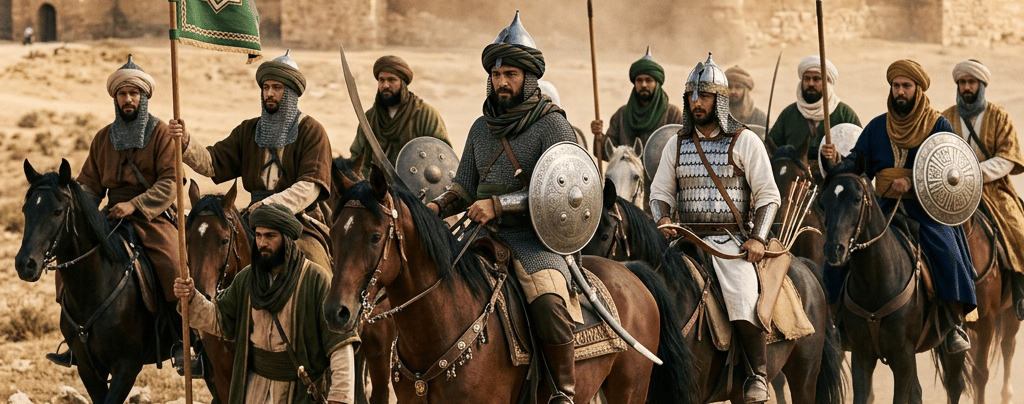
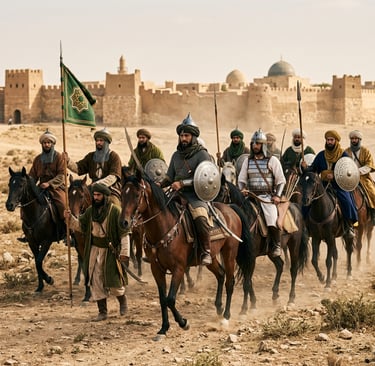
Some longed for justice. Some longed for equality. Some longed for the spiritual simplicity of the earliest Islamic generation. And some waited for change. Far away in the eastern province of Khurasan, whispers of revolution slowly turned into movement. Khurasan was unlike the old deserts of Arabia. Its lands connected Persia, Central Asia, and the eastern Islamic world. Soldiers, traders, scholars, Persians, Turks, Arabs, and countless cultures mixed there together. And from those distant lands, a new call began rising beneath black banners.
The Abbasid movement.
The Abbasids were descendants of Al-Abbas RA, the uncle of Prophet Muhammad ﷺ.
Their supporters presented them as an alternative to Umayyad rule — a leadership that would restore justice, dignity to the family of the Prophet ﷺ, and equality among Muslims. Many who were loyal to the memory of Ahl al-Bayt sympathized with the movement. Many Persians joined it. any tired soldiers joined it.
Many ordinary people simply hoped for a better future. Leading the revolution was a mysterious and brilliant figure:
Abu Muslim al-Khurasani.
Young, intelligent, and politically dangerous. Under his leadership, the black banners of the Abbasid movement spread rapidly through Khurasan. The Umayyad state, once feared across continents, now faced rebellion from within. Battle after battle followed.
Cities changed allegiance. Governors fell. Armies collapsed. And slowly, the old Umayyad world began to break apart. Finally, in the year 750 CE, the decisive Battle of the Zab took place. The Abbasid forces defeated the Umayyad army. The dynasty that had ruled the Muslim world for nearly a century came crashing down.
The Umayyad era had ended.
But revolutions are rarely peaceful.
As Abbasid forces took control, many members of the Umayyad family were hunted down and killed to prevent future uprisings. The age of political mercy had long disappeared from the Muslim world. One by one, princes who had once ruled from palaces became fugitives.
Yet history still preserved one extraordinary escape.
A young Umayyad prince named Abdul Rahman escaped across deserts, rivers, and enemy territories until he finally reached Al-Andalus in Spain. There, far away from Baghdad and the Abbasid world, he would later establish a surviving Umayyad emirate in Cordoba. Even in defeat, the Umayyad legacy refused to disappear completely.
Meanwhile in the East, a new capital began rising beside the River Tigris. Baghdad.
Unlike the Umayyads, whose power had emerged largely from Arab military expansion, the Abbasids inherited a far more diverse world. Persian influence grew strongly inside administration and culture. Scholars, poets, scientists, translators, and philosophers gathered under Abbasid patronage. The center of the Muslim world slowly shifted from the old Arab deserts toward cosmopolitan cities filled with knowledge and debate.
And while empires changed around them, the descendants of Ahl al-Bayt continued largely away from political power. Many among them became scholars, jurists, spiritual teachers, and respected figures within Muslim society. Among them emerged personalities whose knowledge and spirituality deeply influenced Islamic thought for generations. The wounds of Karbala had not disappeared…but neither had the legacy of the Prophet’s family.
The Muslim world was now entering a different age. Not merely the age of conquest… but the age of civilization.
Soon, under the Abbasids, Baghdad would become one of the greatest intellectual capitals the world had ever seen. Libraries would rise. Philosophers would debate. Astronomers would study the heavens. Doctors would transform medicine.
And from India, Persia, Greece, and beyond, knowledge itself would travel into the heart of the Islamic Golden Age.