
Chapter 1: Part 1 - The Day the Prophet صلى الله عليه وسلم Left and Abu Bakr Al-Ṣiddīq رَضِيَ ٱللَّٰهُ عَنْهُ !
The city that had once echoed with the Prophet's صلى الله عليه وسلم footsteps suddenly fell into an unbearable silence. Shock surged like lightning through every home. Some wept openly. Others stood frozen, unable to speak. Many simply could not accept what they had heard.
THE BRIEF HISTORY OF ISLAM!
Danish Shafiq
5/17/202615 min read
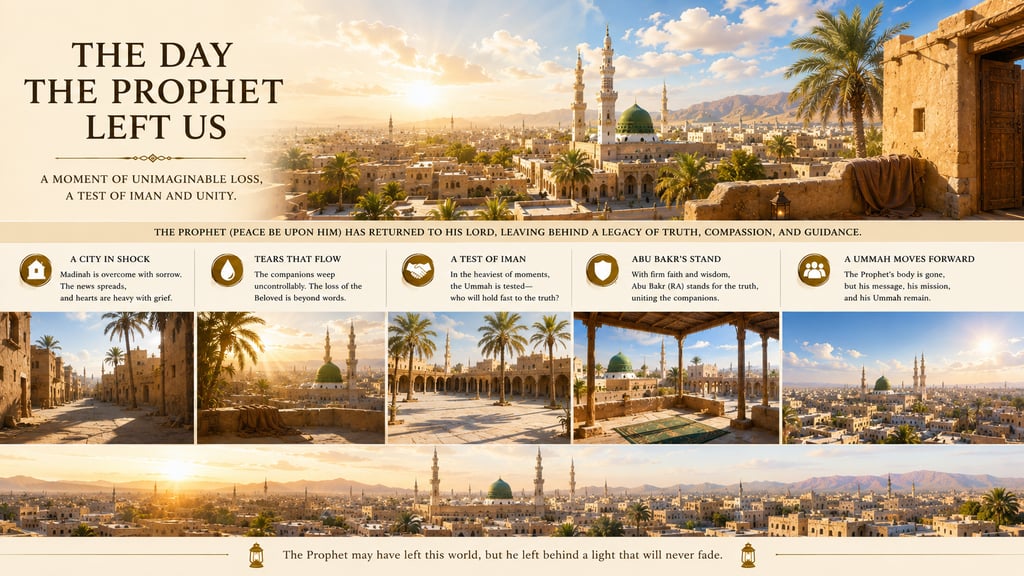
It was a quiet Monday morning in Medina, the year 632 CE. The air felt unusually heavy, and an eerie stillness blanketed the city. People went about their chores slowly, exchanging worried glances and hushed whispers. Everyone knew the Prophet Muhammad صلى الله عليه وسلم (Peace be upon Him) had been unwell for some days, and anxiety gripped the hearts of all those who loved him dearly.
Inside the modest room of Aishah رَضِيَ ٱللَّٰهُ عَنْهَا, the Messenger of Allah صلى الله عليه وسلم (Peace be upon Him) rested his blessed head upon her lap.
The greatest man ever to walk the earth owned No Palace, No Throne, No Crown. The leader who had transformed Arabia and changed the course of human history spent his final moments in a humble room beside the mosque he had built with his own hands. Even at the end of his earthly journey, his life reflected the very message he had lived: complete submission to Allah سُبْحَانَهُ وَتَعَالَى alone.
Then, in complete serenity, his blessed Soul returned to its Creator.
Within the small room of Aishah رَضِيَ ٱللَّٰهُ عَنْهَا, silence overcame every heart. She remained beside the Messenger of Allah صلى الله عليه وسلم, overwhelmed by a grief no words could carry. Soon, the members of his blessed household devoted themselves to the most sacred duty they would ever perform. Among them were Ali ibn Abi Talib رَضِيَ ٱللَّٰهُ عَنْهُ—the Prophet's صلى الله عليه وسلم cousin, son-in-law, and one of the earliest believers—along with Al-Abbas رَضِيَ ٱللَّٰهُ عَنْهُ, his sons, Usamah ibn Zayd رَضِيَ ٱللَّٰهُ عَنْهُ, and a small number of the Prophet's صلى الله عليه وسلم closest family and companions entrusted with preparing the Messenger of Allah صلى الله عليه وسلم for his final resting place.
For the moment, however, the Messenger of Allah صلى الله عليه وسلم remained in the room where he had passed away. Within that humble chamber, his blessed family and those closest to him stood beside him, struggling to comprehend a reality they had never imagined they would face. The man they had followed, loved, and served was now silent before them.
While the Prophet's صلى الله عليه وسلم family remained gathered around his blessed body, the news began to spread through the streets of Madinah:
"The Messenger of Allah صلى الله عليه وسلم has returned to his Creator."
For a brief moment, it seemed as though time itself had stopped.
The city that had once echoed with the Prophet's صلى الله عليه وسلم footsteps suddenly fell into an unbearable silence. Shock surged like lightning through every home. Some wept openly. Others stood frozen, unable to speak. Many simply could not accept what they had heard.
Among them was Umar ibn al-Khattab رَضِيَ ٱللَّٰهُ عَنْهُ. The fearless warrior whose strength had shaken the enemies of Islam now found his own heart shattered by love. Drawing his sword, he cried out in anguish:
"The Messenger of Allah صلى الله عليه وسلم has not died! He has gone to meet his Lord as Musa عليه السلام went to meet his Lord, and he will return. Whoever says that Muhammad صلى الله عليه وسلم has died, I will strike him with this sword."
No one challenged him. The grief had overwhelmed reason itself. The Companions stood in stunned silence, each struggling to comprehend a reality that seemed impossible to accept.
At that very moment, Abu Bakr al-Siddiq رَضِيَ ٱللَّٰهُ عَنْهُ was returning to Madinah from his residence on the outskirts of the city. As news reached him that the Messenger of Allah صلى الله عليه وسلم had returned to his Lord, he hastened immediately to the Prophet's (صلى الله عليه وسلم) Mosque. While confusion spread among the people and emotions overcame even the strongest hearts, Abu Bakr رَضِيَ ٱللَّٰهُ عَنْهُ remained composed, seeking first to see his beloved friend with his own eyes.
Narrated Aishah رَضِيَ ٱللَّٰهُ عَنْهَا:
Abu Bakr رَضِيَ ٱللَّٰهُ عَنْهُ came riding his horse from his dwelling place in As-Sunh. He got down from it, entered the Mosque, and did not speak with anybody till he came to me and went directly to the Prophet صلى الله عليه وسلم, who was covered with a marked blanket. Abu Bakr رَضِيَ ٱللَّٰهُ عَنْهُ approached the blessed body of the Messenger صلى الله عليه وسلم, uncovered his noble face, kissed his forehead, and said through his tears, "My father and my mother be sacrificed for you, O Messenger of Allah! Allah will not combine two deaths upon you. You have died the death which was decreed for you." (Sahih al-Bukhari 1241, 1242. sunnah.com)
He then covered him once more. There was no denial. No panic. No search for worldly answers. Only complete certainty in Allah سُبْحَانَهُ وَتَعَالَى.
Stepping into the mosque, Abu Bakr رَضِيَ ٱللَّٰهُ عَنْهُ addressed the grieving companions with words that would forever become one of the greatest reminders of Tawḥīd:
"Whoever worshipped Muhammad صلى الله عليه وسلم, then Muhammad صلى الله عليه وسلم has passed away. But whoever worships Allah, then indeed Allah is Ever-Living and never dies."
He then recited the words of Allah سُبْحَانَهُ وَتَعَالَى:
وَمَا مُحَمَّدٌ إِلَّا رَسُولٌ ۚ قَدْ خَلَتْ مِن قَبْلِهِ الرُّسُلُ ۚ أَفَإِن مَّاتَ أَوْ قُتِلَ انقَلَبْتُمْ عَلَىٰ أَعْقَابِكُمْ ۚ وَمَن يَنقَلِبْ عَلَىٰ عَقِبَيْهِ فَلَن يَضُرَّ اللَّهَ شَيْئًا ۗ وَسَيَجْزِي اللَّهُ الشَّاكِرِينَ
"Muhammad is no more than a Messenger. Messengers have passed away before him. So if he dies or is killed, will you turn back on your heels? Whoever turns back on his heels will never harm Allah in the least. And Allah will reward those who are grateful."
Al Qur'an – Surah Āl 'Imrān (3), Verse 144
As Abu Bakr رضي الله عنه recited the verse, its meaning struck the hearts of the Companions with overwhelming force. Umar رضي الله عنه, who had moments earlier refused to accept that the Messenger of Allah صلى الله عليه وسلم had passed away, suddenly understood the reality. He later recalled that it was as though he had never heard the verse before. His legs could no longer carry him, and he fell to the ground as the reality finally settled upon every heart.
The Messenger of Allah صلى الله عليه وسلم had indeed returned to his Lord. But the Lord of Muhammad صلى الله عليه وسلم and the Lord of every believer... Allah —the Ever-Living would never die.
His simple words fell upon the crowd, quieting their grief, reminding them of the truth they had known but momentarily forgotten. The words of Abu Bakr رضي الله عنه settled over Madinah like a calm after a violent storm. Hearts were still shattered, tears continued to flow, and Umar رَضِيَ ٱللَّٰهُ عَنْهُ slowly lowered his sword, his anger turning to tears as reality sank in.
While the family of the Prophet صلى الله عليه وسلم and those entrusted with his final preparation remained occupied with the sacred responsibility of preparing his body for burial, another gathering had already begun elsewhere in Madinah.
The Ansār had assembled at the Saqīfah of Banū Sāʿidah.
The Messenger of Allah صلى الله عليه وسلم had only just returned to his Lord. Madinah was still overwhelmed by grief, and his blessed body had not yet been laid to rest.
Yet another question had suddenly arisen—one that the Muslim community had never faced before:
Who would lead the Ummah after the Messenger of Allah صلى الله عليه وسلم?
At the Saqīfah, the Ansār had gathered to discuss the future leadership of the Muslim community. Among them was Saʿd ibn ʿUbādah رضي الله عنه, one of the most prominent leaders of the Ansār and chief of the Khazraj. The Ansār were gathered around him as they discussed who should lead the Ummah after the passing of the Messenger of Allah صلى الله عليه وسلم. Their discussion included the proposal that the Ansār should have a leader from among themselves, while the Muhājirūn should likewise have a leader.
Meanwhile, Umar ibn al-Khattab رضي الله عنه and Abu Bakr al-Siddiq رضي الله عنه were in the mosque of the Messenger of Allah صلى الله عليه وسلم when news reached them that the Ansār had gathered at the Saqīfah.
They understood immediately that this was not an ordinary gathering.
The Prophet صلى الله عليه وسلم had only just passed away. His community was without its Messenger for the first time. The question of leadership could not simply be left unresolved while different groups began making separate arrangements.
So Abu Bakr رضي الله عنه, Umar رضي الله عنه, and Abu ʿUbaydah ibn al-Jarrāḥ رضي الله عنه immediately made their way toward the Saqīfah of Banū Sāʿidah.
They did not know exactly what awaited them there. They only knew that the future of the Ummah was being discussed at a moment when grief had barely settled upon Madinah. When they arrived, the gathering was already deep in discussion, each side making its case for where the leadership of the Ummah should rest.
The question before them was urgent and unprecedented: Who would lead the Muslim community after the Messenger of Allah صلى الله عليه وسلم?
The Ansār were discussing their own claim to leadership, while the Muhājirūn were faced with the responsibility of presenting their own understanding of where the leadership of the wider Muslim community should rest.
It was not a casual conversation. The future political leadership of the Ummah was being debated intensely, at a moment when the Prophet صلى الله عليه وسلم had only just returned to his Lord and his blessed body had not yet been laid to rest.
The Ansār spoke of their sacrifices. They had sheltered the Messenger of Allah صلى الله عليه وسلم when he was driven from Makkah. They had opened their homes to the Muhājirūn. They had defended Madinah and stood beside the Prophet صلى الله عليه وسلم through some of the most dangerous years of Islam.
Their claim was therefore not born from insignificance. They had given Islam a home when it had been persecuted in Makkah, and they believed that their sacrifice and their position within the Ummah gave them a legitimate claim to be heard in the question of leadership.
They were the Ansār — the Helpers.
But the Muhājirūn also carried a unique history. They had believed in the Messenger of Allah صلى الله عليه وسلم from the earliest days, endured persecution in Makkah, abandoned their homes and wealth for Allah, and accompanied the Prophet صلى الله عليه وسلم in the Hijrah.
They too therefore believed that they had a legitimate claim to consideration in deciding who should carry the leadership of the wider Muslim community.
The discussion was therefore serious. It was not a pre-arranged ceremony. It was an urgent political consultation held in the extraordinary hours after the passing of the Messenger of Allah صلى الله عليه وسلم from this world.
As the discussion intensified, the possibility was raised that a leader might come from among the Ansār and another from among the Muhājirūn. At this moment, Umar رضي الله عنه was prepared to speak. He later recalled that he had already prepared words in his mind and wished to present them before the gathering.
But Abu Bakr رضي الله عنه asked him to wait. Umar رضي الله عنه later explained that he had feared that Abu Bakr رضي الله عنه might not speak as effectively as he could. Yet when Abu Bakr رضي الله عنه began speaking, Umar رضي الله عنه found that he had expressed everything necessary — and expressed it even better.
Abu Bakr رضي الله عنه acknowledged the extraordinary virtues of the Ansār. He did not deny their sacrifice or their honoured position in Islam. But he argued that the leadership of the wider Arab community should remain with Quraysh, while the Ansār would continue to hold their honoured position as the Helpers of Islam.
He then proposed two men for leadership: Umar ibn al-Khattab رضي الله عنه and Abu ʿUbaydah ibn al-Jarrāḥ رضي الله عنه.
But Umar رضي الله عنه immediately rejected the suggestion. He did not believe that anyone should be placed above Abu Bakr رضي الله عنه while Abu Bakr رضي الله عنه was present among them. He turned toward him and affirmed his virtue, his closeness to the Messenger of Allah صلى الله عليه وسلم, and his standing among the Muslims.
Then Umar رضي الله عنه reached for Abu Bakr's (رضي الله عنه) hand. And there, at the Saqīfah of Banū Sāʿidah, Umar ibn al-Khattab رضي الله عنه gave his pledge of allegiance to Abu Bakr رضي الله عنه.
Others present followed. The first allegiance had been given. But this was not yet the end of the matter.
The Wider Bayʿah!
The wider Muslim community in Madinah had not all been present at the Saqīfah. The Prophet's صلى الله عليه وسلم family and many other Companions were still occupied with the events surrounding the burial of his blessed body. The community therefore still needed a wider public confirmation of the new leadership.
The following day, Abu Bakr رضي الله عنه stood before the people of Madinah. Umar رضي الله عنه urged him to ascend the mimbar. Abu Bakr رضي الله عنه did so. And there, in the mosque of the Messenger of Allah صلى الله عليه وسلم, the people of Madinah gave him the wider public pledge of allegiance.
The distinction is important.
The Caliphate of Abu Bakr رضي الله عنه was not established through one isolated speech or a single gathering. Rather, it emerged through a rapidly unfolding process in the extraordinary hours following the passing of the Messenger of Allah صلى الله عليه وسلم from this world: the consultation at the Saqīfah, the pledge given there, and then the wider public Bayʿah in Madinah.
The Prophet صلى الله عليه وسلم Is Laid to Rest!
Yet while the question of leadership had been unfolding, another sacred responsibility remained before the family of the Messenger of Allah صلى الله عليه وسلم and the Companions in Madinah: the preparation and burial of the one whom they had loved more than anyone in this world.
The Messenger of Allah صلى الله عليه وسلم had returned to his Lord on Monday. His blessed body remained in the room of ʿAishah رضي الله عنها, where he had passed away, while the Companions struggled to comprehend the reality of his departure. The arrangements for his burial were carried out with great care and reverence. He صلى الله عليه وسلم was shrouded in three white garments, without a shirt or turban. The Prophet صلى الله عليه وسلم was then prepared for burial.
When the time came for the funeral prayer, the Muslims did not appoint a single imam to lead them over him. Rather, the people entered in groups to offer the funeral prayer over the Messenger of Allah صلى الله عليه وسلم, with the men praying first, followed by the women and then the children. In this way, the people of Madinah came to bid farewell to their Messenger and pray for him.
The question of where he should be buried was then discussed. Some suggested that he should be buried in the mosque, while others suggested another place among his Companions. Abu Bakr رضي الله عنه, however, recalled the guidance he had heard from the Messenger of Allah صلى الله عليه وسلم: that a Prophet is buried where he dies. The decision was therefore made to bury him in the very room where he had passed away.
And so, on Tuesday night, the Messenger of Allah صلى الله عليه وسلم was laid to rest in the room of ʿAishah رضي الله عنها, at the very same place he passed away. Among those who descended into the grave were Ali ibn Abi Talib رضي الله عنه, al-Fadl ibn ʿAbbas رضي الله عنه, Qutham ibn ʿAbbas رضي الله عنه, and Shuqran رضي الله عنه.
The city that had once been filled with his presence now carried the unbearable silence of his absence. The Prophet صلى الله عليه وسلم had entered Madinah as its Messenger, teacher, leader, and guide. Now Madinah had to continue without his physical presence.
Within only a few days, the Ummah had been confronted with grief, uncertainty, consultation, disagreement, and the responsibility of preserving its unity. The Messenger of Allah صلى الله عليه وسلم had returned to his Lord; the question of leadership had been discussed at the Saqīfah; Abu Bakr رضي الله عنه had received the pledge there and then the wider public Bayʿah in Madinah; and finally, the beloved Messenger صلى الله عليه وسلم had been laid to rest in the room of ʿAishah رضي الله عنها.
The Prophet صلى الله عليه وسلم was gone from this earthly world, but the community he had nurtured remained.
And now, upon the shoulders of Abu Bakr al-Ṣiddīq رضي الله عنه rested an immense responsibility: to preserve the faith, hold the Ummah together, and carry forward the mission that the Messenger of Allah صلى الله عليه وسلم had spent his life establishing.
As the first chosen Caliph of the Messenger of Allah صلى الله عليه وسلم, Abu Bakr رضي الله عنه did not celebrate it. He did not seek leadership. He understood that the Khilafah was not an honor to be desired, but a trust for which he would one day answer before Allah سُبْحَانَهُ وَتَعَالَى.
Abu Bakr رَضِيَ ٱللَّٰهُ عَنْهُ was the Prophet's صلى الله عليه وسلم closest friend. The first adult man to embrace Islam. The companion of the Cave during the Hijrah. The one who spent his wealth freeing oppressed believers. The one entrusted to lead the prayers in the Prophet's صلى الله عليه وسلم final days, and the man whose unwavering faith, humility, and complete reliance upon Allah سُبْحَانَهُ وَتَعَالَى earned him a place unlike any other among the Companions.
For more than twenty-three years, Abu Bakr رَضِيَ ٱللَّٰهُ عَنْهُ walked beside the Messenger of Allah صلى الله عليه وسلم through hardship and victory alike. His unwavering faith, profound humility, and complete trust in Allah سُبْحَانَهُ وَتَعَالَى made him not only the Prophet's صلى الله عليه وسلم closest companion but one of the greatest servants of Islam in all of history.
When Abu Bakr رضي الله عنه emerged as the leader of the Muslim community through the consultation and pledges that unfolded after the passing of the Messenger of Allah صلى الله عليه وسلم, Ali رَضِيَ ٱللَّٰهُ عَنْهُ did not immediately give his own pledge of allegiance.
The Dispute of Fadak and the Bay'ah of Ali رَضِيَ ٱللَّٰهُ عَنْهُ
There is another part of this period that must be approached with honesty and delicacy, as mentioned in Sahih al-Bukhari 4240 and 4241. (sunnah.com)
The question of the Prophet's صلى الله عليه وسلم property also became a source of serious disagreement between Fatimah رضي الله عنها and Abu Bakr رضي الله عنه. According to the authentic narration preserved in Sahih al-Bukhari, Fatimah رضي الله عنها sought her share of what she regarded as her inheritance from the property left by the Messenger of Allah صلى الله عليه وسلم, including Fadak and certain other properties.
Abu Bakr رضي الله عنه did not grant the request. His reasoning was based upon a statement he attributed directly to the Messenger of Allah صلى الله عليه وسلم: that the Prophets are not inherited from and that what they leave is to be treated as charity. Abu Bakr رضي الله عنه therefore insisted that he would administer those properties according to the same principles by which the Messenger of Allah صلى الله عليه وسلم had administered them during his lifetime.
The disagreement was painful.
The narration records that Fatimah رضي الله عنها became upset with Abu Bakr رضي الله عنه and remained distant from him until her death, approximately six months after the passing of the Messenger of Allah صلى الله عليه وسلم.
This is not a detail that should be hidden from the reader. Nor should it be turned into a weapon against either of them.
Abu Bakr رضي الله عنه was acting according to what he believed to be the instruction of the Messenger of Allah صلى الله عليه وسلم. Fatimah رضي الله عنها, the beloved daughter of the Prophet صلى الله عليه وسلم, was asserting what she understood to be her right. The disagreement was therefore real, and so were the emotional consequences.
During those same six months, Ali رضي الله عنه had not yet given his Bayʿah to Abu Bakr رضي الله عنه.
Yet the reconciliation eventually came about!
Ali رضي الله عنه sent word to Abu Bakr رضي الله عنه and asked him to come to him, requesting that no one accompany him. He did not wish for Umar رضي الله عنه to be present at that particular meeting, perhaps because the disagreement had been especially sensitive and he wanted the conversation to take place privately.
When Umar رضي الله عنه learned that Abu Bakr رضي الله عنه intended to go alone, he expressed concern and advised him not to enter upon them without protection. His response should not be understood as hostility toward Ali رضي الله عنه or his family. Umar رضي الله عنه was known for his intense sense of responsibility and his determination to protect the Caliph and preserve the authority of the Muslim community during a period when tensions were still very real.
The detail is important, but it should not be understood as evidence of lasting hostility between Ali رضي الله عنه and Umar رضي الله عنه. Rather, it reflects the sensitivity of the moment and the particular circumstances surrounding the reconciliation.
Abu Bakr رضي الله عنه, however, replied that he would go to them himself and place his trust in Allah سُبْحَانَهُ وَتَعَالَى. He therefore entered alone, respecting Ali's رضي الله عنه request for a private meeting. It was a remarkable moment. Abu Bakr رضي الله عنه walked alone into the home of the Prophet's (صلى الله عليه وسلم) family, not with an armed escort or a display of authority, but seeking reconciliation.
The exchange that followed is among the most important accounts for understanding the relationship between Ali رضي الله عنه and Abu Bakr رضي الله عنه. Ali رضي الله عنه did not describe Abu Bakr رضي الله عنه as an illegitimate ruler. Nor did he accuse him of jealousy, hatred, or hostility toward the family of the Messenger of Allah صلى الله عليه وسلم. Rather, Ali رضي الله عنه acknowledged Abu Bakr's رضي الله عنه excellence and the favour Allah had bestowed upon him.
He explained that his grievance was that the family of the Messenger of Allah صلى الله عليه وسلم had not been consulted in the question of leadership, and that they believed they had a legitimate consideration in that matter because of their close relationship to the Prophet صلى الله عليه وسلم.
The disagreement, therefore, was not simply a question of personal hostility. It involved a genuine grievance over consultation, the rights and position of the Prophet's family, and the extraordinary circumstances in which the leadership of the Muslim community had been decided.
Abu Bakr رضي الله عنه listened.
He was deeply moved and, according to the authentic narration, wept. He explained that maintaining good relations with the relatives of the Messenger of Allah صلى الله عليه وسلم was dearer to him than maintaining relations with his own relatives.
Regarding the disputed property, Abu Bakr رضي الله عنه again affirmed that he would not abandon the practice he had learned directly from the Messenger of Allah صلى الله عليه وسلم. His position was therefore presented not as a personal claim over property, but as his understanding of the Prophet's (صلى الله عليه وسلم) instruction concerning it.
The conversation gradually brought reconciliation.
Ali رضي الله عنه then promised that he would give his allegiance to Abu Bakr رضي الله عنه.
The public fulfilment of that promise followed the very same day, after the Zuhr prayer. Abu Bakr رضي الله عنه stood before the gathered people and explained what had taken place between them. Ali رضي الله عنه then rose and stood before the people himself — he praised Abu Bakr's (رضي الله عنه) position, sought Allah's forgiveness, and made clear before everyone present that his earlier hesitation had never been motivated by jealousy or by any resentment toward the favour Allah had shown Abu Bakr رضي الله عنه.
He explained again, this time publicly, that the grievance had been about consultation — that the family of the Messenger of Allah صلى الله عليه وسلم had believed they possessed a rightful claim to be consulted, and that its absence had caused them real pain. With that, in front of the whole community, Ali رضي الله عنه gave his Bayʿah.
The Companions were human beings who loved Allah سُبْحَانَهُ وَتَعَالَى and His Messenger صلى الله عليه وسلم, yet they could still experience grief, disagreement, and different judgments in moments for which no previous generation had provided an easy example. There had been a genuine disagreement, there had been genuine hurt, but there was also enough faith, respect, and sincerity for reconciliation to take place.
The reconciliation brought relief to the people of Madinah. The Muslims became pleased, and relations between Ali رضي الله عنه and Abu Bakr رضي الله عنه were restored. This episode therefore deserves to be remembered neither as proof that the Companions were enemies nor as something that should be erased from history.
The Bayʿah was renewed. But this pledge of allegiance did not bring immediate peace.
The Messenger of Allah صلى الله عليه وسلم had returned to his Lord. Revelation had come to an end. Across Arabia, uncertainty began to spread. Tribes watched Madinah carefully. Some questioned whether their allegiance had ended with the passing of the Prophet صلى الله عليه وسلم. Others hesitated, while ambitious men saw an opportunity to claim leadership for themselves.
The Ummah stood at one of the most fragile moments in its history.
It was now Abu Bakr رَضِيَ ٱللَّٰهُ عَنْهُ who carried a trust heavier than any crown a king had ever worn. Before him stood a community grieving its beloved Prophet صلى الله عليه وسلم. Around him stood tribes whose loyalty had not yet been fully tested. Beyond Arabia waited the greatest empires on earth, watching closely to see whether this new nation would survive—or collapse before it had truly begun.
The storms had already begun to gather.
But Abu Bakr رَضِيَ ٱللَّٰهُ عَنْهُ did not place his trust in numbers, wealth, or worldly power. He grasped the Rope of Allah سُبْحَانَهُ وَتَعَالَى with unwavering certainty. His heart remained firm when others trembled, and his conviction did not waver when uncertainty surrounded him. The same faith that had carried him beside the Messenger of Allah صلى الله عليه وسلم through every trial would now carry an entire Ummah through one of the darkest chapters of its history.
The Prophet صلى الله عليه وسلم had completed his mission.
Now the responsibility of preserving that mission rested upon the shoulders of those he had nurtured.
The first and greatest of them was Abu Bakr al-Ṣiddīq رَضِيَ ٱللَّٰهُ عَنْهُ.
His story was only just a beginning.
(End of Chapter 1 - Part 1)
Go to Chapter 1: Part 2 - Abu Bakr Al-Ṣiddīq رَضِيَ ٱللَّٰهُ عَنْهُ - The Man Who Held the Ummah Together!