
Chapter 1: The Day the Prophet صلى الله عليه وسلم (Peace be upon Him) Left!
It was a quiet Monday morning in Medina, the year 632 CE. The air felt unusually heavy, and an eerie stillness blanketed the city. People went about their chores slowly, exchanging worried glances and hushed whispers. Everyone knew the Prophet Muhammad صلى الله عليه وسلم (Peace be upon Him) had been unwell for some days, and anxiety gripped the hearts of all those who loved him dearly.
THE BRIEF HISTORY OF ISLAM!
Danish Shafiq
5/17/20268 min read
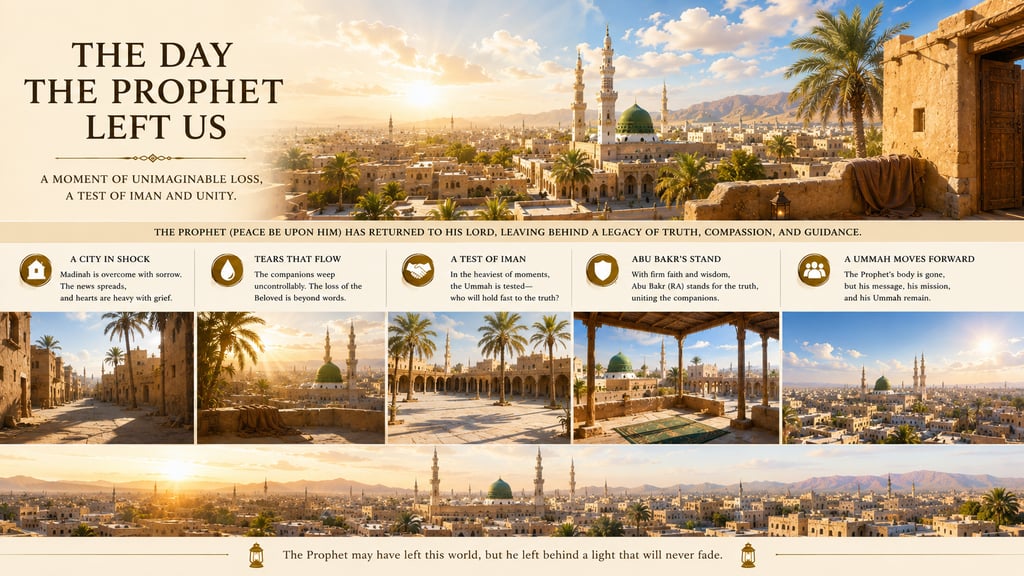
It was a quiet Monday morning in Medina, the year 632 CE. The air felt unusually heavy, and an eerie stillness blanketed the city. People went about their chores slowly, exchanging worried glances and hushed whispers. Everyone knew the Prophet Muhammad صلى الله عليه وسلم (Peace be upon Him) had been unwell for some days, and anxiety gripped the hearts of all those who loved him dearly.
Inside the modest room of Aishah رَضِيَ ٱللَّٰهُ عَنْهَا, the Messenger of Allah صلى الله عليه وسلم (Peace be upon Him) rested his blessed head upon her lap. The greatest man ever to walk the earth owned No Palace, No Throne, No Crown. The leader who had transformed Arabia and changed the course of human history departed this world in a humble room beside the mosque he had built with his own hands. His final moments reflected the very message he had lived: complete submission to Allah سُبْحَانَهُ وَتَعَالَى alone.
Then, in complete serenity, his blessed Soul returned to its Creator.
Within the small room of Aishah رَضِيَ ٱللَّٰهُ عَنْهَا, silence overcame every heart. She remained beside the Messenger of Allah صلى الله عليه وسلم, overwhelmed by a grief no words could carry. Soon, the members of his blessed household devoted themselves to the most sacred duty they would ever perform. Among them were Ali ibn Abi Talib رَضِيَ ٱللَّٰهُ عَنْهُ—the Prophet's صلى الله عليه وسلم cousin, son-in-law, and one of the earliest believers—along with Al-Abbas رَضِيَ ٱللَّٰهُ عَنْهُ, his sons, Usamah ibn Zayd رَضِيَ ٱللَّٰهُ عَنْهُ, and a small number of the Prophet's صلى الله عليه وسلم closest family and companions entrusted with preparing the Messenger of Allah صلى الله عليه وسلم for his final resting place.
With the utmost reverence, they carefully washed his blessed body, shrouded him, and prepared him for burial. Every movement was filled with love. Every tear reflected a devotion that words could never fully describe. Throughout Madinah, hearts were shattered by grief, yet each Companion strove to fulfill the responsibility that Allah سُبْحَانَهُ وَتَعَالَى had placed upon him during one of the most delicate moments in Islamic history.
Outside that humble home, however, another reality was beginning to unfold.
The news spread quietly through the streets of Madinah:
"The Messenger of Allah صلى الله عليه وسلم has returned to his Creator."
For a brief moment, it seemed as though time itself had stopped.
The city that had once echoed with the Prophet's صلى الله عليه وسلم footsteps suddenly fell into an unbearable silence. Shock surged like lightning through every home. Some wept openly. Others stood frozen, unable to speak. Many simply could not accept what they had heard.
Among them was Umar ibn al-Khattab رَضِيَ ٱللَّٰهُ عَنْهُ. The fearless warrior whose strength had shaken the enemies of Islam now found his own heart shattered by love. Drawing his sword, he cried out in anguish:
"The Messenger of Allah صلى الله عليه وسلم has not died! He has gone to meet his Lord as Musa عليه السلام went to meet his Lord, and he will return. Whoever says that Muhammad صلى الله عليه وسلم has died, I will strike him with this sword."
No one challenged him. Not because they believed his words, but because grief had overwhelmed reason itself. The Companions stood in stunned silence, each struggling to comprehend a reality that seemed impossible to accept.
At that very moment, Abu Bakr al-Siddiq رَضِيَ ٱللَّٰهُ عَنْهُ was returning to Madinah from his residence, on the outskirts of the city. As news reached him that the Messenger of Allah ﷺ had returned to his Lord, he hastened immediately to the Prophet's Mosque. While confusion spread among the people and emotions overcame even the strongest hearts, Abu Bakr رَضِيَ ٱللَّٰهُ عَنْهُ remained composed, seeking first to see his beloved friend with his own eyes.
Narrated Aishah رَضِيَ ٱللَّٰهُ عَنْهَا:
Abu Bakr رَضِيَ ٱللَّٰهُ عَنْهُ came riding his horse from his dwelling place in As-Sunh. He got down from it, entered the Mosque and did not speak with anybody till he came to me and went directly to the Prophet ﷺ, who was covered with a marked blanket. Abu Bakr رَضِيَ ٱللَّٰهُ عَنْهُ approached the blessed body of the Messenger ﷺ, uncovered his noble face, kissed his forehead, and said through his tears, "My father and my mother be sacrificed for you, O Messenger of Allah! Allah will not combine two deaths upon you. You have died the death which was decreed for you."
Then, overwhelmed with love and reverence, he kissed him once more and whispered: "You were beautiful in life, and you are beautiful in death."
(Sahih al-Bukhari 1241, 1242. In-book reference: Book 23, Hadith 5. USC-MSA web (English) reference: Vol. 2, Book 23, Hadith 333)
He then covered him once more. There was no denial. No panic. No search for worldly answers. Only complete certainty in Allah سُبْحَانَهُ وَتَعَالَى.
Stepping into the mosque, Abu Bakr رَضِيَ ٱللَّٰهُ عَنْهُ addressed the grieving companions with words that would forever become one of the greatest reminders of Tawḥīd:
"Whoever worshipped Muhammad صلى الله عليه وسلم, then Muhammad صلى الله عليه وسلم has passed away. But whoever worships Allah, then indeed Allah is Ever-Living and never dies."
He then recited the words of Allah سُبْحَانَهُ وَتَعَالَى:
"Muhammad is no more than a Messenger. Messengers have passed away before him. So if he dies or is killed, will you turn back on your heels? Whoever turns back on his heels will never harm Allah in the least. And Allah will reward those who are grateful."
Qur'an – Surah Āl 'Imrān (3), Verse 144
Arabic:
وَمَا مُحَمَّدٌ إِلَّا رَسُولٌ ۚ قَدْ خَلَتْ مِن قَبْلِهِ الرُّسُلُ ۚ أَفَإِن مَّاتَ أَوْ قُتِلَ انقَلَبْتُمْ عَلَىٰ أَعْقَابِكُمْ ۚ وَمَن يَنقَلِبْ عَلَىٰ عَقِبَيْهِ فَلَن يَضُرَّ اللَّهَ شَيْئًا ۗ وَسَيَجْزِي اللَّهُ الشَّاكِرِينَ
As the verse echoed through the mosque, Umar's رَضِيَ ٱللَّٰهُ عَنْهُ sword slowly slipped from his hand. He later said that it was as though he had never heard that verse before. His legs could no longer carry him, and he fell to the ground as the reality finally settled upon every heart.
The Messenger of Allah صلى الله عليه وسلم had indeed returned to his Lord. But the Lord of Muhammad صلى الله عليه وسلم. The Lord of Abu Bakr. The Lord of Ali. The Lord of Umar. The Lord of every believer...
Allah—the Ever-Living—would never die.
His simple words fell upon the crowd, quieting their grief, reminding them of the truth they had known but momentarily forgotten. The words of Abu Bakr رضي الله عنه settled over Madinah like a calm after a violent storm. Hearts were still shattered, tears continued to flow, and Umar رَضِيَ ٱللَّٰهُ عَنْهُ slowly lowered his sword, his anger turning to tears as reality sank in.
While the family of the Prophet ﷺ, including Ali ibn Abi Talib رَضِيَ ٱللَّٰهُ عَنْهُ, Al-Abbas رَضِيَ ٱللَّٰهُ عَنْهُ, and other members of Ahl al-Bayt رَضِيَ ٱللَّٰهُ عَنْهُمْ, devoted themselves to preparing the Prophet صَلَّى ٱللَّٰهُ عَلَيْهِ وَسَلَّمَ for burial—a duty of immense love and honor—the leaders among the Muhajiroon and Ansar gathered at Saqifah to prevent the community from descending into confusion.
For the first time since revelation had descended upon the cave of Hira, the Muslim Ummah stood without its Prophet صَلَّى ٱللَّٰهُ عَلَيْهِ وَسَلَّمَ (Peace be upon Him).
An unsettling question now echoed through every heart:
Who will lead the believers now?
The Messenger of Allah صَلَّى ٱللَّٰهُ عَلَيْهِ وَسَلَّمَ had united tribes that had fought one another for generations. Under the banner of Lā ilāha illā Allāh (لَا إِلٰهَ إِلَّا ٱللَّٰهُ), old rivalries had begun to fade, and hearts once divided had become brothers in faith.
But now the Messenger صَلَّى ٱللَّٰهُ عَلَيْهِ وَسَلَّمَ had returned to his Lord.
Would that fragile unity endure? Or would Arabia once again return to the divisions that had consumed it before the advent of Islam?
The Ansar wondered who would safeguard the city they had sacrificed everything to protect. The Muhajiroon reflected upon the immense responsibility of preserving the mission that had begun in Makkah. Beyond Madinah, countless tribes watched closely, uncertain about what would happen next.
Some had only recently entered Islam. Others had accepted the authority of Madinah because of the Messenger of Allah صلى الله عليه وسلم himself. If leadership was not established swiftly and wisely, confusion could spread across Arabia, and the unity so painstakingly built over twenty-three years might begin to unravel.
Never before had the Muslims faced such questions. During the Prophet's (صلى الله عليه وسلم) lifetime, every disagreement found its answer in revelation or in his judgment. Now, for the first time, the community stood without its Prophet, and every decision carried consequences that could shape generations to come.
The Prophet صلى الله عليه وسلم had completed his mission. Still, the responsibility of carrying that mission now rested upon ordinary human beings—men grieving the greatest loss of their lives while simultaneously bearing the weight of an entire civilization's future.
Every decision made during those first few hours would echo through history.
The discussions were intense and differed sharply, with voices raised as each proposed their own views. The Ansar had sheltered Islam when nearly all Arabia opposed it. The Muhajiroon had sacrificed everything for the sake of Allah سُبْحَانَهُ وَتَعَالَى. Both groups possessed immense virtue. Neither wished to divide the Ummah. It was a delicate time—one wrong move could tear apart the fragile unity the Prophet صَلَّى ٱللَّٰهُ عَلَيْهِ وَسَلَّمَ had established.
“Abu Bakr رَضِيَ ٱللَّٰهُ عَنْهُ is the best among us,” a voice called out clearly. Many nodded in agreement. Gradually, a consensus formed around him and eventually, they pledged allegiance, placing their hands gently on his, accepting Abu Bakr رَضِيَ ٱللَّٰهُ عَنْهُ as their new leader, the first Khalifa (Caliph) after Prophet Muhammad صلى الله عليه وسلم.
Abu Bakr رضي الله عنه did not seek leadership, nor did he celebrate it. He understood that the Khilafah was not an honor to be desired, but a trust for which he would one day answer before Allah سُبْحَانَهُ وَتَعَالَى.
Abu Bakr رَضِيَ ٱللَّٰهُ عَنْهُ was the Prophet's صلى الله عليه وسلم closest friend. The first adult man to embrace Islam. The companion of the Cave during the Hijrah. The one who spent his wealth freeing oppressed believers. The one entrusted to lead the prayers in the Prophet's صلى الله عليه وسلم final days, and the man whose unwavering faith, humility, and complete reliance upon Allah سُبْحَانَهُ وَتَعَالَى earned him a place unlike any other among the Companions.
For more than twenty-three years, Abu Bakr رَضِيَ ٱللَّٰهُ عَنْهُ walked beside the Messenger of Allah صلى الله عليه وسلم through hardship and victory alike. His unwavering faith, profound humility, and complete trust in Allah سُبْحَانَهُ وَتَعَالَى made him not only the Prophet's صلى الله عليه وسلم closest companion but one of the greatest servants of Islam in all of history.
When Abu Bakr رَضِيَ ٱللَّٰهُ عَنْهُ was chosen as Khalifa through consultation among the leading Companions, Ali رَضِيَ ٱللَّٰهُ عَنْهُ did not immediately give the public pledge of allegiance.
The authentic narration in Sahih al-Bukhari (Sahih al-Bukhari: 4240 - Darussalam numbering) records that Ali رَضِيَ ٱللَّهُ عَنْهُ pledged allegiance to Abu Bakr رَضِيَ ٱللَّهُ عَنْهُ several months later, after the passing of Fatimah رَضِيَ ٱللَّهُ عَنْهَا. Abu Bakr رَضِيَ ٱللَّهُ عَنْهُ visited Ali رَضِيَ ٱللَّهُ عَنْهُ in his house, spoke with him respectfully, and affirmed his love and esteem for the family of the Prophet صلى الله عليه وسلم.
Ali رَضِيَ ٱللَّهُ عَنْهُ acknowledged Abu Bakr's (رَضِيَ ٱللَّهُ عَنْهُ) virtues and did not accuse him of lacking merit. Rather, he expressed that he had hoped to be consulted more fully regarding the leadership. Abu Bakr رَضِيَ ٱللَّهُ عَنْهُ explained his actions as motivated by concern for the unity of the Muslims in those delicate hours. Their conversation concluded with reconciliation, and Ali رَضِيَ ٱللَّهُ عَنْهُ gave his pledge of allegiance.
From that point onward, Ali رَضِيَ ٱللَّهُ عَنْهُ did not establish a rival government. He did not call people to revolt. He did not declare Abu Bakr رَضِيَ ٱللَّهُ عَنْهُ an unbeliever or an oppressor. Instead, he continued serving the Muslim community. During Abu Bakr's (رضي الله عنه) caliphate, Ali (رضي الله عنه) remained one of the most respected senior Companions. They shared the same faith in Allah سبحانہ و تعالیٰ and love for His Messenger صلى الله عليه وسلم.
These events remind us that disagreement did not erase mutual respect. The greatest Companions of the Messenger صلى الله عليه وسلم were those human beings who experienced sorrow, disagreement, and immense pressure. Yet, they refused to allow those moments to destroy the brotherhood that Allah سبحانہ و تعالیٰ had established between them. They understood that preserving the Ummah was greater than preserving their own opinions.
But this pledge of allegiance did not bring immediate peace.
The Messenger of Allah صلى الله عليه وسلم had returned to his Lord. Revelation had come to an end. Across Arabia, uncertainty began to spread. Tribes watched Madinah carefully. Some questioned whether their allegiance had ended with the passing of the Prophet صلى الله عليه وسلم. Others hesitated, while ambitious men saw an opportunity to claim leadership for themselves.
The Ummah stood at one of the most fragile moments in its history.
It was now Abu Bakr رَضِيَ ٱللَّٰهُ عَنْهُ who carried a trust heavier than any crown a king had ever worn. Before him stood a community grieving its beloved Prophet صلى الله عليه وسلم. Around him stood tribes whose loyalty had not yet been fully tested. Beyond Arabia waited the greatest empires on earth, watching closely to see whether this new nation would survive—or collapse before it had truly begun.
The storms had already begun to gather.
But Abu Bakr رَضِيَ ٱللَّٰهُ عَنْهُ did not place his trust in numbers, wealth, or worldly power. He grasped the Rope of Allah سُبْحَانَهُ وَتَعَالَى with unwavering certainty. His heart remained firm when others trembled, and his conviction did not waver when uncertainty surrounded him. The same faith that had carried him beside the Messenger of Allah صلى الله عليه وسلم through every trial would now carry an entire Ummah through one of the darkest chapters of its history.
The Prophet صلى الله عليه وسلم had completed his mission.
Now the responsibility of preserving that mission rested upon the shoulders of those he had nurtured.
The first and greatest of them was Abu Bakr al-Ṣiddīq رَضِيَ ٱللَّٰهُ عَنْهُ.
His story was only just beginning.
(End of Chapter 1)