
Chapter 15: Osman — The Dream That Rose from the Ashes
Far away in the rugged hills and frontier towns of Anatolia — present-day Turkey — scattered Muslim tribes struggled to survive between collapsing empires and constant warfare. To the East stood lands shattered by Mongol invasions. To the West remained the fading Byzantine Empire — the last shadow of ancient Rome. Between them existed a harsh frontier world filled with uncertainty.
THE BRIEF HISTORY OF ISLAM!
Danish Shafiq
6/18/20264 min read


Chapter 15: After the Flames—How the Mongols Embraced Islam
The Muslim world was tired. For centuries, the Ummah had witnessed both greatness and grief. It had seen the tears of Karbala… the rise of mighty empires… the brilliance of Baghdad… the bloodshed of the Crusades… and the terrifying destruction brought by the Mongols.
Cities had burned. Libraries had vanished. Kingdoms had collapsed. And many Muslims wondered silently:
Would the Muslim world ever rise again with dignity? Or would it remain divided forever between kings, wars, and wounded memories?
Yet history often hides new beginnings inside broken worlds.
Far away in the rugged hills and frontier towns of Anatolia — present-day Turkey — scattered Muslim tribes struggled to survive between collapsing empires and constant warfare.
To the East stood lands shattered by Mongol invasions. To the West remained the fading Byzantine Empire — the last shadow of ancient Rome. Between them existed a harsh frontier world filled with uncertainty. Villages were raided. Borders shifted constantly. Refugees moved from place to place carrying memories of destroyed homes.
And among these wandering Turkish Muslim tribes was a small principality led by a man named:
Osman ibn Ertugrul. No palace surrounded him. No enormous empire stood behind him. He was not born into the luxury of kings. He belonged to a world of horsemen, tents, mountains, prayer, survival, and struggle.
But sometimes history changes through men whose strength comes not from wealth… but from conviction.
Osman grew up during an age when many Muslims feared the spirit of Islam itself was weakening beneath political corruption, luxury, and endless divisions. The early simplicity of Islam — the humility taught by Prophet Muhammad ﷺ — often seemed distant from the lifestyles of rulers competing for power. And so among ordinary Muslims, scholars, and spiritual teachers, a quiet longing began spreading: A longing to reconnect faith with character.
Power with justice. Strength with humility. It was during this atmosphere that spirituality deeply shaped the early Ottoman world. Sufi teachers, dervishes, scholars, and humble worshippers traveled across Anatolia reminding people about patience, sincerity, discipline, remembrance of Allah, and service to humanity.
Mosques and simple lodges became places not only of worship… but of healing for tired hearts. Among the figures who influenced Osman was Shaykh Edebali — a respected spiritual teacher known for wisdom and piety.
According to famous Ottoman traditions, Osman once stayed in the Shaykh’s home. Out of respect for the Qur’an hanging upon the wall, Osman remained awake through the night rather than sleeping carelessly in its presence. That small moment became symbolic of something greater: Respect for faith before power. That night, Osman reportedly saw a remarkable dream. A moon emerged from the chest of Shaykh Edebali and entered Osman’s heart. Then from Osman grew a mighty tree whose branches spread across mountains, rivers, and continents, giving shade to countless people beneath it. Whether entirely literal or partly symbolic, the dream remained deeply woven into Ottoman memory. Because what began as a tiny frontier state would indeed become an empire stretching across vast parts of the world.
But dreams alone do not build civilizations. Osman’s life was filled with hardship. The early Ottomans fought constantly for survival against rival tribes, Byzantine forts, political instability, and economic struggle. There were cold winters. Food shortages. Betrayals. Losses. And years when survival itself seemed uncertain.
Yet slowly, Osman united different Turkish Muslim tribes under a common vision.
Many who joined him were known as Ghazis — frontier warriors who believed they were defending Muslim lands while carrying the banner of Islam into unstable border regions.
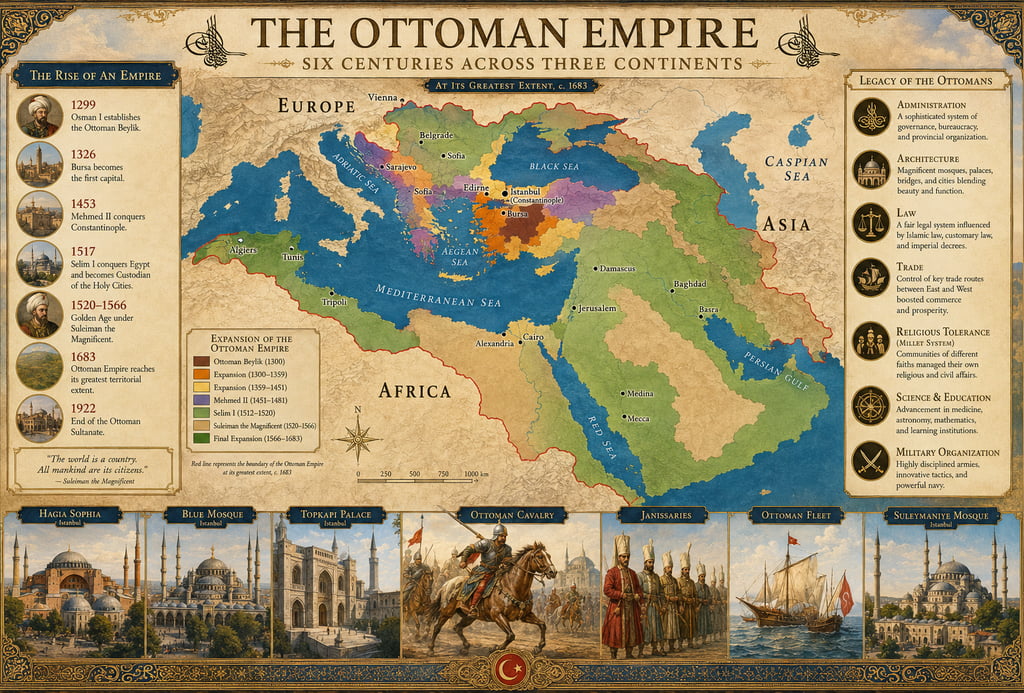
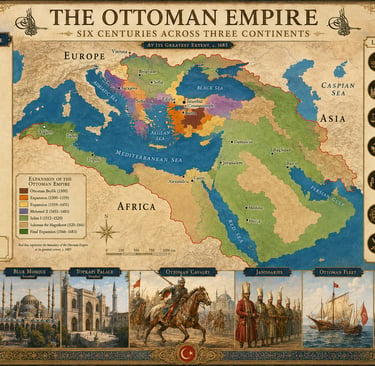
But unlike some conquerors driven only by destruction, the early Ottoman expansion often relied upon alliances, trade, local cooperation, and gradual integration. Villages entered Ottoman protection. Markets grew safer. Roads became more secure. And ordinary people exhausted by endless wars sometimes preferred stability over chaos. This became one of the hidden strengths of the Ottomans.
They understood that empires survive not only through fear… but through administration, justice, and the trust of ordinary people. As the Ottoman state slowly expanded, Sufi influence continued shaping society deeply. Dervishes traveled through villages teaching humility and remembrance of Allah.
Poets wrote about divine love and human compassion. Ordinary people found comfort in spiritual gatherings where rich and poor sat together. And this spiritual atmosphere would later connect strongly with places like India, where Sufi traditions also spread Islam through compassion, service, and humanity rather than force alone.
Yet like every empire before them, the Ottomans too were human. And humans carry both light and shadow within them. In their rise, the Ottomans often protected trade routes, revived stability, supported scholarship, built mosques, hospitals, schools, bridges, and public kitchens. They would later preserve many Islamic holy lands and stand as major defenders of the Muslim world against external invasions.
But over centuries, power also brought harshness. Some Ottoman rulers became consumed by palace politics. Brothers fought brothers for thrones. Political executions occurred. Heavy taxation burdened some populations.
At times, Arab regions felt neglected by distant rulers in Istanbul. And like many empires in history — Muslim and non-Muslim alike — the Ottomans sometimes used religion alongside political authority to strengthen their control. This was not the pure spiritual simplicity taught by Prophet Muhammad ﷺ.
Because Islam itself had always emphasized justice, mercy, humility, and accountability before Allah. The Prophet ﷺ taught kindness toward neighbors… mercy toward animals… care for the poor… and dignity for human beings regardless of race or tribe.
But rulers across history often struggled to fully live up to those ideals. The Ottoman story, like much of Islamic history, was therefore not a story of perfect people. It was the story of human beings trying — succeeding in some moments, failing in others — while carrying the enormous burden of power.
Still, despite imperfections, the Ottoman rise brought renewed confidence to many Muslims after centuries of chaos. The shattered world left behind by Mongols slowly began healing.
Mosques filled again. Trade expanded. Scholarship revived. And from the frontier towns of Anatolia emerged a new Islamic civilization preparing to stand between East and West for centuries.
Meanwhile, far ahead stood the greatest challenge of all.
The mighty city of Constantinople. Protected by enormous walls. The capital of the Byzantine Empire. The dream of conquerors for generations. And a city connected deeply to a famous prophecy remembered by Muslims across centuries. Many had tried to conquer it.
All had failed. But destiny was slowly preparing a young Ottoman prince for that moment. A prince whose victory would shake the world.
Mehmed. The Conqueror. Mehmed al-Fatih.
End of Chapter 15