Chapter 20: The Divided Hearts of the Ummah — Divided into Sects, and the Search for Unity!
The Muslim world itself began developing different emotional memories of history. This begun one of the deepest divisions within Islamic civilization. The division between Sunni and Shia traditions. Yet to understand this division honestly, one must first remove hatred from the heart.
THE BRIEF HISTORY OF ISLAM!
Danish Shafiq
6/18/20265 min read
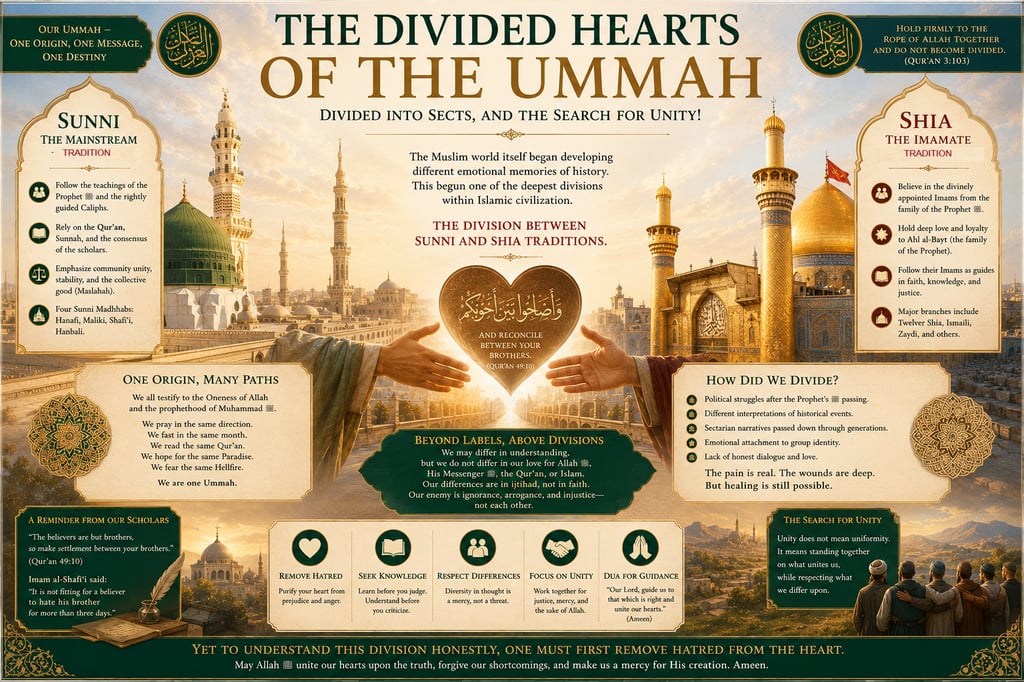
Chapter 20: The Divided Hearts of the Ummah — Divided into Sects, and the Search for Unity!
Towards the East...
As centuries passed, the Muslim world remained united by one faith, one Qur'an, and one Messenger ﷺ, even as its political powers and historical memories took different paths.
Yet while the Ottomans stood as the great guardians of Islam in the West, another remarkable chapter was quietly unfolding thousands of miles away in the East.
Across the vast lands of Hindustan, Islam was not carried by mighty armies alone. It travelled with humble merchants across the seas, with wandering scholars across deserts, and with devoted Sufi saints whose compassion, wisdom, and sincerity opened hearts long before kingdoms were established.
Their khanqahs became sanctuaries for the poor. Their words transcended language. Their character reflected the beauty of the Prophet Muhammad ﷺ. For countless people, Islam was encountered not through the sword, but through mercy, justice, humility, and love of the Almighty.
Long before the rise of the Mughal Empire, the seeds of faith had already taken root across the Indian subcontinent.
And so, the story now turns eastward.
To a land of ancient civilizations and timeless traditions...
A land where saints and sultans, poets and scholars, emperors and ordinary believers would together shape one of the most extraordinary chapters in the history of Islam.
The journey continues...
India — Where Spirituality Met Civilization.
This is an important chapter that should be cover in between the existing chapters. Read carefully and think for yourself!
When the dust of Karbala settled upon the burning sands of Iraq, something inside the Muslim world changed forever. It was no longer only a political wound. It became an emotional wound. A spiritual wound. A wound that generations would carry within their hearts.
The grandson of Prophet Muhammad ﷺ had been martyred.
The family of the Prophet ﷺ had been humiliated.
The children of Ahle Bayt had cried from thirst beneath the desert sun.
And across the Muslim world, people asked silently: “How did the Ummah of Muhammad ﷺ reach this point?”
The pain of Karbala did not end in one day. Its echoes continued through centuries. Some Muslims mourned openly.
Some remained silent out of fear. Some supported rulers for political stability. Others withdrew from politics entirely and focused upon spirituality and worship. And gradually, the Muslim world itself began developing different emotional memories of history.
This was the beginning of one of the deepest divisions within Islamic civilization.
The division between Sunni and Shia traditions.
Yet to understand this division honestly, one must first remove hatred from the heart. Because history is often more painful and human than propaganda allows. The word “Shia” originally meant: “party” or “supporters.” In early Islamic history, it referred to those Muslims who strongly supported Ali ibn Abi Talib رَضِيَ ٱللَّٰهُ عَنْهُ and believed leadership of the Ummah rightfully belonged within the family of Prophet Muhammad ﷺ.
Over time, especially after Karbala, this emotional attachment toward Ahle Bayt رَضِيَ ٱللَّٰهُ عَنْهُمْ became even stronger. For many Muslims, Hussain رَضِيَ ٱللَّٰهُ عَنْهُ no longer represented merely a political figure.
He became a symbol of sacrifice against oppression. A symbol of standing for truth even when abandoned by the world. A symbol whose blood awakened the conscience of the Ummah. And naturally, deep grief transformed into theological identity over generations.
Within Shia traditions, the descendants of Prophet Muhammad ﷺ through Ali رَضِيَ ٱللَّٰهُ عَنْهُ and Fatimah رَضِيَ ٱللَّٰهُ عَنْهَا gained immense spiritual importance. The concept of Imamate gradually developed: the belief that certain descendants of the Prophet ﷺ carried special spiritual and religious authority after him.
Books such as Al-Kafi later became major theological references within Twelver Shia Islam, preserving narrations, teachings, and understandings connected to Ahle Bayt رَضِيَ ٱللَّٰهُ عَنْهُمْ.
Meanwhile, Sunni Islam evolved differently.
Sunni scholars generally emphasized:
the unity of the companions,
broader community consensus,
and the preservation of Islamic law through multiple companions and scholars rather than through one sacred lineage alone.
Yet one reality is often forgotten by modern sectarian voices:
both Sunni and Shia Muslims deeply loved Prophet Muhammad ﷺ.
Both revered the Qur’an.
Both believed in Allah.
Both prayed toward the same Kaaba.
Both wept for Karbala.
Both carried within themselves love for Ahle Bayt رَضِيَ ٱللَّٰهُ عَنْهُمْ in different ways.
And perhaps this itself reveals the tragedy of Islamic history:
the Ummah often agreed upon the foundations…
yet became divided through politics, memory, and power.
As dynasties rose and fell, rulers sometimes exploited these divisions.
Some persecuted Shia communities.
Others persecuted Sunni scholars.
Some imprisoned descendants of the Prophet ﷺ.
Others silenced scholars who challenged authority.
Even during the Abbasid era — despite its intellectual brilliance — many members of Ahle Bayt رَضِيَ ٱللَّٰهُ عَنْهُمْ lived under surveillance, imprisonment, or political pressure. Great scholars suffered too.
Imam Abu Hanifa رَحْمَۃُ اللہ عَلَیہ faced imprisonment after refusing political manipulation.
Imam Malik رَحْمَۃُ اللہ عَلَیہ was punished.
Imam Ahmad ibn Hanbal رَحْمَۃُ اللہ عَلَیہ endured torture during theological conflicts.
And throughout all this turmoil, ordinary Muslims continued asking the same question:
“What was the true Islam taught by Prophet Muhammad ﷺ?”
Was it power?
Was it kingship?
Was it dynastic politics?
Or was it something far deeper?
And perhaps the answer remained where it had always been: within Tawheed. Pure monotheism.
The belief that above every ruler,
every empire,
every sect,
every scholar,
every dynasty,
and every political movement —
there is only One Eternal Lord:
Allah سبحانه وتعالى.
The Qur’an never taught Muslims to worship personalities.
Not kings.
Not scholars.
Not saints.
Not descendants.
Not rulers.
Islam honored human beings — but worship belonged only to Allah. Even Prophet Muhammad ﷺ himself repeatedly reminded humanity: “I am only a servant and messenger of Allah.” This was the essence of Islam. To free the human soul from slavery to creation and connect it directly with the Creator.
Yet throughout history, emotions sometimes exceeded balance. Some people turned political leaders into sacred personalities. Others turned sectarian identity into hatred. Some cursed companions. Others ignored the suffering of Ahle Bayt رَضِيَ ٱللَّٰهُ عَنْهُمْ . Some weaponized religion for power. Others abandoned spirituality entirely.
And slowly the Ummah fractured further. But despite these divisions, another beautiful reality also emerged within Islamic civilization.
The rise of spirituality and inner purification.
Across the Muslim world, righteous scholars, ascetics, and later Sufi saints reminded people that Islam was not merely political authority.
It was:
purification of the heart,
patience,
compassion,
remembrance of Allah,
humility,
knowledge,
and service to humanity.
Figures such as:
Abdul Qadir Jilani RA,
Imam Jafar al-Sadiq RA,
Hasan al-Basri RA,
and many others became spiritual lights for millions.
Their message was not hatred. Their message was: Return to Allah. And perhaps this became one of the greatest survivals of the Ummah.
Because while empires fought for thrones, the ordinary believer still whispered:
“La ilaha illallah.” There is no god except Allah.
This sentence survived every civil war.
Every invasion.
Every dynasty.
Every sectarian conflict.
And perhaps that itself is the miracle of Islam.
The Ummah divided politically —
yet the Qur’an remained one.
Accents changed.
Empires changed.
Clothing changed.
Languages changed.
But from Morocco to India,
from Syria to Indonesia,
Muslims still bowed their heads toward the same Kaaba and recited the same Qur’an.
And maybe this is what future generations must understand most carefully:
Islam should not be judged merely through the mistakes of rulers or the anger of sects.
Because kings were human.
Dynasties were human.
Scholars were human.
And human beings often carried both greatness and flaws together.
But the message of Islam remained higher than all of them.
The message remained:
worship Allah alone,
establish justice,
protect the weak,
feed the poor,
honor parents,
avoid oppression,
seek knowledge,
control anger,
forgive,
and remember that every soul will return to its Creator.
The tragedy of Islamic history was not that Muslims loved the family of the Prophet ﷺ too much. The tragedy was that politics repeatedly transformed love into division.
And perhaps the healing of the Ummah can only begin when Muslims once again place Tawheed above sectarian pride.
For on the Day of Judgment,
no dynasty will save humanity.
No sectarian slogan will matter.
Only truth,
sincerity,
justice,
and faith in Allah سبحانه وتعالى
will remain.
And somewhere beyond all the divisions of history, the voice of Prophet Muhammad ﷺ still calls humanity toward the same eternal message:
Worship One God.
Purify your heart.
Do not oppress others.
And remember that every human soul belongs ultimately to Allah alone.