
Chapter 24: Babur — History, Memory, and the Difference Between a Ruler and a Religion
Babur laid the foundations of the Mughal Empire, which under his successors became one of the largest and most politically integrated empires in South Asian history.
THE BRIEF HISTORY OF ISLAM!
Danish Shafiq
6/18/20263 min read
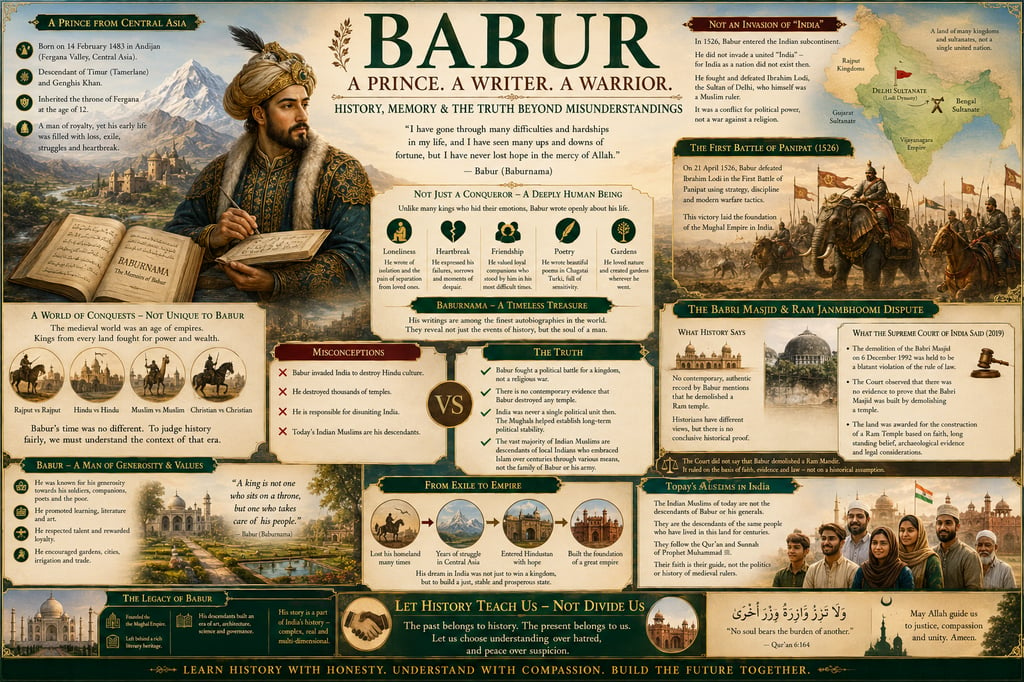
Chapter 24: Babur — History, Memory, and the Difference Between a Ruler and a Religion
Few figures in Indian history evoke emotions as deeply as Ẓahīr-ud-Dīn Muhammad Babur.
To some, he is remembered as the founder of the Mughal Empire, a gifted military commander, an accomplished writer, and the author of one of history's finest autobiographies—the Baburnama.
To others, he represents the beginning of foreign rule over North India and has become a symbol of historical grievances that continue to shape political discourse centuries later.
History deserves a more careful reading.
A Prince Searching for a Kingdom!
Babur was born in 1483 in Andijan, in present-day Uzbekistan. A descendant of both Timur and Genghis Khan, he spent much of his youth struggling to retain his ancestral lands in Central Asia.
Long before he marched toward Hindustan, Babur had already experienced repeated defeats, exile, betrayal, and the loss of his homeland.
His own memoirs reveal a ruler who openly wrote about failure, friendship, gardens, poetry, loneliness, and hope—qualities rarely found in medieval kings.
Eventually, after years of unsuccessful attempts to reclaim Samarkand, Babur turned his attention toward Hindustan.
The Battle That Changed History!
When Babur entered North India in 1526, he did not overthrow a united modern nation.
He confronted the forces of Ibrahim Lodi, the Sultan of Delhi, who himself belonged to the Afghan Lodi dynasty. The First Battle of Panipat was therefore a struggle between rival claimants for political authority in North India, not a war between "India" and "Islam."
The Indian subcontinent at that time consisted of numerous kingdoms, sultanates, and regional powers, many of which competed with one another regardless of religion.
Like many rulers of the medieval world—whether in Asia, Europe, or elsewhere—Babur sought to establish a durable empire.
Judging the Past Fairly...
The medieval world was an age of conquest.
Across continents, kingdoms expanded through military campaigns. Rajput rulers fought neighboring Rajput rulers. Hindu kings battled Hindu kings. Muslim sultans fought Muslim sultans. Christian monarchs fought other Christian kingdoms. Dynasties rose and fell through war.
Recognizing this context does not celebrate violence. Rather, it helps us understand that empire-building was a defining feature of that era and cannot be explained solely through religion.
History should neither romanticize conquerors nor reduce every conflict to a religious narrative.
The Babri Masjid and Ram Janmabhoomi Dispute!
No discussion of Babur in modern India can ignore the Ayodhya dispute.
The mosque historically known as the Babri Masjid was traditionally attributed to Babur's reign through later inscriptions and historical accounts. However, historians have long debated several aspects of its origin, and there is no surviving contemporary record from Babur himself stating that he ordered the demolition of a temple at the site.
In its 2019 judgment, the Supreme Court of India made several important findings.
The Court held that the demolition of the Babri Masjid on 6 December 1992 was an egregious violation of the rule of law.
At the same time, after considering archaeological findings, documentary evidence, and the long history of worship and possession claims, the Court awarded the disputed land for the construction of a Ram Temple while directing that an alternative five-acre plot be provided for the construction of a mosque.
The judgment did not conclude that there was historical proof that Babur personally demolished a Ram temple. Instead, the Court assessed a complex body of civil evidence relating to title, possession, archaeology, and the continuous religious beliefs associated with the site.
For that reason, historians continue to study the question with differing interpretations, while the legal dispute itself has been settled by the Court.
History Is Not Inherited!
Perhaps the most important lesson is this:
No community living today should be held responsible for the actions of rulers who lived five hundred years ago.
The overwhelming majority of Indian Muslims are descendants of the same people who have lived on the Indian subcontinent for centuries. They share the same languages, the same cultures, the same rivers, and the same homeland as their fellow Indians.
Their faith is derived from the Qur'an and the teachings of Prophet Muhammad ﷺ—not from the political decisions of Babur, Timur, Mahmud of Ghazni, or any other medieval ruler.
To judge today's Muslims by the actions of long-dead emperors would be as unjust as judging today's Hindus by every action of every medieval Hindu king, or today's Christians by every medieval European conquest.
History should be remembered.
Justice should be upheld.
But inherited blame should have no place in a modern democratic society.
Looking Beyond the Past.
Babur founded a dynasty.
His successors would transform it into one of the world's greatest empires—producing remarkable achievements in architecture, administration, literature, art, and governance.
The story now moves beyond conquest.
It moves toward a ruler whose vision of governance, dialogue, and statecraft would leave an even deeper mark upon the Indian subcontinent.
The next chapter begins with Jalal-ud-Din Muhammad Akbar.
End of Chapter 24