
Chapter 25: Humayun — The Emperor Who Lost an Empire but Refused to Lose Hope
Humayun was thoughtful, generous, deeply spiritual, and fascinated by astronomy, mathematics, literature, and philosophy. He spent long hours studying the heavens and surrounded himself with scholars and poets. While these qualities made him an enlightened prince, they also meant that he sometimes lacked the decisiveness demanded by an age of relentless warfare.
THE BRIEF HISTORY OF ISLAM!
Danish Shafiq
6/18/20264 min read
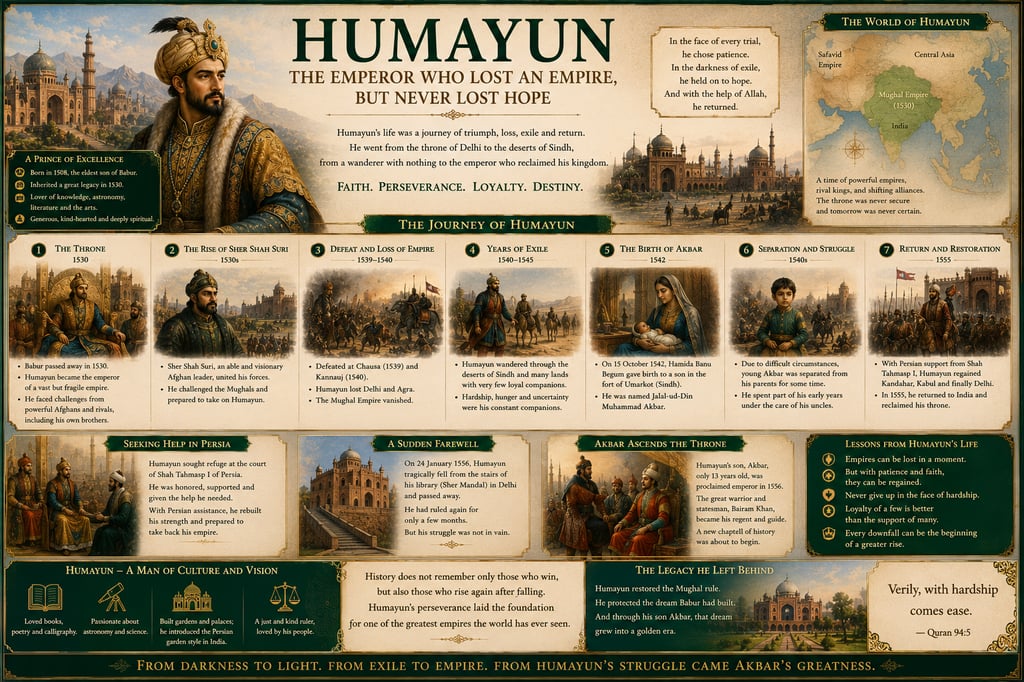
Chapter 25: Humayun — The Emperor Who Lost an Empire but Refused to Lose Hope!
When Babur passed away in 1530, the foundations of the Mughal Empire had only just been laid. His eldest son, Nasir-ud-Din Muhammad Humayun, inherited not a secure empire, but a fragile kingdom surrounded by uncertainty.
The empire stretched across much of northern India, yet it remained politically unstable. Afghan nobles longed to restore the old Lodi rule, ambitious regional kingdoms watched for signs of weakness, and even within the Mughal family, Humayun faced rivalry from his own brothers, whose loyalty often gave way to personal ambition.
Unlike Babur, who had won an empire through conquest, Humayun now faced the far more difficult task of preserving it.
Yet Humayun possessed a character quite different from his father.
He was thoughtful, generous, deeply spiritual, and fascinated by astronomy, mathematics, literature, and philosophy. He spent long hours studying the heavens and surrounded himself with scholars and poets. While these qualities made him an enlightened prince, they also meant that he sometimes lacked the decisiveness demanded by an age of relentless warfare.
Meanwhile, in eastern India, another remarkable leader was steadily rising.
Sher Shah Suri, an Afghan noble of exceptional administrative and military ability, gradually united the Afghan chiefs who opposed Mughal rule. Patiently and strategically, he built an army capable of challenging the Mughals themselves.
The inevitable confrontation arrived.
In 1539, at the Battle of Chausa, Humayun suffered a devastating defeat. Barely escaping with his life, he crossed the Ganges under desperate circumstances.
A year later, in 1540, at the Battle of Kannauj, Sher Shah inflicted another crushing defeat.
The Mughal Empire collapsed.
For the first time since Babur's victory at Panipat, the House of Timur possessed no throne in Hindustan.
An Emperor Without a Kingdom!
What followed transformed Humayun from a king into a wanderer.
With only a handful of loyal companions, he journeyed through the burning deserts of Sindh, often without enough food, water, or shelter. Those who had once bowed before him disappeared, while only a few faithful supporters remained.
It was during these darkest days that Humayun's young wife, Hamida Banu Begum, accompanied him through exile despite unimaginable hardship.
In 1542, while the fallen emperor possessed almost nothing, a son was born to them inside the desert fortress of Umarkot, in present-day Sindh.
The child was named Jalal-ud-Din Muhammad Akbar.
Humayun reportedly had so little wealth at the time that he could offer no lavish celebration for the birth of his heir. Instead, he distributed the little musk he possessed among his companions, expressing his hope that one day his son's fame would spread across the world just as the fragrance of musk spreads through the air.
History would prove those words remarkably prophetic.
A Family Torn Apart. Exile offered no peace.
Political pressures, constant pursuit by enemies, and shifting alliances forced Humayun to keep moving from one refuge to another. During these turbulent years, the infant Akbar was separated from his parents and spent part of his childhood under the care of his uncles in Kandahar and Kabul.
For years, father and son lived apart.
The prince who would one day rule one of the world's greatest empires grew up amid uncertainty rather than luxury.
Humayun, meanwhile, carried not only the burden of a lost empire but also the pain of separation from his family.
Hope Beyond Defeat!
Many rulers would have surrendered. Humayun did not.
Crossing into Persia, he sought the protection of Shah Tahmasp I of the Safavid Empire. The Persian ruler received him with honor and eventually provided military assistance. Tahmasp is known for his religious piety and fervent zealotry for the Shia branch of Islam. He bestowed many privileges on the clergy and allowed them to participate in legal and administrative matters. In 1544 he demanded that the Mughal emperor Humayun convert to Shi'ism in return for military assistance to reclaim his throne in India.
Supported by Persian forces and by loyal Mughal commanders, Humayun slowly began rebuilding what had once seemed forever lost.
He first reclaimed Kandahar, then Kabul, patiently restoring his strength over many years.
This was no dramatic comeback. It was a slow reconstruction built upon perseverance, diplomacy, and unwavering hope.
The Return of the Mughals!
Fifteen long years after losing everything, opportunity finally arrived.
Sher Shah Suri had died in 1545, and his successors struggled to maintain the stability of the Sur Empire. Internal conflicts weakened their rule, opening the door for Humayun's return.
In 1555, the Mughal armies marched once more into Hindustan. Delhi was recaptured.The empire founded by Babur had risen again from the ashes.
It seemed that Humayun's years of suffering had finally come to an end. But destiny had written another chapter.
A Sudden Farewell!
Only a few months after reclaiming his throne, tragedy struck.
One evening in January 1556, while descending the staircase of his library known as the Sher Mandal in Delhi, Humayun reportedly heard the call to prayer. As was his custom, he paused out of reverence. In the process, he lost his footing, fell down the steep steps, and suffered fatal injuries.
The emperor who had spent fifteen years fighting to regain his kingdom ruled it again for less than a year.
His earthly journey ended unexpectedly. Yet his greatest legacy was still to come.
His thirteen-year-old son, Akbar, was proclaimed emperor under the guardianship of the experienced general Bairam Khan.
Few watching that young boy could have imagined that the child born during exile, separated from his parents, and raised amid uncertainty would become one of the most influential rulers in the history of the Indian subcontinent.
Humayun's life reminds us that not every great king is remembered for the size of his empire. Some are remembered because they refused to surrender when everything seemed lost. Had Humayun abandoned hope in the deserts of Sindh or during his years of exile, there might never have been an Akbar, a Jahangir, a Shah Jahan, or the Mughal civilization that would shape the Indian subcontinent for centuries.
And so, with the restoration of the Mughal throne secured through sacrifice and perseverance, history now turns to the remarkable reign of Jalal-ud-Din Muhammad Akbar—the young emperor who would transform a fragile kingdom into one of the greatest empires the world had ever known.
End of Chapter 25