Chapter 26: Akbar — The Emperor Searching for Unity
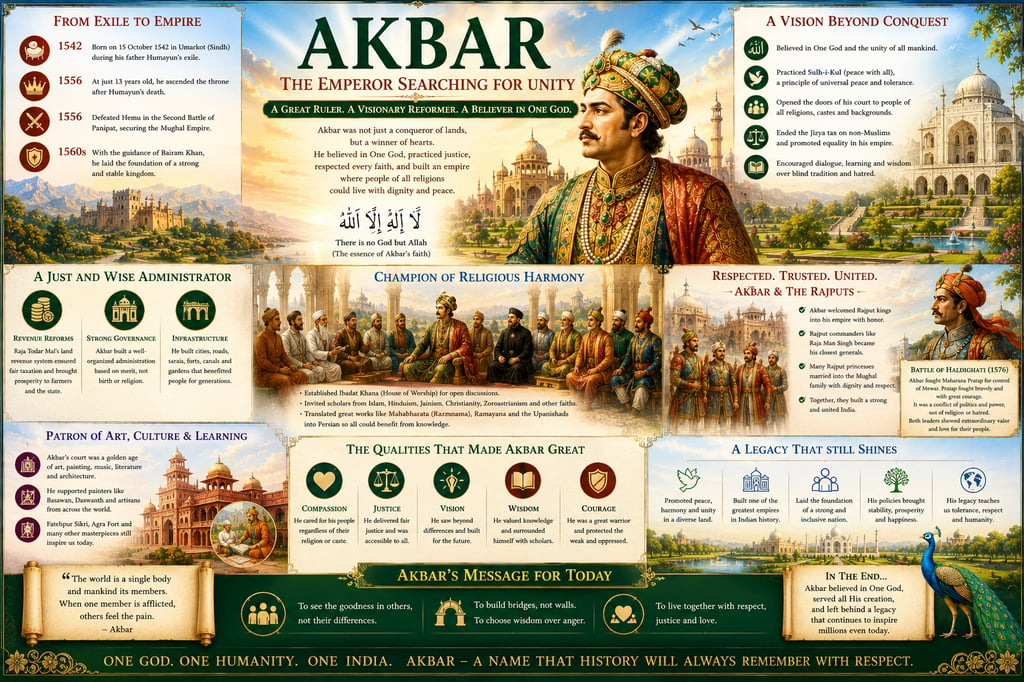
In 1542, during Humayun’s difficult years of exile, a child was born in the desert fortress of Umarkot in Sindh. That child was Jalal-ud-Din Muhammad Akbar. The boy who would later become one of the most influential rulers in Indian history.
THE BRIEF HISTORY OF ISLAM!
Danish Shafiq
6/18/20268 min read


Chapter 26: Akbar — The Emperor Searching for Unity!
"Some rulers build empires through fear. A few attempt to build civilizations through understanding."
Among all the emperors who ruled the Indian subcontinent, few continue to inspire as much admiration—and as much debate—as Jalal-ud-Din Muhammad Akbar.
To some, he is remembered as one of India's greatest emperors—a ruler who strengthened administration, encouraged learning, welcomed people of different faiths into his court, and laid the foundations for centuries of political stability.
To others, he is viewed simply as another Mughal conqueror whose empire emerged through war.
History, however, is rarely so simple. Akbar's story is not merely one of conquest.
It is the story of a young boy born in exile who spent his life searching for a way to govern one of the world's most diverse civilizations.
A Child Born Without a Kingdom!
When Babur died in 1530, the Mughal Empire was still fragile. It was not yet the mighty empire history would later remember. It was a newly established kingdom surrounded by uncertainty, rebellions, rival powers, and internal weakness. Babur’s son, Humayun, inherited the throne, but his rule quickly faced immense challenges. Afghan rulers resisted Mughal authority, regional kingdoms fought for independence, and political instability spread across North India.
Eventually, Humayun lost much of his empire and was forced into exile. For years, the Mughal future itself appeared uncertain.
But history was quietly preparing another turning point.
When Akbar was born in 1542 at the fortress of Umarkot, his father Humayun possessed neither a palace nor an empire. He was an emperor without a throne. The infant prince entered the world not amid celebration, but amid uncertainty. For years he was separated from his parents, moving through Kabul and Kandahar while political rivalries surrounded his family.
Akbar’s childhood was not spent in comfort and luxury alone. He grew up witnessing political struggle, military campaigns, uncertainty, and the constant burden carried by rulers fighting to survive. When Humayun eventually regained Delhi with Persian support, the Mughal Empire slowly returned.
Unlike many princes, Akbar received little formal education. He never became a scholar in the conventional sense. He remained largely unable to read or write fluently throughout his life. Yet those who knew him remarked upon something else. He possessed an extraordinary memory. He listened. He observed. He asked questions.
Knowledge entered his mind not through books alone, but through conversations with scholars, soldiers, saints, philosophers, artists, merchants, and travelers from every corner of his empire.
A Throne at Thirteen!
When Humayun unexpectedly died in 1556, Akbar was only thirteen years old. The empire his grandfather had founded and his father had painfully restored stood once again on uncertain ground.
His trusted guardian Bairam Khan assumed the role of regent. Bairam Khan, played a major role in protecting the young empire and the young king. Yet as Akbar matured, he gradually took full control of governance himself.
Within months another challenge emerged. The brilliant Hindu general Hemu, serving the Sur rulers, captured Delhi and proclaimed himself ruler. Everything the Mughals had regained seemed ready to disappear.
The fate of the empire rested upon one battle.
The Second Battle of Panipat
In 1556, the Mughal and Hemu's armies met at Panipat.
The battle remained fiercely contested until Hemu was struck in the eye by an arrow while commanding from the front. Leaderless, his army gradually lost cohesion.
The Mughal victory secured Akbar's throne. Had events unfolded differently that day, Indian history might have taken an entirely different course. This victory did not simply preserve the Mughal dynasty. It marked the beginning of one of the most influential reigns in South Asian history.
Winning Hearts, Not Only Territories!
Many conquerors stop after winning battles but Akbar understood that an empire held together only by military force would never endure. His challenge was unlike that faced by rulers governing relatively homogeneous kingdoms.
The Mughal Empire contained dozens of languages, numerous traditions, and followers of many religions. Its strength depended not merely on conquest, but on cooperation.
And under him, the Mughal Empire began transforming dramatically. Akbar was not merely interested in conquest. He wanted stability and unity. And an empire capable of governing India’s immense diversity. This was no simple task.
India was home to countless languages, religions, castes, kingdoms, traditions, and ethnic communities. Hindus formed the majority population, while Muslims themselves were divided among different ethnic, political, and theological backgrounds including Turks, Persians, Afghans, Central Asians, and Indian Muslims
Akbar understood that ruling India through fear alone would never create lasting stability. And so he began adopting policies that attempted to build cooperation between different communities.
Akbar adopted a different vision of kingship. He invited Rajput rulers into his administration.
He appointed talented Hindu nobles—including celebrated commanders such as Raja Man Singh and Raja Todar Mal—to some of the highest offices in the empire. These appointments were based not simply on birth but on demonstrated ability and loyalty.
His finance minister, Raja Todar Mal, introduced revenue reforms that influenced governance for generations.
Rajput generals commanded Mughal armies. Rajput rulers were integrated into Mughal administration and military structures. Their service reflected political alliances that crossed religious lines, a common feature of many premodern states.
Akbar also ended the jizya tax on non-Muslim subjects during his reign and reduced several other discriminatory practices. He encouraged public discussions among Muslim scholars, Hindu pandits, Jain monks, Christian missionaries, Zoroastrian priests, and others at the Ibadat Khana (House of Worship) in Fatehpur Sikri. These debates reflected his curiosity about different traditions, even though many Muslim scholars of his own time criticized some of his religious experiments.
One of the remarkable rival of Akbar: Maharana Pratap — A Rival, Not a Villain!
No account of Akbar's reign can ignore Maharana Pratap.
Popular memory often presents their struggle as a simple conflict between a foreign invader and a patriotic defender.
The historical picture is more complex.
Maharana Pratap was the ruler of Mewar, a proud Rajput kingdom determined to preserve its independence. Akbar sought to incorporate Mewar into the Mughal imperial system, as he had done with many other regional powers. Their conflict was therefore fundamentally about sovereignty and political authority.
In 1576, the two sides met at the Battle of Haldighati. The Mughal army that fought against Maharana Pratap at the Battle of Haldighati was commanded by Raja Man Singh I of Amber. Akbar did not participate in the battle personally, but he sent a massive imperial army of around 28,000 troops. Some of the key commanders and prominent figures who fought in the Mughal forces include:
Raja Man Singh I (Amber): The chief commander of Akbar’s army and a prominent Rajput general.
Asaf Khan: A key imperial commander alongside Man Singh who led the central contingent of the Mughal forces.
Madho Singh: A Rajput warrior who commanded the right flank of the Mughal forces and fought a direct duel with Maharana Pratap during the conflict.
Maharana Pratap fought with extraordinary courage, and his loyal horse Chetak became a symbol of devotion and sacrifice. Two beliefs remain prevalent today. The Mughals held the battlefield; they did not capture Maharana Pratap, who continued resisting from the Aravalli hills and remained independent for the rest of his life, whereas the second opinion is that, despite outnumbering the Mewar forces, Akbar’s army failed to capture Maharana Pratap, who then continued his resistance.
History allows us to admire both men without diminishing either. Maharana Pratap's determination to preserve his kingdom deserves respect. Akbar's ability to build a durable and inclusive imperial administration also deserves recognition.
Honouring one does not require hatred of the other.
It is equally important to remember that the conflicts of medieval India were contests between kingdoms and dynasties—not between today's religious communities. Rajputs fought alongside the Mughals, and Rajputs also fought against them. Afghans, Turks, Persians, and Indian Muslims likewise found themselves on different sides of various conflicts.
These alliances were shaped primarily by politics, loyalty, and regional interests rather than by simple religious identity. Holding present-day Indian Muslims responsible for the ambitions, victories, or mistakes of medieval emperors is neither historically fair nor morally just. Every generation is accountable only for its own actions, not for those who lived centuries before it.
Beyond the Sword! Akbar's legacy extended far beyond military victories.
He commissioned magnificent forts and cities, encouraged miniature painting, supported translations of Sanskrit works into Persian, and patronized scholars, poets, musicians, architects, and craftsmen.
His court became one of the great cultural centres of the early modern world.
He also sought a moral basis for governance that would reduce conflict among his subjects. His policy of sulh-i kul—"peace with all" or "universal peace"—emphasized justice and tolerance across religious communities. This principle shaped much of his statecraft, even if later rulers interpreted it differently.
It is also true that Akbar introduced ideas, such as the Din-i Ilahi, that were accepted by only a tiny circle and were criticized by many Muslim scholars. They never became the religion of the empire. A balanced history acknowledges both his innovations and the debates they provoked.
Faith, Empire, and Historical Memory! Modern debates often reduce Akbar to a symbol. Some portray him as a flawless hero. Others portray him as nothing more than an invader. Neither portrait captures the whole man.
Akbar was an emperor, The Great Emperor!
Like all rulers of his age, he fought wars and expanded his realm. Yet he was also a statesman who increasingly sought to govern through partnership rather than perpetual conquest. He recognized that an empire as vast and diverse as Hindustan could not endure through force alone.
Whether one agrees with every policy he adopted or not, his reign marked a significant attempt to create institutions that embraced many of the subcontinent's communities.
Under him, Mughal architecture expanded toward extraordinary beauty. Administration became stronger. Agriculture and trade flourished. Persian and Indian artistic traditions blended further together. Music, literature, miniature painting, and cultural exchange reached new heights.
At the same time, ordinary people across India continued living their daily lives beneath imperial politics.
Farmers worked the fields.
Merchants crossed markets.
Sufis taught spirituality.
Scholars wrote books.
Poets composed verses.
And communities of different religions continued sharing languages, food, clothing, and customs across generations.
This complex coexistence became part of India’s civilizational identity.
A Message for Our Own Time!
Perhaps the greatest lesson Akbar leaves us is not about empire. It is about perspective.
Today's Indians—Hindus, Muslims, Sikhs, Christians, Jains, Buddhists, Parsis, and others—did not fight the battles of Panipat or Haldighati.
They inherited a shared civilization shaped by countless generations. The overwhelming majority of Indian Muslims are descendants of this very land. They are not medieval armies. They are not Babur. They are not Akbar.
Likewise, today's Hindus are not responsible for every decision made by every medieval king.
History should help us understand one another, not condemn one another.
When we read the past with fairness, we discover that medieval rulers were products of their own world, while modern citizens have the opportunity to build a different one—guided by justice, mutual respect, and the shared hope of a peaceful future.
The Next Chapter
As Akbar's long reign came to an end, the Mughal Empire stood stronger than ever before.
His son would inherit not merely a throne, but a flourishing civilization.
The story now turns to Jahangir—the emperor remembered for justice, art, and the enduring influence of Nur Jahan, one of the most remarkable women in Mughal history.
End of Chapter 26