Chapter 27: Jahangir — The Emperor of Justice and the Garden of India!
What Akbar passed to his son was no longer merely an empire built by conquest. It had become a civilization. The responsibility now fell upon Prince Salim, who would ascend the throne under a new imperial title. Nur-ud-din Muhammad Jahangir. "The Seizer of the World."
THE BRIEF HISTORY OF ISLAM!
Danish Shafiq
6/18/20264 min read
Chapter 27: Jahangir — The Emperor of Justice and the Garden of India!
As Akbar's extraordinary reign came to an end in 1605, the Mughal Empire stood stronger than ever before. Its cities flourished with commerce. Its fields produced abundant harvests. Its roads connected distant kingdoms. Its scholars, artists, architects, poets, and merchants had transformed Hindustan into one of the richest and most sophisticated civilizations on earth.
The empire that Babur had founded through battle, and Akbar had strengthened through administration and reconciliation, now passed into the hands of his son.
Prince Salim. History remembers him by the name Jahangir. "The Seizer of the World."
Among the great Mughal emperors, Jahangir is perhaps the least celebrated.
Babur founded the empire. Akbar transformed it. Shah Jahan built monuments that amazed the world. Aurangzeb expanded the empire to its greatest territorial extent. Between these towering figures, Jahangir is often remembered as the forgotten emperor.
Yet history deserves to be kinder to him.
For while others became famous through conquest or magnificent architecture, Jahangir devoted much of his reign to preserving stability, encouraging culture, and strengthening justice. Sometimes, the greatest achievement of a ruler is not creating an empire—but preventing it from falling apart.
Unlike his father, Jahangir did not have an easy youth. As a prince, he grew impatient while waiting to inherit the throne. At one stage, he even challenged Akbar's authority by establishing his own court at Allahabad.
The relationship between father and son became strained. But before Akbar passed away, reconciliation prevailed. The empire remained united.
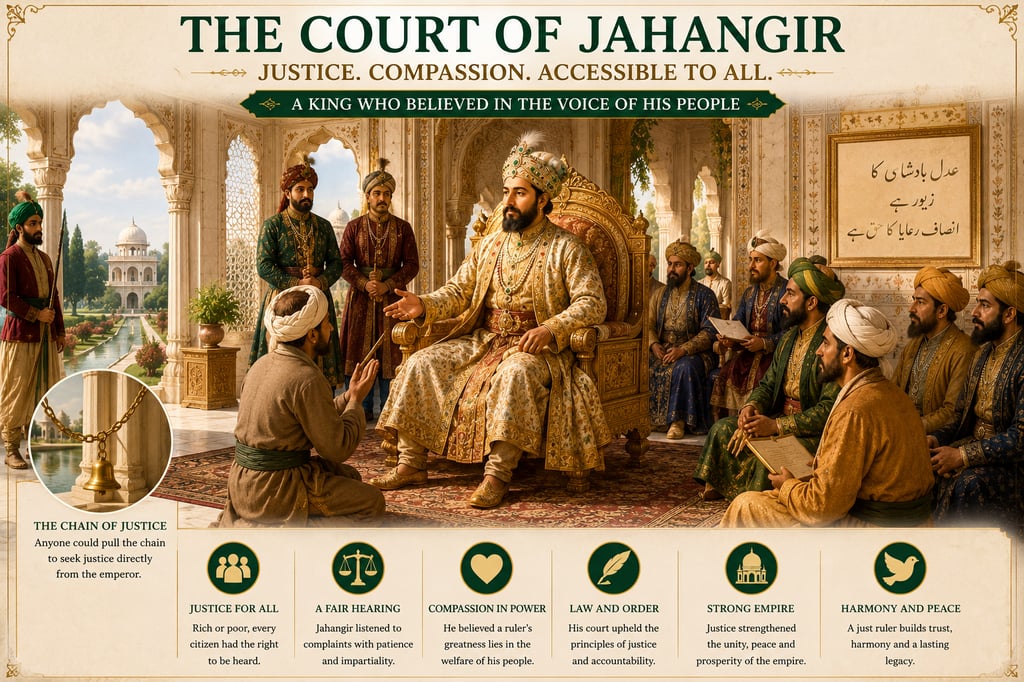
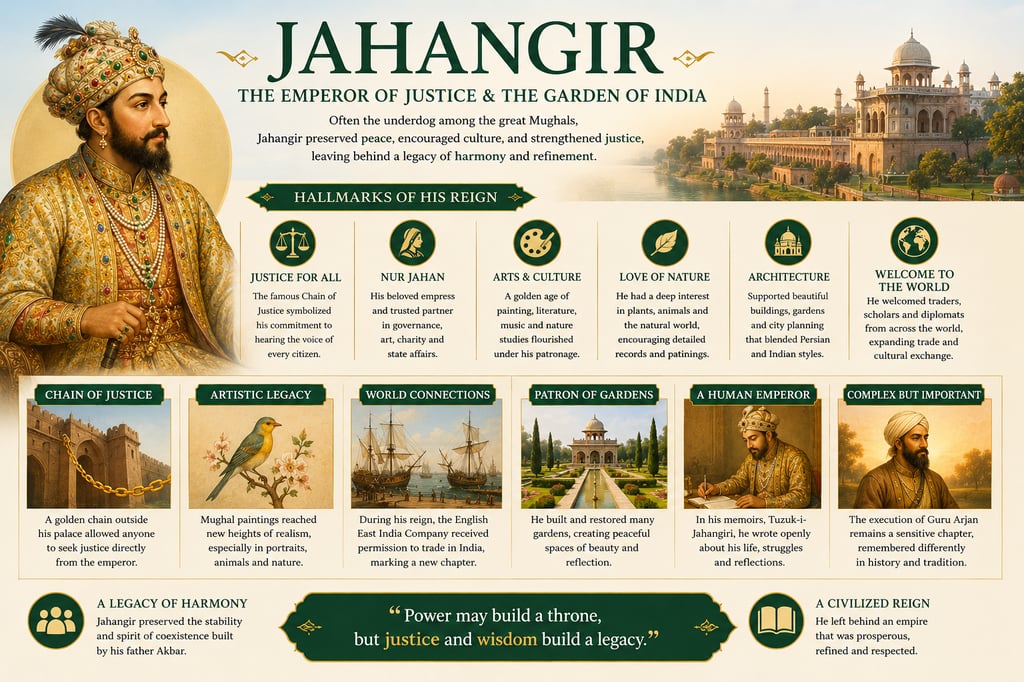
In 1605, Salim ascended the throne as Emperor Jahangir. One of the most famous symbols associated with Jahangir was the Chain of Justice. A great golden chain was suspended outside the royal palace so that any ordinary citizen who believed they had been wronged could seek direct justice from the emperor.
Whether every complaint reached Jahangir personally is something historians continue to discuss. Yet the symbolism spoke volumes. A ruler wished to be remembered as someone who remained accessible to the people rather than hidden behind palace walls.
Justice was to be seen as much as it was to be practiced.
The Qur'an repeatedly reminds believers:
"Indeed, Allah commands justice, excellence, and generosity..." (Surah An-Nahl 16:90).
No Muslim ruler, however powerful, stood above this command. Kings came and went. Empires rose and fell. But justice remained among the highest principles of Islam.
If Jahangir shaped the empire, another remarkable personality shaped the palace itself. Her name was Nur Jahan. History remembers her as one of the most influential women ever to stand beside a Muslim ruler. Born as Mehr-un-Nissa, she possessed remarkable intelligence, political understanding, artistic taste, and administrative ability.
Gradually, she became far more than an empress. She advised the emperor. Royal decrees bore her seal. Coins were even minted carrying her name—an extraordinary distinction for a woman in that era. She patronized architecture, poetry, trade, gardens, and charitable works, leaving an influence that continued long after Jahangir's reign had ended.
Under Jahangir, the Mughal Empire entered one of its finest cultural periods. Artists painted nature with astonishing realism. Birds, flowers, animals, rivers, and mountains appeared in miniature paintings unlike anything produced elsewhere in the world. Persian elegance blended beautifully with Indian craftsmanship.
Gardens spread from Kashmir to Lahore. Markets welcomed merchants from Arabia, Persia, Central Asia, the Ottoman lands, and Europe.
The empire became not merely powerful, but admired.
It was also during Jahangir's reign that a small trading company from England received permission to establish commercial relations in India.
The English East India Company arrived not with armies, but with merchants. At the time, few imagined that these traders would one day become rulers over much of the subcontinent.
History often changes quietly before it changes dramatically. Like every ruler, Jahangir also faced difficult moments.
One of the most significant was the death of Guru Arjan, the fifth Sikh Guru.
Historical sources agree that Guru Arjan died in Mughal custody in 1606, but historians differ over the circumstances and motivations behind his execution. Mughal chronicles emphasize political concerns linked to Prince Khusrau's rebellion, while Sikh tradition remembers Guru Arjan as a martyr whose sacrifice became a defining moment in Sikh history.
Whatever the precise causes, the event profoundly shaped the future relationship between the Mughal Empire and the Sikh community. It remains one of the most sensitive chapters in the history of the subcontinent and deserves to be approached with both honesty and respect.
Jahangir himself never claimed to be a perfect man. In his own memoirs, the Tuzuk-i-Jahangiri, he wrote openly about his struggles and his efforts to overcome them. Few rulers have spoken so candidly about their own weaknesses.
His honesty reminds us that even emperors remained human beings—capable of greatness, yet never free from personal flaws. Modern discussions often divide the Mughal emperors into heroes or villains.
History is rarely so simple. Jahangir was neither a flawless saint nor a ruthless tyrant.
He inherited a flourishing empire and largely preserved its peace and prosperity. He encouraged justice, nurtured the arts, welcomed scholars, strengthened administration, and oversaw one of the most refined cultural periods in Indian history. At the same time, some of his decisions continue to be debated and criticized by historians.
Such complexity should not surprise us.
Islam has never taught its followers to measure truth by the greatness of kings.
Muslims believe that guidance comes from the Qur'an and the authentic Sunnah of Prophet Muhammad ﷺ—not from the perfection of emperors.
When Jahangir passed away in 1627, he left behind an empire that remained wealthy, stable, and admired across the world. His son, Prince Khurram, now prepared to ascend the Peacock Throne. History would remember him by another name. Shah Jahan.
Under his reign, the Mughal Empire would witness the construction of one of humanity's greatest architectural masterpieces—a monument that would become the very symbol of India itself.But before marble spoke of love...
The Mughal family would once again discover that every crown carries its own trials.
End of Chapter 27