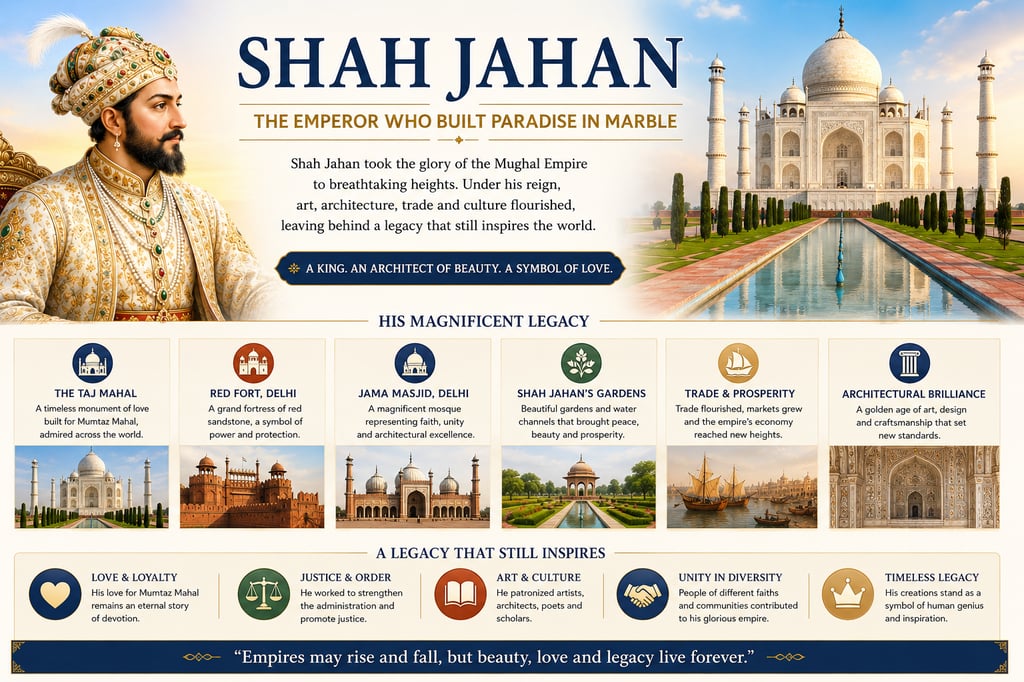
Chapter 28: Shah Jahan — The Emperor Who Built Paradise in Marble!
Under Shah Jahan, Mughal architecture reached extraordinary heights. The magnificent Red Fort of Delhi arose. The grand Jama Masjid welcomed thousands of worshippers. Elegant gardens spread across the empire. Roads improved. Trade expanded. Indian textiles became prized throughout Europe, Arabia, Persia, Africa, and Southeast Asia. The Mughal Empire became one of the richest economies on earth.
THE BRIEF HISTORY OF ISLAM!
Danish Shafiq
6/18/20264 min read
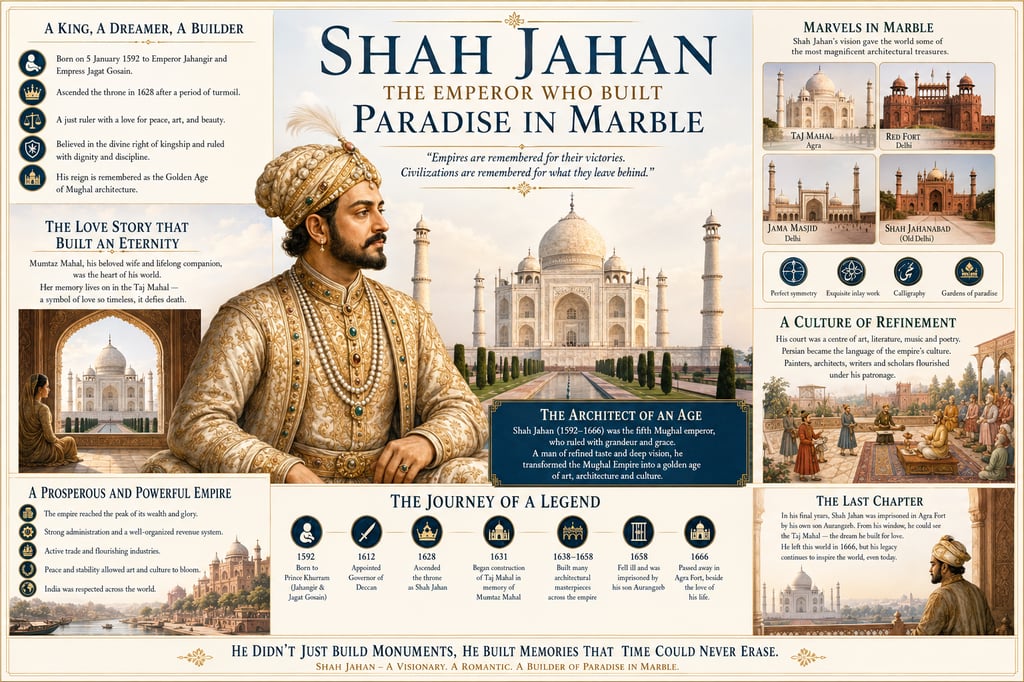
Chapter 28: Shah Jahan — The Emperor Who Built Paradise in Marble
When Jahangir passed away in 1627, the Mughal Empire stood peaceful, wealthy, and admired across much of the known world. Its gardens flourished. Its markets bustled with merchants from distant lands. Its artists painted masterpieces. Its scholars continued teaching in mosques, libraries, and royal courts. But before another emperor could wear the crown, the familiar struggle for succession returned once again.
For among the Mughals, no law guaranteed that the eldest son would inherit the throne. Princes fought. Brothers competed. Ambition tested blood itself. From this contest emerged Prince Khurram.
History remembers him as Shah Jahan— "The King of the World."
Unlike Babur, who built an empire through hardship...Unlike Humayun, who spent years wandering in exile...Unlike Akbar, who united a divided kingdom...Unlike Jahangir, who preserved stability...Shah Jahan would become the emperor who transformed power into beauty.
His reign would later be remembered as the golden age of Mughal architecture. Yet before marble became eternal...Love changed history.
Among all the queens of the Mughal Empire, none became more beloved than Mumtaz Mahal. She was not merely the emperor's wife. She was his trusted companion. She accompanied him on military campaigns. She advised him. She remained beside him through triumph and hardship alike.
In 1631, while giving birth to their fourteenth child during a military campaign in the Deccan, Mumtaz Mahal passed away. Her death shattered Shah Jahan. The emperor who ruled millions found himself powerless before death.
No army... No wealth... No throne... could bring back the one he loved. Out of that grief emerged one of humanity's greatest architectural achievements.
The Taj Mahal.
Built over more than two decades by thousands of craftsmen, architects, calligraphers, stone-carvers, and artisans from across Asia, the monument combined Persian elegance, Indian craftsmanship, Central Asian influences, and Islamic geometric beauty into a masterpiece unlike any the world had seen.
Its white marble reflected sunrise with soft pink hues... Noon with brilliant white... And moonlight with gentle silver. To many, it became the greatest symbol of love ever built. Yet beyond romance, it also reflected something deeper. A civilization that believed beauty itself could become an act of devotion.
The Qur'an repeatedly invites believers to observe beauty in Allah's creation. Islam never opposed beauty. It opposed arrogance. The finest architecture in Islamic civilization was never intended to compete with Paradise. Rather, it reminded people that every earthly beauty remains temporary before the eternal beauty prepared by Allah.
Under Shah Jahan, Mughal architecture reached extraordinary heights. The magnificent Red Fort of Delhi arose. The grand Jama Masjid welcomed thousands of worshippers. Elegant gardens spread across the empire. Roads improved. Trade expanded. Indian textiles became prized throughout Europe, Arabia, Persia, Africa, and Southeast Asia.
The Mughal Empire became one of the richest economies on earth. Travelers often described its cities with astonishment. Yet history rarely grants perfection to any ruler. The same emperor who built monuments of breathtaking beauty also spent enormous sums maintaining royal magnificence.
While the empire remained prosperous, the growing expense of imperial projects increased pressure upon the state's finances. Many historians continue to debate how much these expenditures contributed to the economic challenges faced by later generations.
Civilizations are sustained not only by beauty... but also by balance. Modern debates often reduce Shah Jahan to a single monument. Others dismiss him simply as another foreign ruler.
History deserves greater honesty. Shah Jahan ruled an empire whose administration was deeply rooted in the Indian subcontinent. Its soldiers included Rajputs, Afghans, Persians, Central Asians, and countless Indian Muslims and Hindus. Its craftsmen spoke many languages. Its prosperity was built by people from every community.
The Mughal Empire had long since become woven into the history of India itself. It was no longer the story of one tribe or one family alone. It had become the story of a civilization. This is an important lesson for our own times.
The monuments built during the Mughal period belong to the shared heritage of India. Whether one admires or criticizes particular emperors, these structures were raised by the hands of countless Indian artisans, engineers, calligraphers, stone-cutters, and laborers whose descendants belong to every community of modern India.
History should unite us in preserving that heritage, not divide us in claiming or rejecting it. Yet while visitors admired marble domes... another storm quietly gathered inside the palace.
Shah Jahan had four sons. Dara Shikoh, Shah Shuja, Murad Baksh.
And the youngest... Aurangzeb. Each believed he possessed the qualities needed to rule. Each had loyal supporters. Each watched the aging emperor carefully. No one knew that the greatest threat to the Mughal Empire would not come from beyond its borders... It would come from within the royal family itself.
When Shah Jahan fell seriously ill in 1657, the empire he had adorned with marble prepared once again for civil war. The struggle that followed would reshape the destiny of Hindustan forever. And history would soon meet one of its most debated rulers.
Aurangzeb Alamgir.
Reflection
As we leave the reign of Shah Jahan, we pause before one of history's enduring lessons. The strongest walls cannot keep death away. The grandest monuments cannot stop time. The richest emperor cannot escape old age.
Shah Jahan built a monument that still captures the imagination of the world. But even he eventually spent his final years not within the halls of power... but confined in Agra Fort, looking across the Yamuna River toward the marble tomb of the woman he never forgot.
Empires pass. Kings are buried. Marble slowly weathers.
Only Allah remains eternal.
"Everyone upon the earth will perish. And there will remain the Face of your Lord, full of Majesty and Honor." (Surah Ar-Rahman 55:26–27)