
Chapter 29: Aurangzeb Alamgir — The Last Great Mughal!
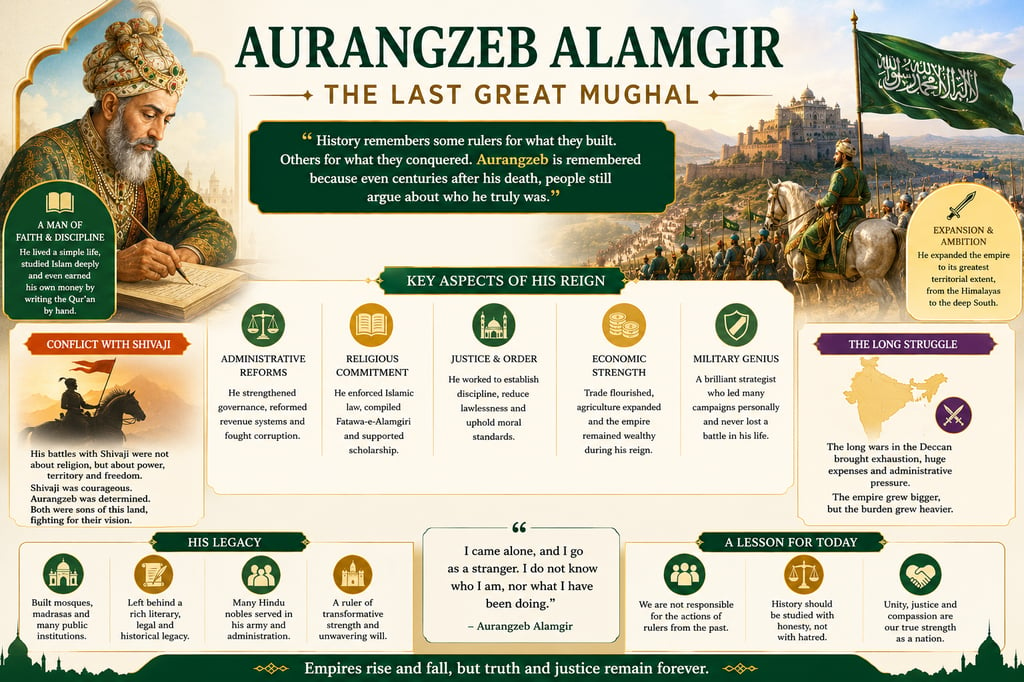
"History remembers some rulers for what they built. Others for what they conquered. Aurangzeb is remembered because even centuries after his death, people still argue about who he truly was."
THE BRIEF HISTORY OF ISLAM!
Danish Shafiq
6/18/202611 min read
Chapter 29: Aurangzeb Alamgir — The Last Great Mughal!
As Shah Jahan grew old, the Mughal Empire glittered with unmatched wealth. Its cities were among the richest on earth. Its architecture astonished travelers. Its administration stretched from the mountains of Kabul to the fertile plains of Bengal. Yet beneath this magnificence, another familiar storm gathered.
The Mughal Empire had no fixed law of succession. A prince did not become emperor simply because he was the eldest. Every son believed he possessed the right to rule. Every noble chose a side. Every succession became a battlefield. Shah Jahan had four sons. Dara Shikoh, Shah Shuja, Murad Baksh, and the youngest...
Muhi-ud-Din Muhammad Aurangzeb. History would remember him by another title.
Alamgir. "The Conqueror of the World."
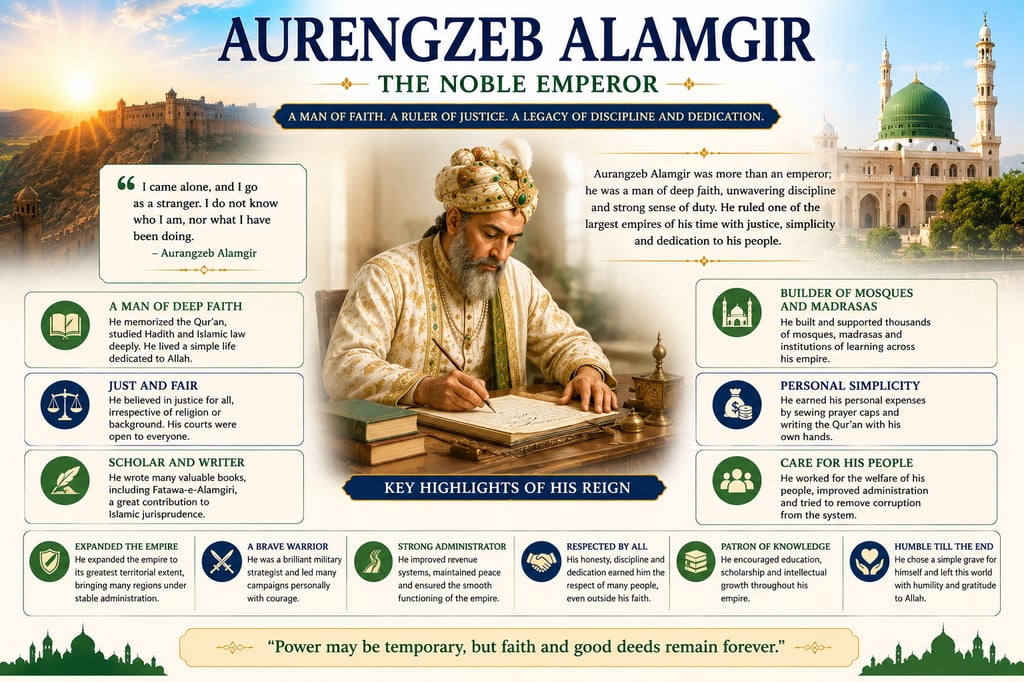
A Prince Unlike the Others! Among Shah Jahan's sons, Aurangzeb stood apart. While other princes admired poetry, luxury, music, and courtly elegance... Aurangzeb preferred study. He memorized the Qur'an. He studied Hadith. He learned Islamic jurisprudence. He copied the Qur'an by hand.
Many historians record that he earned personal income by sewing prayer caps and copying manuscripts, refusing to rely entirely upon the imperial treasury for his personal expenses. Whether one admires him or not, few dispute that Aurangzeb lived a remarkably simple personal life for an emperor ruling one of the richest states in the world.
His clothing remained modest. His meals were simple. His private conduct reflected genuine religious devotion.
The War of Brothers!
When Shah Jahan became seriously ill in 1657, the struggle for succession erupted. The empire divided. Brother marched against brother. Armies that had once defended the empire now fought each other.
Aurangzeb defeated Dara Shikoh. Later he overcame Shah Shuja and Murad Baksh. These were not merely military victories. They were family tragedies. Like the Ottoman princes before them, Mughal succession often demanded choices that today seem heartbreaking.
History does not celebrate these conflicts. It remembers them as the price of a system without peaceful succession.
After securing victory, Aurangzeb confined his father, Shah Jahan, within Agra Fort. From there, the aging emperor spent his final years overlooking the Taj Mahal—the resting place of Mumtaz Mahal.
It remains one of the most emotional scenes in Mughal history. A father. A son. An empire. And a throne that demanded more than either could bear.
The Emperor and His Faith!
Aurangzeb sincerely believed that a Muslim ruler should govern according to Islamic law. He commissioned the compilation of the Fatawa-e-Alamgiri, one of the largest collections of Hanafi legal opinions ever produced. Mosques, madrasas, and scholars received imperial patronage.
He discouraged practices that he considered contrary to Islamic teachings. Many of these reforms reflected his personal understanding of religious responsibility rather than political convenience.
For many Muslims, Aurangzeb became an example of personal piety. For others, some of his policies became subjects of criticism and debate.
History preserves both memories.
The Long War!
Aurangzeb spent nearly the last twenty-five years of his life campaigning across the Deccan. Every new victory demanded another campaign. Every conquered fortress required another garrison. Every expansion stretched imperial resources further. The empire grew larger than ever before.
Under his command, Mughal armies conquered vast territories deep in southern India, stretching the empire’s borders wider than ever before. Victories came swiftly, and Islam’s influence spread further across the subcontinent.
Yet governing such an enormous territory became increasingly difficult. Roads lengthened. Supply lines weakened. Provincial governors became more powerful. The treasury came under increasing strain.
Ironically, the emperor who expanded the Mughal Empire to its greatest territorial extent also unknowingly accelerated the challenges that would confront his successors. History often teaches that expansion without consolidation comes at a cost.
Slowly, this vast empire also began to fracture.
Conflict with the Sikh Community!
In Punjab, the Sikh community continued to grow in influence under Guru Tegh Bahadur Ji and later Guru Gobind Singh Ji. One of the most painful events remembered in Sikh history occurred in 1675. Guru Tegh Bahadur Ji was executed in Delhi during Aurangzeb's reign. Modern historians continue to debate the precise legal and political circumstances surrounding the execution, portraying it within the framework of imperial law and political rebellion.
Yet regardless of differing interpretations, one truth remains beyond dispute: Guru Tegh Bahadur's death became one of the defining moments in Sikh history and profoundly transformed the Sikh community. His son, Guru Gobind Singh Ji, responded not by abandoning faith, but by strengthening it. In 1699, at Anandpur Sahib, he established the Khalsa, initiating a new spiritual order dedicated to courage, equality, discipline, and devotion to the One God.
For the Mughal administration, however, the emergence of an increasingly organized and armed community near a strategically important frontier was viewed through a different lens. Imperial governments throughout history have often regarded rapidly growing military-religious movements with suspicion.
Thus, what Sikhs experienced as the defense of their faith, Mughal officials often interpreted as a political and military challenge to imperial authority. Religion and politics had become deeply intertwined. Separating one from the other became increasingly difficult.
The tragedy that followed is among the most emotional chapters of Sikh history. Guru Gobind Singh Ji's four sons—the Sahibzadas—were all martyred during the struggle. The two elder sons fell in battle at Chamkaur. The two younger sons, still children, were captured and executed after refusing to abandon their faith.
These events remain central to Sikh identity and continue to inspire generations through their extraordinary courage and steadfastness.
Their sacrifice deserves remembrance with dignity and respect.
Near the end of his life, Guru Gobind Singh Ji sent Aurangzeb the famous Zafarnama—the "Epistle of Victory." Remarkably, this was not a letter of hatred. It was a moral challenge. Guru Gobind Singh accused the emperor of breaking oaths and abandoning justice, reminding him that worldly power could never outweigh truth before God.
Even today, the Zafarnama stands as one of the most remarkable political and spiritual letters written in South Asian history. Some historical accounts suggest that Aurangzeb, moved by its contents, expressed a willingness to meet Guru Gobind Singh.
Whether such a meeting would have changed history, we shall never know. As modern readers, we inherit these memories. But we are not required to inherit their hatred. Today's Sikhs are not responsible for the actions of Mughal emperors. Today's Muslims are not responsible for every decision taken by medieval rulers.
|| "Both communities have contributed profoundly to the civilization, culture, and freedom of modern India. History should help us understand one another—not become a weapon to deepen old wounds. For if history teaches us anything, it is that kingdoms rise and fall, but truth, justice, and sincere devotion to the Creator remain greater than every empire."
In Maharashtra, a brilliant Maratha warrior named Shivaji challenged Mughal authority repeatedly, skillfully evading capture and frustrating Aurangzeb’s generals. Shivaji’s defiance inspired others, spreading rebellion like wildfire.
Shivaji — A New Power in the Deccan!
Perhaps the most delicate part in the entire chapter.
Shivaji Maharaj is not merely a historical ruler today. For millions of Indians—especially in Maharashtra—he is a symbol of courage, self-rule (Swarajya), resistance against oppression, and cultural pride. Likewise, Aurangzeb remains one of the most debated figures in Indian history. Modern political narratives often reduce their relationship to a simplistic "Hindu versus Muslim" conflict.
History, however, is considerably more complex.
Shivaji employed many Muslims in senior positions. Aurangzeb commanded thousands of Hindu nobles and Rajput generals. Their struggle was undoubtedly shaped by religion at times, but it was also profoundly about sovereignty, regional autonomy, military strategy, taxation, and imperial authority.
Unlike many rulers who relied upon enormous standing armies, Shivaji mastered mobility. The rugged mountains of the Western Ghats became his greatest ally. His forces struck swiftly, disappeared into difficult terrain, and repeatedly challenged armies many times larger than their own.
His network of hill forts, intelligence gathering, and naval initiatives transformed warfare in western India.
Meanwhile, Aurangzeb viewed the Deccan through a different lens. For the Mughal emperor, maintaining control over the empire required integrating every major region under imperial administration. The Maratha expansion, therefore, appeared not merely as a regional movement but as a direct challenge to Mughal authority.
Thus emerged one of the longest and most exhausting struggles in Indian history.
Following his defeat at the hands of Jai Singh I (a senior-most general and a high-ranking mansabdar at the imperial court of the Mughal Empire), in the Battle of Purandar, Shivaji entered into a pact with the Mughal Empire, assuming the role of a Mughal chief. He was conferred the title of Raja by the emperor.
( Reference Eraly, A. (2007). Emperors Of The Peacock Throne: The Saga of the Great Moghuls. Penguin Books Limited. p. 672. ISBN 978-93-5118-093-7. Retrieved 27 October 2024.)
In 1666, Aurangzeb summoned Shivaji to Agra (though some sources instead state Delhi), along with his nine-year-old son Sambhaji. Aurangzeb planned to send Shivaji to Kandahar, now in Afghanistan, to consolidate the Mughal empire's northwestern frontier. Shivaji was made to stand at court alongside relatively low-ranking nobles, men he had already defeated in battle. Shivaji took offence, stormed out, and was promptly placed under house arrest.
Shivaji hatched a plan to free himself. After Shivaji's escape, hostilities with the Mughals ebbed, with the Mughal Sardar Jaswant Singh acting as an intermediary between Shivaji and Aurangzeb for new peace proposals. The peace between Shivaji and the Mughals lasted until 1670. Aurangzeb, when occupied in fighting the Afghans, greatly reduced his army in the Deccan; many of the disbanded soldiers quickly joined Maratha service. Shivaji launched an offensive against the Mughals and, in a span of four months, recovered a major portion of the territories that had been surrendered to them.
He worked to establish administrative institutions, strengthen local governance, improve revenue collection, secure trade routes, and protect coastal regions through the development of a navy.
His coronation in 1674 symbolized not only military success but the formal establishment of an independent Maratha kingdom. Shivaji employed people of all castes and religions, including Muslims and Europeans, in his administration and armed forces. Over the course of his life, Shivaji engaged in both alliances and hostilities with the Mughal Empire.
Their conflict became one of strategy, endurance, and political ambition. Like many wars throughout history, it was shaped by geography, alliances, taxation, succession, and control of territory—not by religion alone.
Aurangzeb outlived Shivaji by more than two decades. Yet despite commanding one of the largest armies in the world, he never fully subdued the Maratha movement. The long Deccan campaigns consumed enormous financial and military resources.
By the time Aurangzeb died in 1707, the empire remained vast, but its foundations had begun to weaken. The politics of seventeenth-century India cannot be reduced to a simple conflict between religions.
Today, both Aurangzeb and Shivaji remain powerful symbols. Some remember one only as a tyrant and the other only as a hero. Others reverse those judgments. Yet history asks more from us than choosing sides. It asks us to understand the world they inhabited.
Neither lived in an age of constitutional democracy. Neither ruled within the framework of the modern nation-state. Both acted within a seventeenth-century political order where expansion, warfare, and territorial ambition were common features of kingship across the world.
Their conflict was undoubtedly shaped by religious identities, but it was equally a contest over sovereignty, regional autonomy, imperial authority, and competing visions for the future of India.
For modern India, perhaps the greatest lesson lies elsewhere. Today's Hindus are not warriors from the seventeenth century. Today's Muslims are not representatives of the Mughal court. Neither community should inherit the hostility of battles fought centuries before they were born.
History should teach wisdom rather than resentment. For kingdoms eventually disappear. But the people who continue living together inherit the responsibility of building a more just and peaceful future.
The Question of Temples!
No issue surrounding Aurangzeb has generated more debate than the destruction of certain temples. Some modern narratives claim that he destroyed every Hindu temple across India. This is historically inaccurate.
Other narratives deny that any temples were destroyed. That, too, does not reflect the historical record.
Contemporary Persian chronicles, royal orders, regional records, and modern historians indicate that some temples were indeed demolished during Aurangzeb's reign, particularly in contexts involving political rebellion, punishment of hostile rulers, or assertions of imperial authority.
At the same time, numerous temples throughout the empire continued to function. Imperial grants to some Hindu religious institutions have also survived. Several Hindu nobles remained among Aurangzeb's highest-ranking officers throughout his reign. History, therefore, presents a more complex picture than either complete denial or universal destruction.
Recognizing complexity does not excuse suffering. Nor should isolated events be expanded into claims unsupported by evidence.
Justice demands accuracy.
|| Readers are encouraged to consult multiple primary sources, including the Sabhasad Bakhar, Persian Mughal chronicles, European travelers' accounts, and modern historians such as Jadunath Sarkar, Stewart Gordon, Satish Chandra, John F. Richards, and Audrey Truschke, among others. The purpose of this chapter is not to diminish the legacy of either Chhatrapati Shivaji Maharaj or Emperor Aurangzeb Alamgir, but to understand their conflict within the broader political realities of seventeenth-century India. ||
A Lonely Emperor!
As old age approached, Aurangzeb's letters reveal a ruler very different from the triumphant conqueror imagined by later generations. He wrote with remarkable humility about death. He reflected upon the burdens of kingship.
One of his most famous letters includes words that continue to move historians:
"I came alone, and I go as a stranger. I do not know who I am, nor what I have been doing."
Whether one agrees with every decision he made or not, these words reveal an aging ruler conscious that worldly power could not accompany him into the grave.
Islam and Empire!
One of the greatest mistakes modern discussions make is confusing Islamic faith with imperial politics. Aurangzeb ruled an empire. Like every emperor in history, he made political decisions that historians continue to examine, debate, praise, and criticize.
Islam itself, however, cannot be reduced to the actions of any emperor. The Qur'an remains unchanged. The Sunnah remains unchanged. Kings rise and fall. Revelation does not. This distinction is essential. Throughout history, Muslim rulers have sometimes acted with extraordinary justice. At other times they committed errors, and sometimes grave injustices. Their actions remain their own responsibility before Allah. They do not define the religion.
A Word for Today's India!
Modern India is home to people whose ancestors came from every imaginable background. Some descended from Rajputs. Some from Marathas. Some from Afghans. Some from Persians. Many from ancient Indian communities that embraced Islam over centuries through trade, scholarship, Sufi teachers, marriages, and personal conviction.
The overwhelming majority of Indian Muslims are not descendants of Mughal emperors. Nor do they bear responsibility for the ambitions or decisions of medieval rulers. Just as today's Hindus are not responsible for every decision made by ancient kings...
Today's Muslims cannot be judged by emperors who lived more than three centuries ago.
The Qur'an establishes a timeless principle:
"No bearer of burdens shall bear the burden of another."
(Surah Al-An'am 6:164)
History should become a bridge toward understanding—not a weapon against neighbours.
The End of a Giant!
Aurangzeb died in 1707 after ruling for almost fifty years. Unlike many emperors, he requested a simple grave. No grand marble dome. No magnificent mausoleum. His tomb near Khuldabad remains remarkably modest, covered only with plain earth and simple stone.
It reflects the life he sought to live. Powerful before people. Humble before Allah. Yet after his death, the empire he had spent decades expanding began to fragment.
Provincial governors asserted independence. The Marathas grew stronger. European trading companies became increasingly influential. Within a few generations, the mighty Mughal Empire that had dominated India for nearly two centuries would slowly yield to new powers.
Reflection!
Aurangzeb remains one of history's most debated rulers because he embodied many contradictions. A devout Muslim who governed a vast, religiously diverse empire. A disciplined emperor who expanded his dominion farther than any Mughal before him.
A ruler whose policies inspired both admiration and criticism. A conqueror whose greatest victories also exposed the limits of imperial power. History does not ask us to worship kings. Nor does it ask us to hate them. It asks us to understand them.
Empires belong to history. Faith belongs to Allah.
And every soul, whether emperor or shepherd, will one day stand before the same Lord.
"That was a nation who has passed away. Theirs is what they earned, and yours is what you earn. You will not be questioned about what they used to do." (Qur'an 2:134)