
Chapter 30: The Empire Fades — The Coming of the British and the Fracturing of the Ummah!
The long wars of Aurangzeb had exhausted the treasury. Regional governors had grown ambitious. Rival princes fought for power. Trust between communities had become increasingly fragile. And across the empire, ordinary people once again carried the burden of political instability.
THE BRIEF HISTORY OF ISLAM!
Danish Shafiq
6/18/20263 min read
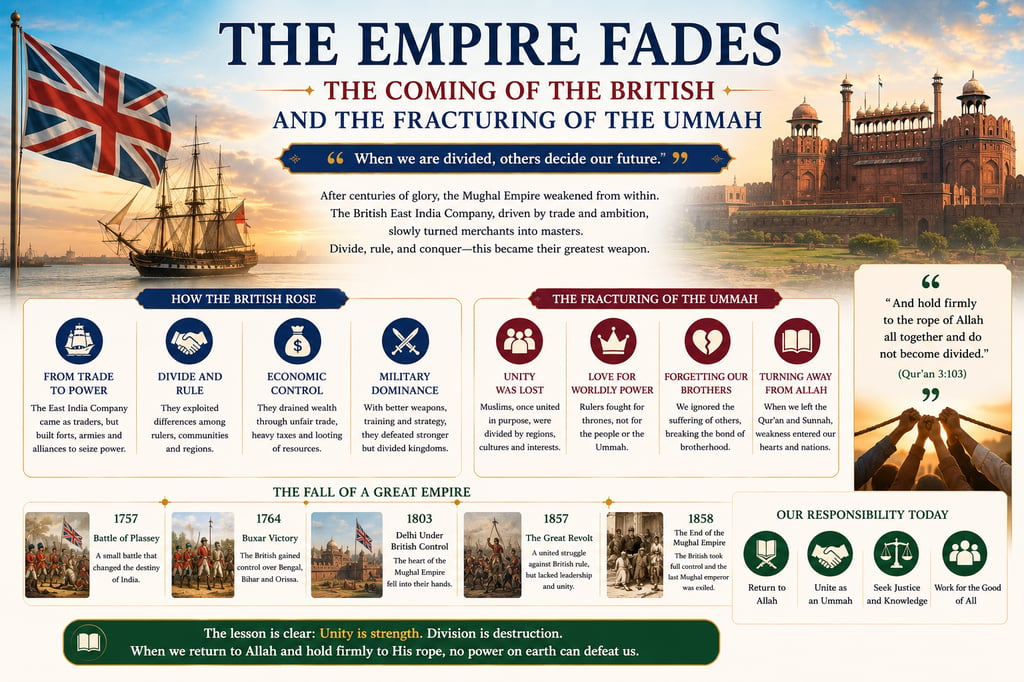
Chapter 30: The Empire Fades — The Coming of the British and the Fracturing of the Ummah!
When Aurangzeb Alamgir died in 1707, the Mughal Empire still looked powerful from the outside. Its banners still flew across vast lands. Its armies still marched through great cities. Its courts still carried memories of imperial glory. But deep inside, the empire had begun weakening.
The long wars of Aurangzeb had exhausted the treasury. Regional governors had grown ambitious. Rival princes fought for power. Trust between communities had become increasingly fragile. And across the empire, ordinary people once again carried the burden of political instability.
It was a pattern history had repeated many times before. When justice weakens… when rulers become consumed by power… when knowledge declines… when spiritual sincerity fades beneath luxury and politics… civilizations slowly begin cracking from within.
The Muslim world had experienced this before, after the Abbasids. And now India too was entering such a moment.
Meanwhile, along the coasts of India, foreign merchants continued expanding quietly. At first, they did not arrive as conquerors. They arrived as traders. Portuguese ships had already entered Indian waters centuries earlier. Then came the Dutch, the French, and finally the British East India Company.
They built trading ports. Signed agreements.Bought spices, silk, cotton, and tea. And slowly, while Indian rulers fought one another, European companies studied the weaknesses of the subcontinent carefully. They understood something important: A divided land is easier to control than a united one.
As Mughal authority weakened after Aurangzeb, regional kingdoms rose across India. The Marathas expanded rapidly. Nawabs governed semi-independent territories. Sikh power increased in Punjab. Court conspiracies weakened Delhi itself.
And the British watched patiently. Unlike earlier invaders, the British did not initially rely only on military conquest. They used trade. Finance. Diplomacy. Political manipulation. And alliances between rival Indian powers. One kingdom was used against another. One ruler betrayed another. And slowly, the East India Company transformed from a commercial enterprise into a political power.
The Battle of Plassey in 1757 became one of the great turning points in Indian history. Through betrayal, political manipulation, and military strategy, the British gained enormous control over Bengal — one of the richest regions in the world at that time.
From there, their influence expanded steadily. And while political control slipped away from old Muslim dynasties, another crisis spread quietly through the Muslim world itself:
A crisis of identity.
For centuries, Muslims had seen themselves as part of great civilizations stretching from Spain to India. Even when divided politically, there remained emotional connections through faith, scholarship, pilgrimage, trade, and shared memory.
But now the balance of power was changing globally. European empires were rising rapidly through industrialization, naval dominance, scientific advancement, and colonial expansion. Meanwhile, many Muslim regions struggled with internal corruption, political stagnation, illiteracy, and fragmentation.
And once again, ordinary people suffered most. Farmers faced crushing taxation. Local industries declined beneath colonial trade systems. Famines devastated communities. Traditional centers of knowledge weakened. And across India, tensions between religious communities increasingly became entangled with colonial politics.
The British often strengthened divisions strategically because divided populations were easier to govern.
Yet even during decline, Islam in India did not disappear into darkness. The spiritual legacy of the Sufis remained alive. Mosques still echoed with Qur’an. Madrasas continued teaching knowledge. Scholars attempted reform and revival. Ordinary believers still gathered for prayer, charity, fasting, and remembrance of Allah.
Because Islamic civilization had never survived through kings alone. It survived through people. Through mothers teaching children faith. Through scholars preserving knowledge. Through laborers stopping for prayer despite hardship. Through hearts still connected to Allah even after empires collapsed.
And perhaps this became one of the greatest lessons of Islamic history:
Political power rises and falls. Empires appear eternal and then vanish. But faith survives through ordinary human beings carrying it sincerely across generations.
As British power expanded further into India, resistance also grew. Some fought militarily. Others intellectually. Others spiritually.
Muslim scholars debated difficult questions: How should Muslims respond to colonial rule? How could education be revived? How could Islamic identity survive beneath foreign domination? And alongside Muslims, many Hindus, Sikhs, and others across India also struggled against the growing control of the colonial empire.
Then, in 1857, northern India exploded into rebellion. Soldiers mutinied. Princes revolted. Cities rose in resistance. For many Indians — Muslim and Hindu alike — it became a desperate attempt to push back against British domination. And at the symbolic center of that fading world stood the last Mughal emperor:
Bahadur Shah Zafar. Old. Poetic. Powerless. A king in name more than authority. Yet history would soon place upon his shoulders the final chapter of the Mughal age.
The empire Babur founded… Akbar expanded… and Aurangzeb struggled to preserve… was approaching its end. And with its fall, the Muslim world in India would enter into a different scenario, unlike the Muslim Kingdoms.