Chapter 31: Islam in the Modern World — Between Broken Images and the Eternal Message
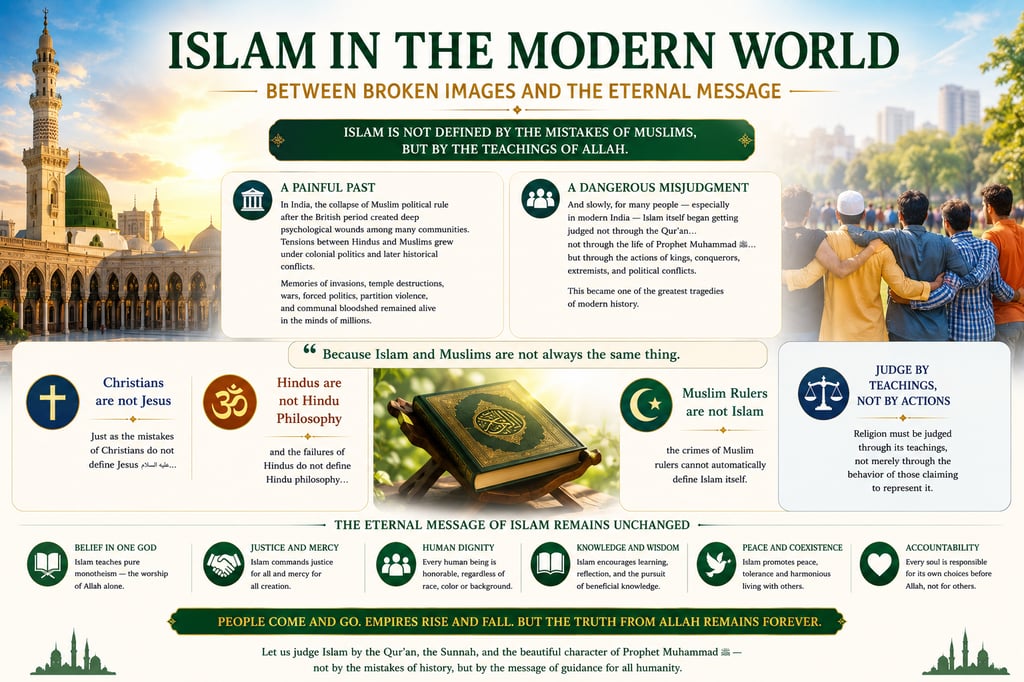
In India, the collapse of Muslim political rule after the British period created deep psychological wounds among many communities. At the same time, tensions between Hindus and Muslims increasingly grew under colonial politics and later historical conflicts. Memories of invasions, temple destructions, wars, forced politics, partition violence, and communal bloodshed remained alive in the minds of millions.
THE BRIEF HISTORY OF ISLAM!
Danish Shafiq
6/18/20264 min read
Chapter 31: Islam in the Modern World — Between Broken Images and the Eternal Message
Islam in the Modern World — Between Broken Images and the Eternal Message!
As centuries passed, the world changed faster than ever before. Empires collapsed. Borders shifted. Kings disappeared. New nations emerged. Science and technology transformed human civilization.
The British eventually took full control over much of the Indian subcontinent. The Mughal Empire faded into memory. Muslim political authority weakened across many regions of the world, while European colonial powers expanded from Africa to Asia.
And during this great transformation, the Muslim Ummah entered one of the most painful periods in its history.
Not only politically. But emotionally. Spiritually. And intellectually.
For centuries, Muslims had once led some of the world’s greatest centers of knowledge, trade, philosophy, mathematics, medicine, astronomy, and spirituality. Cities like Baghdad, Cordoba, Cairo, Samarqand, Istanbul, and Delhi had once attracted scholars from across civilizations.
But now much of the Muslim world found itself divided, colonized, impoverished, and struggling to understand its place in a rapidly changing modern world.
In India, the collapse of Muslim political rule after the British period created deep psychological wounds among many communities. At the same time, tensions between Hindus and Muslims increasingly grew under colonial politics and later historical conflicts. Memories of invasions, temple destructions, wars, forced politics, partition violence, and communal bloodshed remained alive in the minds of millions.
And slowly, for many people — especially in modern India — Islam itself began getting judged not through the Qur’an…not through the life of Prophet Muhammad ﷺ… but through the actions of kings, conquerors, extremists, and political conflicts.
This became one of the greatest tragedies of modern history. Because Islam and Muslims are not always the same thing. Just as the mistakes of Christians do not define Jesus عليه السلام… and the failures of Hindus do not define Hindu philosophy… the crimes of Muslim rulers cannot automatically define Islam itself.
Throughout this entire history, one reality remained constant: Human beings repeatedly failed to fully live according to the moral standards taught by their own religions. Muslim rulers committed injustices. Christian kings committed massacres. Hindu rulers fought brutal wars.
Empires across every civilization shed blood in the pursuit of power. History is filled with human ambition, greed, fear, ego, politics, and violence. But religion itself must be judged through its teachings… not merely through the behavior of those claiming to represent it.
And when one studies Islam sincerely from its original sources, a very different picture begins to emerge.
The foundation of Islam is simple:
There is only One Almighty God, Allah. Without a partner. Without children. Without idols. Without division.
And every human being — regardless of race, caste, language, tribe, or nationality — is equally His creation.
The Qur’an repeatedly calls human beings toward justice, mercy, honesty, patience, charity, humility, and accountability before Allah.
Islam strictly prohibited many evils that continue damaging societies even today: Murder. Rape. Theft. Bribery. Fraud. False testimony. Cheating in business. Oppression. Humiliation of the weak. Abuse of women. Exploitation of the poor. And unjust killing of innocent people.
The Qur’an declared with extraordinary clarity: “Whoever kills a soul unjustly… it is as if he has killed all humanity.”
And whoever saves one life… it is as if he has saved all humanity.
Prophet Muhammad ﷺ taught mercy not only toward human beings, but even toward animals, servants, neighbors, travelers, widows, orphans, and the poor. He warned against arrogance and hatred. He taught that the best among people are those best in character.
He never taught Muslims to spread hatred toward entire communities. He never taught mob violence. He never taught terrorism. He never taught the killing of innocent civilians. He never taught the destruction of ordinary places of worship out of hatred.
And yet today, across many parts of the world, Islam is often remembered mainly through headlines of extremism, terrorism, political violence, or the actions of those who misuse religion for power. This false image deeply wounds millions of ordinary Muslims who simply wish to live peaceful lives connected to Allah.
Mothers teaching children prayer. Laborers fasting quietly during Ramadan. Families gathering for Eid. Students memorizing Qur’an. Ordinary people trying to live honestly, help neighbors, feed the poor, and protect their families.
These people rarely appear in global headlines. But they represent the overwhelming majority of the Muslim world.
At the same time, Muslims themselves must also honestly confront internal failures. Corruption. Sectarian hatred. Political extremism. Misuse of religion. Ignorance. Blind hero worship of rulers. And emotional reactions replacing knowledge and wisdom.
Islamic history itself repeatedly showed what happens when power becomes more important than justice.
Karbala showed it. The destruction of Makkah showed it. Palace conspiracies showed it. Colonial collapse showed it.
Again and again, Muslims suffered when they moved away from the moral essence of Islam while preserving only political identity or emotional slogans. Because Islam was never meant to be merely a banner. It was meant to transform the human soul. To purify the heart. To humble the ego. To connect humanity with its Creator.
And perhaps this is the most important lesson of this entire journey through history: Islam should not be understood only through kings, empires, wars, or politics. It should first be understood through the Qur’an. Through the character of Prophet Muhammad ﷺ.
Through sincerity. Through justice. Through compassion. Through truthfulness. Through the idea that every human being will one day stand before Allah alone.
The modern world today is filled with division, hatred, loneliness, consumerism, depression, violence, and spiritual emptiness despite enormous technological progress. Human beings have conquered oceans, skies, and machines…yet many hearts still struggle to find peace.
And perhaps this is why the message of Tawheed — the Oneness of Allah — still carries such power. Because it reminds humanity that beyond race, religion, caste, wealth, politics, and nationality…
There is one Creator. One Lord. And one final return for every soul.
This book was never written to glorify Muslim rulers blindly. Nor to hide the mistakes of Islamic history. Rather, it was written so that readers — Muslim or non-Muslim — could separate Islam itself from the failures of human beings. To understand that many kings acted according to politics and ambition… while Islam itself continued calling humanity toward mercy and accountability before Allah.
And perhaps if future generations study one another with sincerity instead of hatred…history may stop becoming a weapon. And begin becoming a lesson.
For all humanity.