Chapter 32: What Remains After Empires Fall!
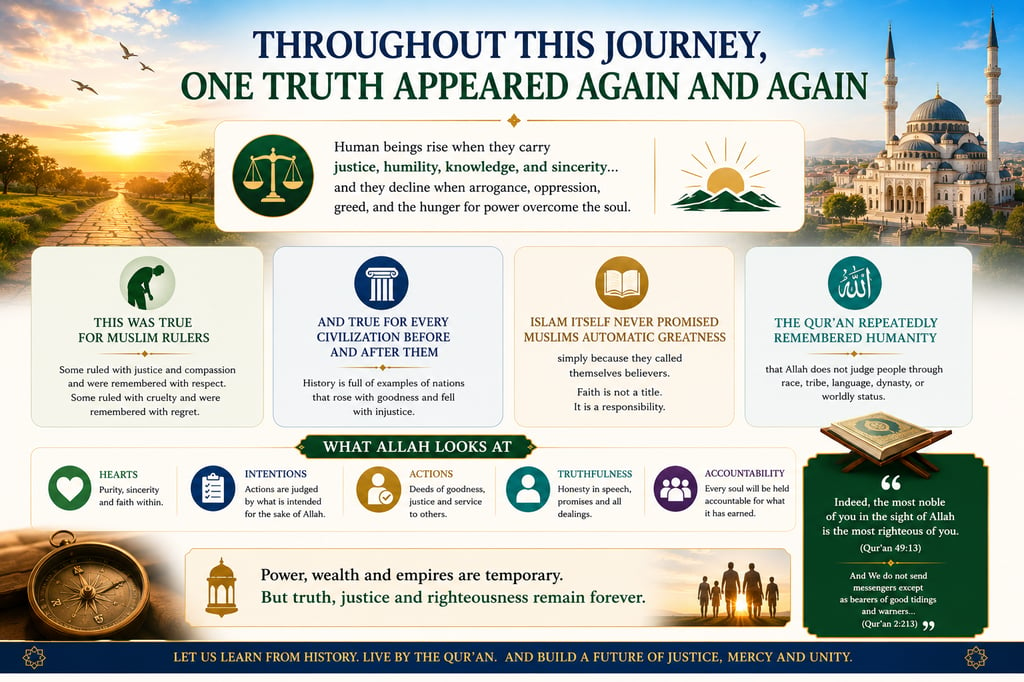
Throughout this long journey of Islamic history, one truth appeared again and again: Human beings rise when they carry justice, humility, knowledge, and sincerity… and they decline when arrogance, oppression, greed, and the hunger for power overcome the soul. The Qur’an repeatedly reminded humanity that Allah does not judge people through race, tribe, language, dynasty, or worldly status. He judges hearts. Intentions. Actions. Truthfulness.
THE BRIEF HISTORY OF ISLAM!
Danish Shafiq
6/18/20263 min read
Chapter 32: What Remains After Empires Fall!
What Remains After Empires Fall!
After all the battles…after all the kings…after all the victories and collapses…after the rise of great cities and the destruction of mighty empires…
History leaves behind one final question:
What truly remains?
The Umayyads once believed their empire would last forever. The Abbasids filled Baghdad with unimaginable brilliance. The Ottomans ruled across continents. The Mughals built monuments that touched the sky.
Yet today, many of those empires survive only in ruins, books, memories, and fading echoes of history. Their palaces became dust. Their armies disappeared. Their banners fell.
And the rulers who once commanded millions now lie silently beneath the earth, standing before Allah alone.
Because this world was never meant to last forever. Neither power. Nor wealth. Nor kingdoms. Nor fame.
Throughout this long journey of Islamic history, one truth appeared again and again: Human beings rise when they carry justice, humility, knowledge, and sincerity…and they decline when arrogance, oppression, greed, and the hunger for power overcome the soul.
This was true for Muslim rulers. And true for every civilization before and after them.
Islam itself never promised Muslims automatic greatness simply because they called themselves believers.
The Qur’an repeatedly reminded humanity that Allah does not judge people through race, tribe, language, dynasty, or worldly status. He judges hearts. Intentions. Actions. Truthfulness. Justice. Mercy. And sincerity.
Many rulers throughout history claimed to defend Islam while committing injustice. Others carried deep personal faith yet struggled beneath the brutal realities of politics and empire. Some scholars preserved knowledge during times of darkness.
Some saints healed broken hearts while kings fought wars around them. And often, the people who kept Islam alive were not emperors…but ordinary believers.
A mother teaching her child how to pray. A laborer refusing to cheat despite poverty. A traveler helping a stranger for the sake of Allah. A student studying Qur’an by candlelight. A hungry family still sharing food with neighbors during Ramadan.
These quiet acts rarely enter history books. Yet perhaps they are more beloved to Allah than the victories of kings.
Because Islam was never meant to exist only inside palaces, courts, or battlefields. It was meant to live inside human character. Inside honesty. Inside mercy. Inside humility before the Creator.
Prophet Muhammad ﷺ did not arrive in this world as an emperor surrounded by armies. He walked through the streets of Makkah insulted and rejected. He buried his children with tears in his eyes. He forgave enemies who once tortured him. He mended his own clothes. Sat beside the poor. Fed the hungry. And reminded humanity that every soul — rich or poor — would return to Allah.
That was the heart of Islam. Not pride. Not supremacy. Not hatred. But surrender to the One Creator. And mercy toward creation.
The modern world today remains deeply wounded despite all its technological progress. People speak more…yet understand each other less. The world has more wealth… yet millions still feel spiritually empty.
Communities remain divided by religion, caste, race, nationalism, politics, and fear. And often, history itself becomes a weapon used to keep hatred alive between generations.
But perhaps history was never meant to imprison humanity inside old wounds. Perhaps it was meant to humble us. To remind us how temporary power truly is. To teach us that no civilization remains pure forever. And to show us that human beings repeatedly fail when ego becomes greater than morality.
This journey through Islamic history was never written to claim Muslims were perfect. They were not. Muslim rulers committed mistakes. At times, terrible mistakes. Wars were fought. Blood was spilled. Political ambitions corrupted hearts.
And religion itself was sometimes misused by those hungry for power.
But alongside those dark chapters, there also existed light.
Knowledge. Compassion. Scholarship. Spirituality. Charity. Civilizations built upon learning.
People who sincerely worshipped Allah and served humanity quietly without recognition. And perhaps that balance is the real story of humanity itself.
Light and shadow exist together. Goodness struggles against ego. The soul constantly choose between pride and humility.
For Muslims reading this book, history should not become a source of blind pride. It should become a source of reflection. A reminder that Islam survives not through slogans or anger… but through character. Through justice. Through sincerity.
Through becoming better human beings. And for non-Muslims reading this journey, perhaps the most important thing to understand is this:
Islam cannot be understood only through kings, extremists, or political headlines. It must also be understood through the Qur’an, through the life of Prophet Muhammad ﷺ, and through the ordinary believers whose faith teaches them honesty, mercy, prayer, patience, and accountability before Allah.
Beyond all differences, every human being searches for meaning. For peace. For truth. For hope.
And one day, every empire, every nation, every ideology, and every human soul will stand before the same Creator. Alone. Without titles. Without wealth. Without armies. Without history to protect them. Only truth will remain. Only deeds will remain. Only Allah will remain.
And perhaps that is how this journey truly begins…
and ends.