
Chapter 3: Part 2 - Umar ibn al-Khattab رَضِيَ ٱللَّٰهُ عَنْهُ and Yarmouk - When Faith Defeated an Empire!
“I have been entrusted with a heavy burden,” Umar رَضِيَ ٱللَّٰهُ عَنْهُ spoke, his deep voice echoing softly through the mosque. “I seek your support when I do right, and your correction when I err.”
THE BRIEF HISTORY OF ISLAM!
Danish Shafiq
6/12/202614 min read
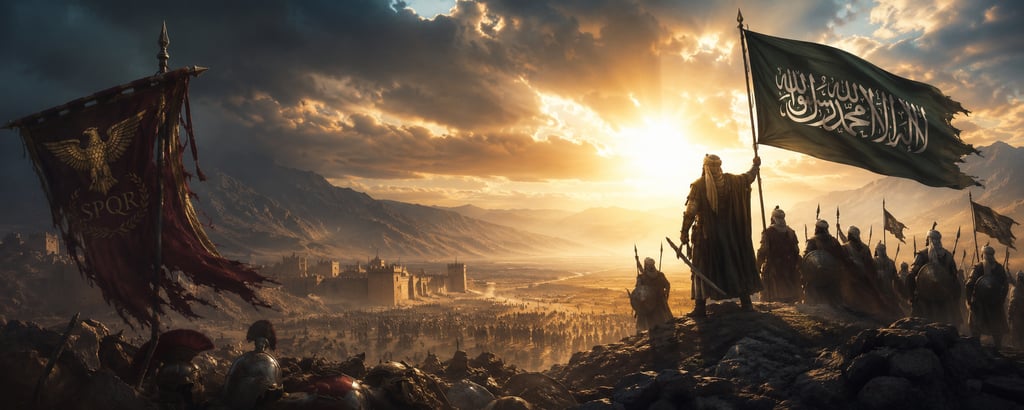
The Battle of Yarmouk and the Fall of an Empire!
Chapter 3: Part 2 - Umar ibn al-Khattab رَضِيَ ٱللَّٰهُ عَنْهُ and Yarmouk - When Faith Defeated an Empire!
Far beyond the quiet streets of Madinah, history itself was preparing for one of its greatest turning points.
To the north, the mighty Byzantine Empire had not accepted its earlier defeats. The same Empire, ruled from the magnificent city of Constantinople. Its governors administered lands stretching across Syria, Egypt, Anatolia, and beyond. Its roads connected continents, its fortresses guarded ancient frontiers, and its disciplined armies had long been regarded as among the finest on earth.
To many people of that age, Rome did not merely appear powerful. It appeared eternal.
Emperor Heraclius, one of the most accomplished rulers of his age, had watched with growing concern as city after city slipped beyond Roman control. Only a few years earlier, he had crushed the mighty Persian Empire and restored the True Cross to Jerusalem. Across Christendom, he was celebrated as the savior of the Roman world.
Yet years before these great armies gathered, another event had quietly taken place.
From the humble city of Madinah, the Messenger of Allah صلى الله عليه وسلم had sent Heraclius not an army, but a letter. It was an invitation—not to surrender to an empire, but to submit to Allah alone.
"Accept Islam, and Allah will grant you a double reward. But if you turn away, then upon you will be the sin of your subjects."
Heraclius listened carefully. He questioned Abu Sufyan—who at that time had not yet embraced Islam—about the character of Muhammad صلى الله عليه وسلم. After hearing his answers, Heraclius is reported to have recognized the signs of Prophethood and admitted that if what he had heard was true, Muhammad صلى الله عليه وسلم would one day possess the lands beneath his feet. Yet fearing the reaction of his nobles and the loss of his throne, he did not embrace Islam.
Now, years later, A new force had emerged from the deserts of Arabia—not an empire seeking tribute, nor a dynasty pursuing worldly glory, but a community united by faith in the One God and guided by the teachings of His Messenger صلى الله عليه وسلم.
To many Roman nobles, this seemed impossible to comprehend. How could tribes who had once fought among themselves now defeat armies that had ruled for centuries? How could men with little armor stand before the finest legions in the world? Heraclius resolved that the answer would come upon the battlefield.
Messengers rode across the provinces of the empire. Orders were dispatched to Syria, Anatolia, Armenia, and the Christian Arab federations. Veteran commanders assembled their forces. Heavy cavalry prepared their armor. Priests blessed the soldiers before they marched.
Thousands upon thousands gathered beneath the imperial banners. This would not be another frontier skirmish or a dispute over distant provinces. For the Byzantine Empire, it had become a struggle to preserve its eastern dominions and halt the advance of a new civilization.
One of the largest Byzantine armies assembled during the early Islamic conquests now marched toward Syria. The Muslim army likely numbered around twenty to forty thousand men, while the Byzantine host may have been two or three times larger. The Romans possessed heavier armor, greater resources, established military institutions, and centuries of imperial warfare behind them. By every conventional measure of the ancient world, the balance favored Byzantium.
The ancient world believed the outcome was already decided. Yet hundreds of miles away...
Madinah remained remarkably quiet. There were no marble palaces. No royal court. No emperor issuing commands from a golden throne. Instead, the leader of this rapidly growing nation walked its dusty streets clothed in garments patched by his own hand.
When Umar رضي الله عنه entered the mosque, he entered not as a king, but as a servant of Allah سُبْحَانَهُ وَتَعَالَىٰ. Every morning began where all true leadership begins—with prayer. Every decision began with remembrance of Allah سُبْحَانَهُ وَتَعَالَىٰ. Every victory was sought not through pride, but through reliance upon the Lord of the Worlds.
Those who looked only with worldly eyes saw merely a city of mud-brick homes standing against two civilizations.
Such was the foundation upon which the Muslim state now stood, and no one carried its weight more heavily than Umar ibn al-Khattab رضي الله عنه. The burden resting upon him was unlike anything Arabia had ever witnessed.
Thousands of soldiers now stood upon distant frontiers. Entire provinces depended upon his judgment. Governors awaited his instructions. Commanders sought his counsel. Widows, orphans, merchants, travelers, judges, and ordinary citizens all looked toward Madinah for justice.
Many imagine that history is written only where swords clash. Yet Umar understood a deeper truth. An army can fight only if a nation stands behind it. Every horse required provisions. Every soldier left behind a family. Every commander needed guidance. Every province required justice. If corruption entered Madinah... victory at the frontier would eventually lose its blessing. If injustice spread among the believers... no battlefield success could preserve the Ummah for long.
For Umar رضي الله عنه, governing was itself an act of worship.
Meanwhile, upon the frontiers of Syria, another remarkable servant of Allah سُبْحَانَهُ وَتَعَالَىٰ prepared for the greatest test of his life. His name had already begun to echo across Arabia.
He was Khalid ibn al-Walid رضي الله عنه. The Messenger of Allah صلى الله عليه وسلم had called him Saifullah — "The Sword of Allah". Yet Khalid never regarded himself as the source of victory. He knew better than anyone that swords do not grant triumph.
Allah does.
The man who once rode against Islam at Uhud now stood willing to sacrifice everything for its protection. Such is the power of sincere repentance. Allah سُبْحَانَهُ وَتَعَالَىٰ does not merely forgive a heart that returns to Him.
Sometimes... He raises that very heart to change history.
Khalid رضي الله عنه was unlike most commanders. He did not merely fight battles. He understood movement. He understood surprise. He understood the hearts of soldiers. His speed bewildered enemies. His strategy confused experienced generals. His calmness inspired exhausted men. Even before swords were drawn, he often won half the battle by forcing his opponents to react to him rather than allowing himself to react to them.
It is said that news of Khalid's approach alone caused unease within enemy camps. Not because Muslims believed him invincible... but because his opponents had learned never to underestimate a man whose greatest confidence rested not in his own brilliance, but in Allah - The One God, Lords of the Worlds.
Standing beside him were men whose names would illuminate Islamic history forever.
Abu Ubaydah ibn al-Jarrah رضي الله عنه — the trustworthy one of this Ummah, Amr ibn al-As رضي الله عنه — whose political wisdom would later open Egypt. Yazid ibn Abi Sufyan, Shurahbil ibn Hasanah رضي الله عنه. Each commanded his own army. Each possessed unique strengths. Each sought neither fame nor wealth. Each hoped only that Allah سُبْحَانَهُ وَتَعَالَىٰ would accept their efforts.
Together, they represented something the world had rarely witnessed. Different tribes. Different families. Different temperaments. United by one Book. One Prophet صلى الله عليه وسلم. One Lord.
Before them stretched the valley of Yarmouk. Steep ravines guarded its edges. Strong winds swept across the plains. Dust rose beneath marching feet. Somewhere beyond the horizon...the Roman banners were already approaching.
Soon...
The ancient world would witness a battle that neither Rome nor Arabia would ever forget.
The Valley That Changed the World!
As the armies drew closer, the dry plains of southern Syria became heavy with anticipation. Before them lay the valley of Yarmouk — a vast expanse of rugged land bordered by steep ravines and deep gorges. On one side stood the Byzantine Empire.
For centuries, Rome had been regarded as one of the world's greatest powers. Their soldiers were veterans of countless wars, protected by heavy armor, trained in organized formations, and supplied with resources that the Muslims could scarcely imagine.
Across the battlefield stood the Muslims. Many had been shepherds only a few years earlier. Many possessed little more than a sword, a shield, and unwavering faith. They owned no magnificent palaces. They marched beneath no imperial banners. Their greatest treasure was not gold... It was the certainty that Allah سُبْحَانَهُ وَتَعَالَى never abandons those who place their trust in Him.
To the eyes of the world, the battle appeared hopeless. To the eyes of the believers... nothing is impossible for Allah سُبْحَانَهُ وَتَعَالَى.
Far away in Madinah, Umar ibn al-Khattab رضي الله عنه remained in constant remembrance of Allah سُبْحَانَهُ وَتَعَالَى. Every report arriving from Syria reminded him that thousands of believers had entrusted their lives to decisions made in the capital of the Islamic state.
He knew every commander by name. He knew every province that required reinforcement. He knew every family waiting anxiously for news. His responsibility extended far beyond strategy. He carried the burden of an entire Ummah. Leadership, he understood, was not measured by authority. It was measured by accountability before Allah سُبْحَانَهُ وَتَعَالَى.
Meanwhile, Khalid ibn al-Walid رضي الله عنه walked quietly among the Muslim camps. He observed the soldiers. Some sharpened their swords. Others repaired worn sandals. Many sat reciting verses from the Qur'an beneath the stars. Some embraced one another, believing it might be their final meeting in this world. There was no panic. There was no despair. Only hearts that had surrendered themselves to Allah سُبْحَانَهُ وَتَعَالَى long before the battle had begun.
Khalid رضي الله عنه looked across the valley. The Roman banners stretched almost beyond sight. Rows upon rows of armored soldiers filled the plain. The earth itself seemed to tremble beneath their movement.
One young Muslim soldier, seeing the sheer size of the opposing army, lowered his gaze. "Commander..." he whispered, "Look at their numbers." Khalid رضي الله عنه placed a reassuring hand upon his shoulder. "My brother..." he replied gently, "Victory has never descended from the number of men. Victory descends from Allah سُبْحَانَهُ وَتَعَالَى. If our hearts remain sincere... then no army on earth can overcome what Allah سُبْحَانَهُ وَتَعَالَى has willed."
Those words spread quietly through the camp. Fear slowly transformed into tranquility. The following morning, the battlefield awakened. Trumpets echoed through the Roman ranks. Their generals rode proudly before thousands of disciplined soldiers. To them, this would be another victory. Another rebellion crushed. Another frontier secured.
Yet they did not understand the people standing before them. The Muslims were not defending a king. They were not fighting to preserve an empire. Many of them had left behind homes, families, and wealth years earlier for one reason alone:
That mankind should know Allah سُبْحَانَهُ وَتَعَالَى alone.
It was this conviction that no army could measure. Before the first swords were drawn, the Muslim commanders gathered. Abu Ubaydah ibn al-Jarrah رضي الله عنه stood calmly beside Khalid. Amr ibn al-As رضي الله عنه studied the Roman positions carefully. Shurahbil ibn Hasanah رضي الله عنه and Yazid ibn Abi Sufyan prepared their men. All of them shared the same hope that Allah سُبْحَانَهُ وَتَعَالَى would accept their efforts.
Their unity itself became one of their greatest strengths. It was a unity born not of tribe... but of faith.
As dawn broke fully across Yarmouk, Khalid رضي الله عنه mounted his horse and looked toward the horizon. Then he addressed the army. "My brothers... Today, the world watches only armies. Allah سُبْحَانَهُ وَتَعَالَى watches hearts. Remain truthful to Him. Protect one another. Stand firm. Whether we return to Madinah... or return to our Lord... we lose nothing if Allah سُبْحَانَهُ وَتَعَالَى is pleased with us."
A silence settled across the ranks. Not the silence of fear. The silence of certainty. Thousands of hearts repeated quietly, Hasbunallahu wa ni'mal wakeel. (حَسْبُنَا اللَّهُ وَنِعْمَ الْوَكِيلُ)Allah is sufficient for us, and He is the Best Disposer of affairs.
Then... the first arrows darkened the Syrian sky. The Battle of Yarmouk had begun.
Six Days That Changed the World!
The first arrows flew silently through the morning sky. Moments later... thousands more followed. The stillness that had covered the Valley of Yarmouk disappeared beneath the thunder of war. The Roman horns echoed across the valley. Heavy infantry advanced in disciplined ranks. Their shields locked together. Their armor glittered beneath the Syrian sun.
Behind them stood mounted cavalry, archers, and elite guards who had spent years mastering the art of warfare. To many observers, it appeared impossible that the Muslims could withstand such overwhelming force.
Yet Khalid ibn al-Walid رضي الله عنه knew something his opponents did not. A united heart often proves stronger than a united army. The battle stretched far beyond a single day.
For nearly a week, both armies had been testing one another. At times, the Romans gained ground; at other moments, the Muslims pushed them back. The valley became filled with dust so thick that men could scarcely recognize their own companions, the cries of horses mixed with the clash of steel.
The wounded called upon Allah سُبْحَانَهُ وَتَعَالَى. Many of the Companions knew this might be the final sunrise they would ever witness upon this earth. Some embraced one another. Others stood quietly in prayer. From every direction, the words rose together across the valley.
(أَشْهَدُ أَنْ لَا إِلَٰهَ إِلَّا ٱللَّٰهُ وَأَشْهَدُ أَنَّ مُحَمَّدًا رَسُولُ ٱللَّٰهِ)
Ashhadu an la ilaha illa Allah... wa ashhadu anna Muhammadan Rasul Allah.
There were no cries for worldly glory. No songs of empire. No promises of wealth. Only hearts renewing the testimony that had transformed their lives years earlier in the streets of Makkah and Madinah. For many among them, victory and martyrdom were no longer opposites. Either path led them toward Allah.
That is Yarmouk. Not tactics, Only Faith.
The Roman commanders relied upon numbers. Khalid relied upon movement. Whenever the Romans believed they had trapped the Muslims... their formations suddenly shifted. Whenever they attempted to surround one wing... Muslim cavalry appeared where they were least expected. Khalid رضي الله عنه constantly rode from one position to another.
He encouraged the weary. Strengthened the hesitant. Reorganized the lines. Every movement reflected careful thought rather than reckless courage. He understood that bravery without discipline could destroy an army. Faith required wisdom.
Among the Muslim ranks stood men who had once walked beside the Messenger of Allah صلى الله عليه وسلم. Some remembered Badr. Others remembered Uhud. Some still carried scars received while defending the Prophet صلى الله عليه وسلم himself. Now they stood together once more. Not to establish their own greatness... but to preserve the message entrusted to them.
Ikrimah رضي الله عنه — From the Enemy of Islam to a Martyr at Yarmouk!
Among the many stories preserved from Yarmouk, few reveal the transformation of the early Muslim generation more powerfully than the story of Ikrimah ibn Abu Jahl رضي الله عنه.
There was a time when Ikrimah had stood on the opposite side of the battlefield. He was the son of Abu Jahl, one of the fiercest opponents of the Messenger of Allah صلى الله عليه وسلم. At Badr, his father Abu Jahl had fallen fighting against the Muslims. Ikrimah himself continued for years on the path of opposition to Islam.
But Allah سُبْحَانَهُ وَتَعَالَىٰ can transform a human heart in ways that no human could predict.
Ikrimah eventually accepted Islam. The man who had once fought against the Messenger of Allah صلى الله عليه وسلم now became one of those willing to sacrifice everything in defence of the faith he had once opposed.
And at Yarmouk, that transformation reached its most extraordinary moment.
As the fighting intensified and sections of the Muslim army came under immense pressure, historical reports describe Ikrimah رضي الله عنه refusing to retreat. He called upon a group of his men to stand with him in a desperate counterattack. In the famous account, around four hundred men responded and pledged themselves to remain firm even at the cost of their lives.
They advanced against the Byzantine forces at a moment when the Muslim ranks were under severe pressure.
Their attack bought precious time for the wider Muslim army to reorganize and regain its position. The cost, however, was immense. Ikrimah رضي الله عنه and many of the men who stood with him were struck down or severely wounded.
Al-Tabari preserves the poignant account of Ikrimah رضي الله عنه being brought wounded to Khalid ibn al-Walid رضي الله عنه. Khalid placed his head upon his lap and cared for him as his life was fading.
The image is difficult to forget. The man who had once been an enemy of Islam now lay wounded in the arms of one of Islam's greatest commanders, having spent his final strength defending the very faith he had once opposed.
This was not simply a story of military courage. It was a story of transformation.
Ikrimah رضي الله عنه's greatest legacy was not that he had once been powerful among Quraysh. Nor was it merely that he died upon a battlefield. It was that the same man whose sword had once been raised against Islam eventually became a man whose life was offered in its defence.
The story of Ikrimah رضي الله عنه therefore reminds us that a person's beginning does not always determine his ending. Some people begin their journey far from Allah... and yet return to Him with such sincerity that their final chapters become among the most remarkable pages of their lives.
Yarmouk was filled with such men. And Ikrimah رضي الله عنه was one of them.
Many quietly repeated the words of Allah سُبْحَانَهُ وَتَعَالَى:
"How many a small company has overcome a large company by permission of Allah. And Allah is with the steadfast." Surah Al-Baqarah (Chapter 2), Verse 249
As the days passed, exhaustion settled over both armies. The Roman soldiers possessed superior equipment. But many had been gathered from distant provinces. They spoke different languages. Served different commanders. Fought for an emperor they had never met.
The Muslim army possessed far fewer resources. Yet they shared something difficult to measure. Every man knew why he stood there. Every man prayed beside the other. Every man believed that whether he returned home or met his Lord, he remained successful if Allah سُبْحَانَهُ وَتَعَالَى accepted him. That certainty cannot be forged by military training. It can only be born through faith.
Far away... in Madinah... another battle continued. Not one fought with swords. But with responsibility. Every morning, Umar ibn al-Khattab رضي الله عنه gathered reports arriving from every frontier. He met governors. Listened to judges. Distributed provisions. Resolved disputes. Strengthened the treasury. Cared for widows. Visited the poor.
He continued governing exactly as he always had. With humility. With accountability. And with constant fear of standing before Allah سُبْحَانَهُ وَتَعَالَى. One evening, after the congregational prayer, Umar رضي الله عنه remained seated inside the Prophet's (صلى الله عليه وسلم) Mosque. The companions noticed his silence. He raised his hands toward the heavens. No magnificent speech. No political declaration. Only a servant speaking to His Lord.
"O Allah... You know the weakness of Your servants. Grant them firmness. Strengthen their hearts. Do not allow us to rely upon ourselves even for the blink of an eye."
Perhaps no one upon the battlefield heard that supplication. But Allah سُبْحَانَهُ وَتَعَالَى heard it. And that was enough. By the sixth day, both armies understood that the battle could not continue indefinitely. One side would prevail. The other would disappear from Syria forever.
Khalid رضي الله عنه studied the Roman formations once more. He noticed hesitation spreading through sections of their lines. Weeks of fighting had begun to wear down even the greatest army in the world. The moment had arrived. Gathering his commanders together, he quietly explained his plan. There would be no panic. No reckless charge. Every division would move with discipline. Every commander understood his responsibility. Every cavalry unit knew exactly when to strike.
Then Khalid رضي الله عنه looked toward the heavens. Victory, he knew, would never come from strategy alone. As dawn illuminated the valley for the final time, the Muslims advanced. Not with arrogance. Not seeking glory. But with hearts that had already surrendered themselves to Allah سُبْحَانَهُ وَتَعَالَى before stepping onto the battlefield.
The Roman lines began to bend. Then fracture. Confusion spread among their ranks. Orders no longer reach every division. What had appeared only days earlier to be an invincible army slowly lost its cohesion. The disciplined formations that had terrified nations for centuries began to break apart. Some attempted to regroup. Others retreated. Soon, the retreat became disorder, and disorder became panic.
The valley that had witnessed the rise of countless armies now witnessed the fall of one of history's greatest military powers. The Battle of Yarmouk had ended. Silence slowly returned. Dust settled upon broken shields. The cries of battle gave way to quiet remembrance. Many companions looked across the battlefield with tears in their eyes. They had lost brothers. Friends. Teachers. Yet they also understood that Allah سُبْحَانَهُ وَتَعَالَى had fulfilled His promise.
The victory belonged not to Khalid رضي الله عنه. Nor to any commander. It belonged to Allah سبحانه وتعالى alone.
The victory at Yarmouk did not happen in six days. It had been prepared over twenty-three years—through revelation, sacrifice, purification of hearts, and the patient leadership of the Messenger of Allah صلى الله عليه وسلم.
Every heart bowed in gratitude. Every tongue glorified its Lord. No celebrations of arrogance echoed across the valley.
Only prayers.
A Victory That Shook the Ancient World
News of Yarmouk spread across the Middle East with astonishing speed. Cities that had once considered the Muslims a temporary desert uprising now understood that something unprecedented had occurred. The Byzantine Empire had not merely lost a battle. It had lost its grip over much of Syria.
As reports of Yarmouk reached Emperor Heraclius, the aging ruler understood the magnitude of what had happened. This was not merely the loss of another battle. It was the loss of Syria itself—the jewel of the Byzantine Empire and one of its oldest provinces.
Gathering what remained of his court and army, Heraclius withdrew northward toward Constantinople. Looking back upon the land he had ruled for so many years, he bid Syria farewell with deep sorrow, saying words to the effect:
"Farewell, O Syria... a beautiful land, now lost."
Whether every word has reached us exactly as spoken or not, history leaves little doubt about the reality behind them. Heraclius knew that an era had come to an end. The empire that had once believed the deserts of Arabia could never threaten Rome had now witnessed the impossible.
Yet the Muslims understood something even greater. They had not defeated Rome because they considered themselves superior. They had defeated fear. They had defeated despair. They had defeated the belief that worldly power alone determines history.
Yarmouk became a living testimony that when a people unite upon faith, justice, discipline, and complete trust in Allah سُبْحَانَهُ وَتَعَالَى, even the mightiest empires can be humbled before His decree.
The Muslims did not view Yarmouk as the end. It was only the beginning. Beyond the mountains stood Damascus. Beyond Damascus stood Jerusalem. Beyond Jerusalem lay Egypt.
To the east, another mighty empire still watched carefully. Persia remained unconquered. History had begun to change...
But it had not yet finished changing.
End of Chapter 3: Part-2
Chapter 4: Part 3 - Umar رَضِيَ ٱللَّٰهُ عَنْهُ and The Fall of Persia — When an Ancient Empire Trembled Before Faith!