
Chapter 3: Part 2 - Umar ibn al-Khattab رَضِيَ ٱللَّٰهُ عَنْهُ — When History Changed!
“I have been entrusted with a heavy burden,” Umar رَضِيَ ٱللَّٰهُ عَنْهُ spoke, his deep voice echoing softly through the mosque. “I seek your support when I do right, and your correction when I err.”
THE BRIEF HISTORY OF ISLAM!
Danish Shafiq
6/12/20269 min read
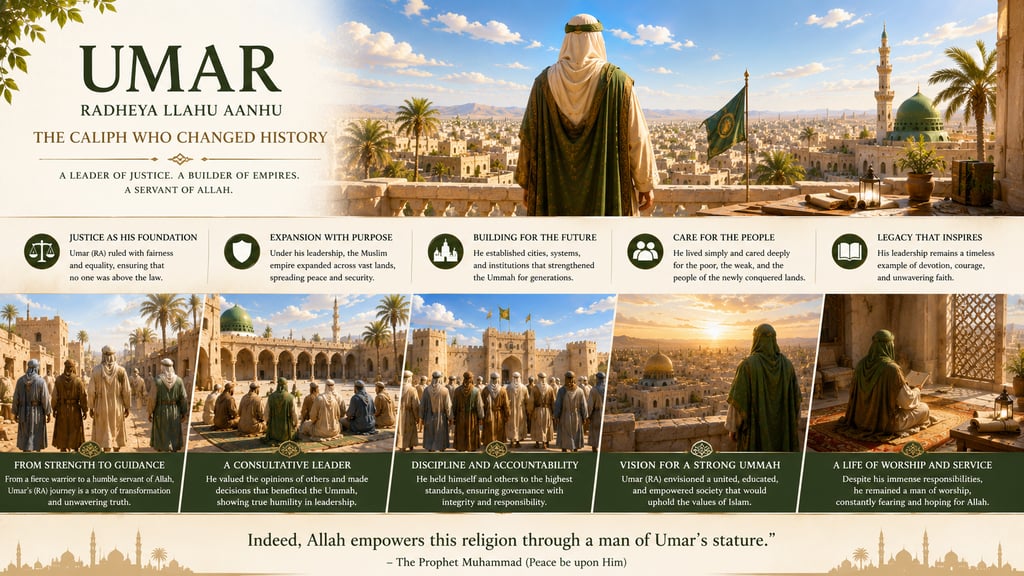
The streets of Madinah had fallen silent once again.
Barely two years had passed since the Muslims had buried the Messenger of Allah ﷺ. The wounds of that loss had never truly healed, and now another beloved Companion had returned to his Lord.
Abu Bakr al-Siddiq رضي الله عنه was gone.
The man who had preserved the Ummah through its darkest storm had completed his trust. He had reunited Arabia when many believed it would fracture forever. He had safeguarded the Qur'an after the tragedy of Yamamah. He had crushed rebellion without allowing hatred to overcome justice. He had sent the armies of Islam beyond Arabia, planting seeds whose fruits he himself would never live to witness.
Now that trust rested upon the shoulders of another. There was no celebration in Madinah. No sense of triumph. Only the quiet awareness that the burden had become even heavier. The Muslim community stood at a crossroads unlike any it had faced before.
To the north, the Byzantine Empire remained the greatest military power of the western world. Though early victories had encouraged the Muslims, Syria was far from secure, and the decisive battles still lay ahead. To the east, the mighty Sasanian Persian Empire had suffered painful defeats along its frontier, yet its heart remained intact. Vast armies still waited beyond the deserts, determined to reclaim what they had lost.
Within Arabia itself, unity had only recently been restored after the Ridda Wars. The scars of rebellion were still fresh, and the young Muslim state had not yet become the stable civilization history would later remember.
The future remained uncertain. One mistake... One moment of weakness... One failure of leadership... could undo everything that Abu Bakr رضي الله عنه and the Messenger of Allah ﷺ had sacrificed to build.
Among the Companions, however, there was one man whom Abu Bakr رضي الله عنه believed possessed the strength, justice, and unwavering fear of Allah necessary for the days ahead.
That man was Umar ibn al-Khattab رضي الله عنه.
As Umar ibn Al-Khattab رَضِيَ ٱللَّٰهُ عَنْهُ stood in the Prophet’s صَلَّى ٱللَّٰهُ عَلَيْهِ وَسَلَّمَ mosque, sunlight filtered through palm branches overhead, casting patterns on his rugged face. The city of Medina waited silently, eyes fixed on him. It was a moment of great responsibility—the mantle of leadership had passed to him from his close friend, Abu Bakr رَضِيَ ٱللَّٰهُ عَنْهُ. Umar's رَضِيَ ٱللَّٰهُ عَنْهُ eyes were filled with humility and determination.
“I have been entrusted with a heavy burden,” Umar رَضِيَ ٱللَّٰهُ عَنْهُ spoke, his deep voice echoing softly through the mosque. “I seek your support when I do right, and your correction when I err.”
Umar ibn al-Khattab رَضِيَ ٱللَّٰهُ عَنْهُ
A man of immense strength, known for his toughness and fairness, tall and strong, with sharp features and intense eyes, unwavering determination, and an unbreakable will. In the early days of Islam, when the believers were few and vulnerable, Umar رَضِيَ ٱللَّٰهُ عَنْهُ stood among its fiercest opponents. He believed he was defending the traditions of his forefathers and preserving the honor of Quraysh. So resolute was he that he once set out with his sword drawn, intending to end the life of Prophet Muhammad ﷺ.
But Allah سُبْحَانَهُ وَتَعَالَى had written a different destiny for him.
A few verses of the Qur'an penetrated a heart that no sword could conquer. The man who had left his home to silence Islam returned having surrendered completely to the Lord of the Worlds. His acceptance of Islam was more than the conversion of a single individual—it marked a turning point for the young Muslim community. The believers who had once worshipped in secrecy now found the courage to proclaim their faith openly. The Prophet ﷺ himself rejoiced at Umar's embrace of Islam, and from that day onward, he became one of the strongest pillars supporting the Ummah.
For the remainder of the Prophet's ﷺ life, Umar رَضِيَ ٱللَّٰهُ عَنْهُ stood shoulder to shoulder with him through every hardship and every triumph. He witnessed the migration to Madinah, fought in the great battles that shaped the destiny of Islam, offered sincere counsel when sought, and devoted every ounce of his strength to the service of Allah سُبْحَانَهُ وَتَعَالَى and His Messenger ﷺ. His love for the Prophet ﷺ was so profound that, at the news of his passing, he could not bring himself to believe that the Messenger of Allah ﷺ had left this world.
The fearless warrior had become a humble servant of Allah. The Companion who once carried a sword against Islam would now carry the burden of an entire civilization.
As Umar ibn al-Khattab رَضِيَ ٱللَّٰهُ عَنْهُ accepted the Khilafat, the responsibility before him was unlike anything the Muslim world had ever known.
The Messenger of Allah ﷺ had built the foundation. Abu Bakr رَضِيَ ٱللَّٰهُ عَنْهُ had preserved it through the first great storm. Now it was Umar's رَضِيَ ٱللَّٰهُ عَنْهُ duty to protect it, strengthen it, and prepare it for a future that remained uncertain.
The challenges surrounding the young Muslim state were immense.
To the north, the mighty Byzantine Empire still commanded vast armies across Syria. Although the Muslims had won encouraging victories during Abu Bakr's رَضِيَ ٱللَّٰهُ عَنْهُ caliphate, the war was far from over. Cities remained unconquered, Roman legions continued to gather, and one decisive confrontation still loomed over the horizon.
To the east, the Sasanian Persian Empire, though shaken by Khalid ibn al-Walid's رَضِيَ ٱللَّٰهُ عَنْهُ brilliant campaigns in Iraq, remained one of the greatest superpowers on earth. Its emperors still believed that the desert Arabs could eventually be crushed and driven back into Arabia.
Within the Peninsula, the wounds of the Ridda Wars had only recently begun to heal. Tribes that had returned to Islam needed stability, justice, and wise leadership. The treasury was modest, the administration was still developing, and every decision carried consequences for generations yet unborn.
Umar رَضِيَ ٱللَّٰهُ عَنْهُ understood that this was no ordinary kingdom.
It was an Amanah—a trust from Allah سُبْحَانَهُ وَتَعَالَى.
Before thinking about new conquests, he strengthened what already existed. He consulted the senior Companions, carefully reviewed the condition of the armies stationed in Syria and Iraq, ensured supplies continued to reach the frontiers, and confirmed the appointments of the commanders who had been entrusted by Abu Bakr رَضِيَ ٱللَّٰهُ عَنْهُ. He knew that continuity, discipline, and consultation were essential if the sacrifices of the previous years were not to be lost.
The Just Ruler!
Umar رَضِيَ ٱللَّٰهُ عَنْهُ lived simply, wearing patched clothes and eating bread dipped in olive oil. He often walked the streets of Medina at night, unnoticed, quietly ensuring that everyone was safe and provided for.
One cool night, Umar رَضِيَ ٱللَّٰهُ عَنْهُ walked alone through the narrow streets of Medina. He heard the cries of hungry children from a humble home nearby. Curious and concerned, he knocked gently.
"What troubles you, sister?" he asked the mother gently.
“Caliph Umar رَضِيَ ٱللَّٰهُ عَنْهُ has forgotten us!” she complained bitterly, not recognizing him. “My children have not eaten for days!” Without revealing his identity, Umar رَضِيَ ٱللَّٰهُ عَنْهُ rushed back, carrying grain and oil on his own shoulders. He cooked food himself, refusing help from his assistant. When the children finally ate, their mother wept in gratitude, unaware that the humble stranger cooking for them was the great Caliph himself. Umar رَضِيَ ٱللَّٰهُ عَنْهُ quietly whispered to himself, "How can I face Allah if I neglect the hungry in my own city?"
It was often said that if a mule were to stumble on the banks of the Euphrates because the road had not been properly maintained, Umar رَضِيَ ٱللَّهُ عَنْهُ feared that Allah would ask him why he had neglected it.
Such was the weight with which he viewed leadership.
Expeditions Under Umar رَضِيَ ٱللَّٰهُ عَنْهُ
Yet while Madinah remained peaceful, the horizons beyond Arabia were anything but calm.
Messengers arrived one after another from Syria and Iraq. Reports spoke of Byzantine armies regrouping in the north and Persian commanders preparing fresh campaigns in the east. The victories achieved under Abu Bakr رَضِيَ ٱللَّٰهُ عَنْهُ had shaken the great empires, but they had not broken them. Both powers still possessed enormous armies, experienced generals, and resources beyond anything the Muslims could match.
Many expected the young Muslim state to slow its advance.
Others believed the Romans and Persians would soon recover and erase every Muslim gain made during Abu Bakr's caliphate.
But Umar رَضِيَ ٱللَّهُ عَنْهُ saw the moment differently.
He understood that hesitation would only invite greater danger. The armies already standing on the frontiers could not simply abandon their positions after so many sacrifices. Nor could the Ummah afford to lose the momentum that Allah had granted through the efforts of the Messenger ﷺ and Abu Bakr رَضِيَ ٱللَّٰهُ عَنْهُ.
After consulting the senior Companions, Umar رَضِيَ ٱللَّهُ عَنْهُ resolved to continue the campaigns already underway. He reinforced the armies in Syria and Iraq, maintained the commanders appointed by Abu Bakr رَضِيَ ٱللَّهُ عَنْهُ, and placed his complete trust in Allah.
Soon, the world would witness one of the most extraordinary chapters in military and human history.
On the plains of Yarmouk...
Along the banks of the Euphrates...
Across the deserts of Syria...
And before the mighty walls of Jerusalem...
History itself was about to change.
The Gathering Storm!
Far beyond the peaceful streets of Madinah, the winds of history were beginning to change.
The victories achieved during Abu Bakr's رَضِيَ ٱللَّٰهُ عَنْهُ caliphate had astonished the world. For centuries, the Byzantine and Sasanian Empires had dominated the Near East. Their emperors ruled over millions. Their armies marched beneath banners that had conquered nations long before Islam had appeared in Arabia.
Yet now, a people whom they had once dismissed as scattered desert tribes stood at their frontiers.
To Emperor Heraclius of Byzantium, the Muslim victories in Syria were no longer isolated raids. They had become an existential threat to the empire itself. Determined to reclaim the lands already lost, he began assembling one of the largest military forces the Byzantine Empire had fielded in generations.
From across the empire, they came. Seasoned Roman veterans... Armenian contingents... Christian Arab allies... Imperial cavalry... Veteran commanders who had spent their lives on the battlefield.
The Byzantine war machine was moving once again. Its objective was clear. Destroy and annihilate the Muslim armies. Recover Syria. Push the Muslims back into the deserts from which they had emerged.
News of this enormous mobilization soon reached Madinah. The reports were sobering. The Muslim commanders stationed in Syria understood the gravity of the situation. Their forces were spread across several cities and smaller garrisons. If they remained divided, the Byzantine army could overwhelm them one by one.
Messages were quickly exchanged between the commanders. Abu Ubaydah ibn al-Jarrah رَضِيَ ٱللَّٰهُ عَنْهُ. Amr ibn al-As رَضِيَ ٱللَّهُ عَنْهُ. Yazid ibn Abi Sufyan رَضِيَ ٱللَّٰهُ عَنْهُ. Shurahbil ibn Hasanah رَضِيَ ٱللَّٰهُ عَنْهُ. Together, after consultation, they agreed upon a difficult but wise decision. Rather than defending every city separately, the Muslim armies would withdraw from their scattered positions and unite at a single battlefield where they could stand together as one force.
When Umar رَضِيَ ٱللَّٰهُ عَنْهُ learned of their decision, he approved it without hesitation. He understood a principle that great leaders throughout history have recognized: Unity is often stronger than territory. Cities can be regained. But a shattered army cannot easily be rebuilt.
The Muslim forces therefore gathered in the valley of Yarmouk, near the deep ravines carved by the Yarmouk River. It was a place unlike any battlefield they had fought upon before. Steep cliffs surrounded much of the plain. Narrow crossings limited movement. Behind them stretched rocky terrain. Before them stood one of the greatest armies on earth.
Many among the Muslims looked across the horizon in silence. The Roman banners seemed endless. Rows upon rows of armored infantry glistened beneath the Syrian sun. Heavy cavalry stood waiting. War drums echoed across the valley.
By every worldly measure... the Muslims should have been defeated. Yet history has often shown that numbers alone do not determine the outcome of nations.
For the Muslims carried something no empire could manufacture. Faith. Discipline. Brotherhood.
And an unshakable certainty that victory belongs only to Allah سُبْحَانَهُ وَتَعَالَى.
Among them rode a commander whose very name had begun to spread fear across enemy camps.
Khalid ibn al-Walid رَضِيَ ٱللَّٰهُ عَنْهُ. The Sword of Allah.
The decisive moment had arrived. The fate of Syria... perhaps even the future of the entire Islamic world... would soon be decided upon the plains of Yarmouk.
The Calm Before the Storm!
|| "History often remembers the general who wins the battle, but forgets the statesman who made the victory possible."
While armies gathered upon distant frontiers, Umar ibn al-Khattab رَضِيَ ٱللَّٰهُ عَنْهُ remained in Madinah. To some, history remembers only the commanders who stood upon the battlefield. It remembers the swords that were drawn... the cities that were opened... and the victories that reshaped nations.
Yet every army that marched from Madinah carried something unseen behind it. A leader. A government. A treasury. A system of justice. A united Ummah.
None of these victories emerged from the brilliance of a single general alone.
Every reinforcement dispatched... every commander appointed... every supply route secured... every strategic decision approved... every dispute settled... and every family left behind by the soldiers...
Ultimately rested upon the shoulders of the Caliph in Madinah. Umar رَضِيَ ٱللَّٰهُ عَنْهُ understood that wars are not won merely by courage on the battlefield. They are won by justice at home. By unity among the believers. By discipline before the march ever begins. By leaders whose hearts remain attached to Allah سُبْحَانَهُ وَتَعَالَى long before swords are unsheathed.
While Khalid ibn al-Walid رَضِيَ ٱللَّٰهُ عَنْهُ stood before the Roman legions...
while Abu Ubaydah ibn al-Jarrah رَضِيَ ٱللَّٰهُ عَنْهُ guided the armies of Syria...
There remained, in the simple city of Madinah, a man whose greatest battlefield was responsibility itself. Night after night, Umar رَضِيَ ٱللَّٰهُ عَنْهُ carried not a sword, but the burden of an entire Ummah. He knew that every decision he made could determine the lives of thousands.
If he appointed the wrong governor... an entire province could suffer.
If he delayed an army... a frontier could collapse.
If injustice entered Madinah... victory on the battlefield would lose its blessing.
Such was the weight of leadership that he often feared standing before Allah more than he feared the armies of Rome and Persia.
And beyond the frontiers... the storm was gathering.
Heraclius was preparing one of the greatest armies the Byzantine Empire had assembled in generations. The Sasanian Persians were determined to reclaim their lost prestige. Two ancient superpowers now stood against a nation that, only a few years earlier, had been nothing more than scattered tribes across the deserts of Arabia.
The decisive battles had not yet been fought. Yarmouk still waited. Qadisiyyah still waited. Jerusalem had not yet opened its gates. The ancient world stood upon the edge of transformation.
And at its center stood Umar ibn al-Khattab رَضِيَ ٱللَّٰهُ عَنْهُ— not upon a jeweled throne... but upon the prayer mat of the Messenger of Allah ﷺ, governing with justice, walking in humility, placing his trust not in armies, but in the Lord of the Worlds.
The story of those extraordinary battles...
has only just begun.
(End of Chapter 3 — Part I)
Chapter 3: Part -2 Umar ibn al-Khattab رَضِيَ ٱللَّٰهُ عَنْهُ — When History Changed